
Netherlands spends €150 million training talent abroad
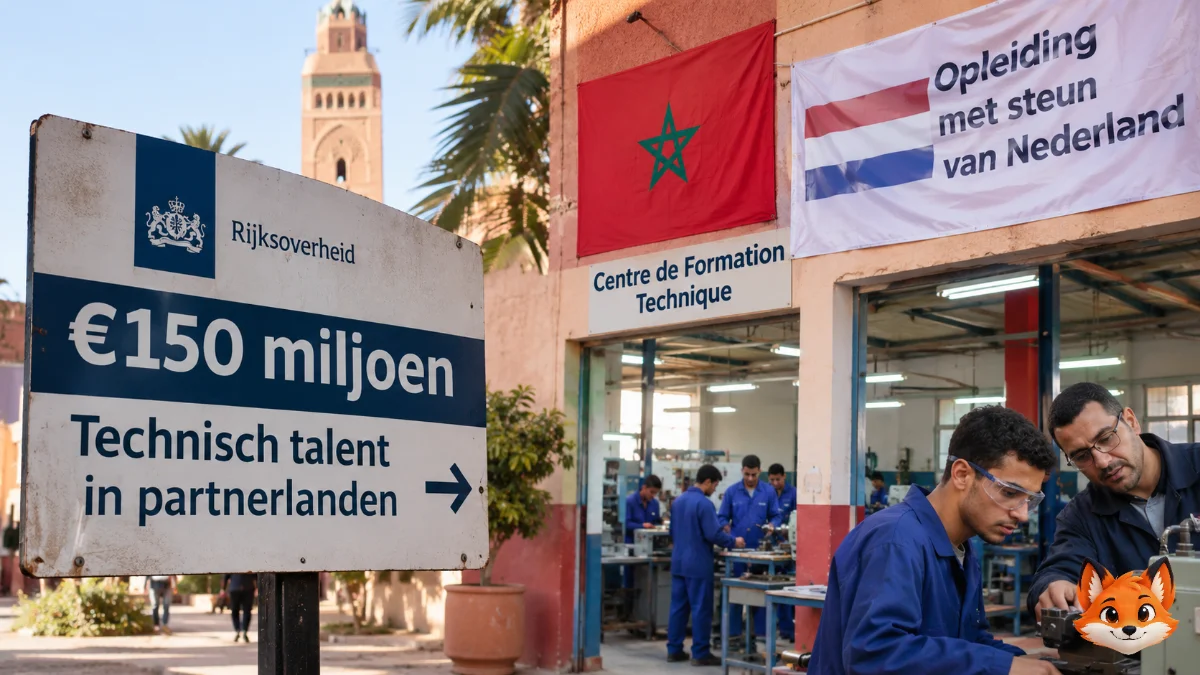 AI image
In short
- The Netherlands is investing €150 million in technical education across seven partner countries between 2027 and 2031.
- Morocco, Egypt, India and Nigeria are among the selected countries.
- The Dutch labour market still faces shortages in 87 of 93 occupational groups examined by UWV.
- The government expects Dutch companies to benefit, but has not specified how many graduates will actually work in the Netherlands.
On 18 November, the Dutch government announced that €150 million would be made available over the next five years for technical education abroad. Morocco, Egypt, India and Nigeria are among the seven selected countries. Dutch companies are ultimately expected to benefit from the additional skilled workforce. Yet Dutch employers are still struggling to find qualified technicians. Why is The Hague choosing to finance part of the solution thousands of kilometres away?
The Netherlands is paying €150 million for training abroad
The new programme is called Knowledge Empowers You, or KEY. The government wants to develop technical talent in countries where Dutch companies see economic opportunities.
The investment totals €150 million between 2027 and 2031. The money comes from the budget for Foreign Trade and Development Cooperation.
The seven selected countries are Egypt, India, Indonesia, Malaysia, Morocco, Nigeria and Vietnam.
The aim is to adapt local education programmes to the needs of Dutch growth sectors. The semiconductor industry is a particular priority.
Students will receive training locally and may receive scholarships. Partnerships with Dutch companies are also planned. The government describes this as a win win situation.
But Dutch taxpayers are entitled to ask an uncomfortable question. Why should development funding pay for education abroad so that the Netherlands can subsequently benefit from that knowledge?
Dutch companies are still struggling to find workers
Labour shortages in the Netherlands are not an imaginary problem. On 5 June 2026, UWV published new figures on the labour market.
In the first quarter of 2026, 87 of the 93 occupational groups examined were still experiencing tight or very tight labour markets. Technical occupations remain particularly difficult to fill.
These include electrical engineers, machine mechanics and plumbers. They are exactly the people needed to keep Dutch industry running.
The semiconductor industry also has an enormous demand for workers. According to the Dutch government, the country's semiconductor industry needs approximately 38,000 additional technically trained people by 2030.
That is a substantial training challenge.
What does that mean? The Netherlands needs more than new factories and machinery. It also needs people who can develop, maintain and operate that technology. Without enough technicians, part of the country's economic ambitions will remain on paper.
The question is therefore not whether the Netherlands needs technical talent. It is why part of the training capacity is being developed abroad.
Morocco receives training funding while Dutch young people need opportunities too
Take Morocco. It is one of the seven partner countries selected by the Netherlands.
Educational institutions there will receive support, teachers will receive additional training and courses will be adapted to the needs of Dutch growth industries.
That sounds attractive to Dutch businesses. They gain access to a larger pool of people with technical skills.
But what does this mean for young people in the Netherlands who want to pursue technical education?
The government must ensure that they receive at least as much attention. A young person studying engineering in the Netherlands deserves access to good internships, modern equipment and employment opportunities at companies that actually invest in the country.
That requires training places, teachers and strong cooperation with employers.
It is striking that the government is prepared to make €150 million available over five years for technical education in partner countries, while Dutch educational institutions also face staffing shortages and difficult financial choices.
That does not automatically make international investment wrong. But it does mean the government must explain what priority it gives to Dutch students.
The government calls it a win win situation, but who benefits?
According to Minister Sjoerdsma, both Dutch companies and partner countries will benefit from the programme.
The logic is straightforward. Moroccan students gain better educational opportunities, while Dutch companies gain access to technically trained workers.
But there is a difference between training someone and having that person actually work in the Netherlands.
The government says graduates may work either in the Netherlands or for suppliers abroad.
That is precisely where the problem lies.
If someone is trained in Morocco and then works for a local company supplying components to a Dutch business, the Netherlands benefits indirectly. But that technician does not directly solve the shortage of workers in Eindhoven, Rotterdam or Twente.
And if that graduate eventually joins a foreign competitor, the benefit to the Netherlands becomes even smaller.
The programme should therefore not be judged solely by the number of students trained. Where those graduates eventually work matters just as much.
The Netherlands also invests at home, but its priorities need explaining
To be fair, the government has not completely neglected Dutch education.
In September 2026, the government announced that €668 million would be invested in 2027 in plans concerning talent, education and media. These include measures for Dutch students and educational institutions.
There is also the National Semiconductor Talent Development Plan.
Under that programme, €450 million in government funding is available through 2030. The industry itself will contribute at least €225 million. The target is to train 33,000 additional technicians.
Those are substantial domestic investments.
But that makes another political question all the more relevant. Why is it necessary to spend another €150 million from development cooperation on technical education abroad?
The government's answer is that the Netherlands wants to strengthen international supply chains and reduce its dependence on other countries.
That is an understandable economic objective. Yet there is a contradiction. The Netherlands wants to become less strategically dependent on foreign countries while building part of the knowledge and training capacity it needs beyond its own borders.
Taxpayers deserve measurable results
€150 million may sound like an abstract figure. But it is public money being spent over five years.
That amounts to an average of €30 million per year.
In numbers: Suppose the total €150 million investment were divided equally between the seven partner countries. That would amount to approximately €21.4 million per country over five years. This is purely a mathematical illustration. The government has not announced an equal distribution.
The government should therefore explain what this investment will deliver.
How many students will be trained? How many teachers will receive additional training? How many graduates will actually join Dutch companies? And how many Dutch vacancies will ultimately be filled as a result?
Without measurable results, the programme risks becoming an investment whose success is difficult to assess.
It should also be clear how much money goes directly to educational institutions and how much is spent on administration, supervision and cooperation.
These are not minor details. They are essential to public accountability.
Dutch workers must not come second
International cooperation is not a bad thing. The Netherlands needs foreign expertise, trading partners and international supply chains.
But there is a difference between cooperating with other countries and shifting part of the domestic training challenge abroad.
The Netherlands has young people looking for a future in technical professions. It has workers who want to retrain and companies that urgently need new employees.
Those people deserve at least the same political attention.
The government should therefore do more than announce how many foreign students the programme reaches. It must also demonstrate how many Dutch companies benefit in concrete terms and how many jobs in the Netherlands are filled.
Otherwise, the question remains: why should Dutch taxpayers help finance education in Morocco, India and Nigeria while the domestic labour market continues to face shortages?
Questions worth asking
- How many trained students will actually work for Dutch companies?
- What proportion of the €150 million will go directly to educational institutions?
- How many Dutch technical vacancies will this programme fill?
- Why is more not being done to expand technical education within the Netherlands?
- How will the government measure whether this investment delivers long term benefits for Dutch workers and taxpayers?
This article is for educational purposes only and does not constitute financial or political advice.
Sources
- Dutch Government, Cabinet invests in technical talent in partner countries, 18 November 2026
- UWV, Labour market pressure continues to ease, 5 June 2026
- Dutch Government, Budget Day: government invests in talent, language and media, 15 September 2026
- Dutch Government, Government invests in talent for the semiconductor industry, 20 November 2024
- Dutch Government, Investing in the future of semiconductors