Europe is making anonymous life harder
 AI image
In short
- Every EU member state must make at least one digital identity wallet available by the end of 2026.
- The European wallet is voluntary, but more online services are asking users to prove their identity.
- The Netherlands introduced a 3,000 euro cash payment limit for purchases of goods from traders in 2026.
- From 10 July 2027, the EU will apply a 10,000 euro ceiling to cash payments to traders, while countries may keep lower limits.
You want to open an online account, collect a parcel or make a payment. First, you have to confirm your age. Then the service asks for your identity. Sometimes you even have to scan your face. Across Europe, it is becoming increasingly normal to prove who you are before you can access a service.
This is not happening because of one sweeping new law. It is the result of several developments coming together: digital identity, biometric checks and rules designed to fight money laundering. The European Union says these measures should improve security and convenience. But they also change how much you can do without leaving your name behind.
Every EU member state must offer a digital identity wallet by the end of 2026
The European digital identity wallet is on its way. By the end of 2026, every member state must make at least one wallet available to citizens, residents and businesses. You will be able to store official documents and prove your identity digitally.
That could include a driving licence, diploma or proof of age. Access to public services, opening a bank account and signing documents are also among the intended uses. The Council of the European Union explicitly describes the wallet as voluntary. Living in Europe does not automatically mean you have to install the app.
There is, however, an important change. The wallet is not designed only for dealing with government agencies. Private services can also use it. A bank, landlord or online platform may ask for a digital statement to check whether you meet a particular requirement.
What does that mean? The digital identity wallet is an official app that lets you prove your identity or confirm a specific attribute. For example, you could prove that you are over 18 without sharing your full date of birth or name.
The European Commission says users should only have to share the information required for a particular check. That sounds privacy friendly. But the question remains: which services will ask for this proof, and how often?
The wallet promises privacy while identity checks become more common
The European wallet is designed to minimise the amount of information shared. For example, you should be able to prove that you are an adult without revealing your full identity. European documentation calls this selective disclosure.
The wallet is also expected to include an overview showing which services have received your information. According to the EU's technical documentation, issuers of digital documents must not simply combine your personal data with information from other parties. The system is also designed to prevent the use of the wallet from being tracked.
These are meaningful safeguards. They do not answer every privacy question, though. A website can still ask for your name, address, email address or payment details outside the wallet. A company may also decide that it will only open an account after checking your identity.
The wallet itself is therefore not intended to become one central record of all your activities. But the services around it will help determine how much information you have to disclose.
Facial recognition cannot be used to track everyone
Biometric identification makes the debate more sensitive. Your face, voice or way of walking can be used to recognise you. You may already use biometrics when you open up your phone with facial recognition.
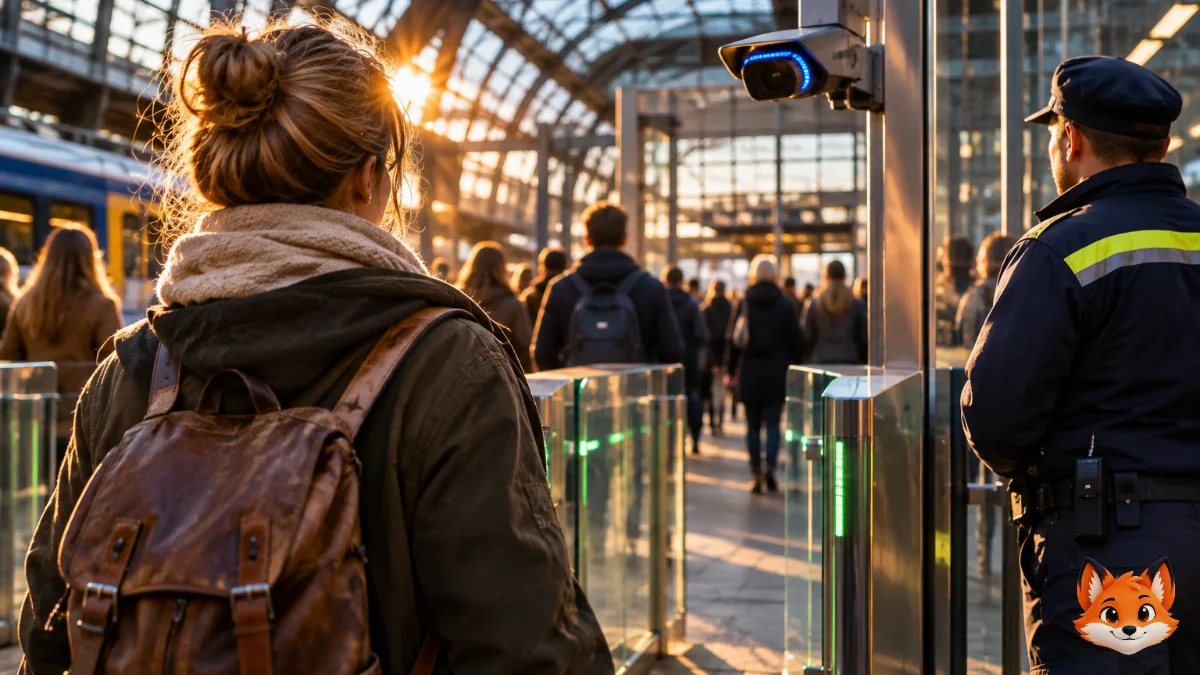
The EU AI Act sets limits. Real time remote facial recognition in public spaces for law enforcement purposes is generally prohibited. There are exceptions. These include searching for specific victims, preventing a terrorist attack and investigating a limited group of very serious crimes.
Those exceptions come with conditions. The use must be necessary and proportionate. Prior authorisation from a court or an independent administrative authority is also required. In urgent cases, approval can be requested within 24 hours.
The rules do not prohibit every form of facial recognition. Unlocking your phone and identity checks at border crossings, for example, fall outside this specific ban on remote biometric identification.
Watch out: European rules distinguish between checking whether someone is who they claim to be and identifying people remotely in a crowd. The second use can have serious consequences for the privacy of innocent people passing by.
The European Commission also highlights the risk of errors. Even an error rate of 0.1 percent can produce many false matches when a system is used on large groups. An incorrect result on a screen is annoying. Being wrongly suspected at a railway station is something else entirely.
Cash payments are facing more limits
For people who want to pay anonymously, cash is an obvious option. A banknote payment usually leaves fewer digital traces than a card payment. But cash is also facing more legal restrictions.
In the Netherlands, a ban on cash payments of 3,000 euros or more for purchases of goods from traders applies in 2026. The restriction does not cover an ordinary sale between two private individuals. Services are currently outside this Dutch limit as well.
Belgium also has a general limit of 3,000 euros for cash payments and donations, subject to exceptions. Cash payments for property purchases are prohibited. Certain payments between private individuals fall outside the general limit.
European rules are coming on top of these national restrictions. From 10 July 2027, traders selling goods or providing services will face an EU wide cash ceiling of 10,000 euros. Member states may set a lower limit. Existing national restrictions therefore remain relevant.
In numbers: Imagine buying a used car from a dealer in the Netherlands in 2026 for 12,000 euros. You cannot pay the full amount in cash. The Dutch limit is 3,000 euros. The remaining 9,000 euros must be paid using another method.
The purpose of these restrictions is to make money laundering and the financing of crime more difficult. That objective is clear. At the same time, it becomes harder to make larger purchases without involving a bank or payment provider.
Your financial data can reveal more about your life than you think
A digital payment leaves information behind. This includes the amount, the time and the recipient, and sometimes the location. A series of payments can build a surprisingly detailed picture of someone's daily life.
Think of recurring payments to a gym, pharmacy, political organisation or travel agency. One payment may reveal very little. Taken together, they can expose sensitive information.
Banks and payment providers have legal duties to monitor certain transactions. They may request additional information or file a report when they identify suspicious patterns. These obligations are part of the rules against money laundering and terrorist financing.
The same issue applies to people using crypto. Regulated crypto service providers must identify customers and monitor certain transactions. Bitcoin itself uses public addresses and transactions. An address does not automatically contain your name. But once an address is linked to an identified exchange account or person, tracing transactions becomes easier.
If you want to understand more about the relationship between digital money and privacy, read our earlier article: The digital euro is coming.
The Netherlands and Belgium still have their own national rules
The European wallet is being introduced across all member states. Cash rules, however, still differ from country to country.
In the Netherlands, the 3,000 euro limit applies in 2026 to cash payments to traders selling goods. The Dutch government is also working on rules to keep cash accessible. A requirement to accept cash payments up to 3,000 euros has been approved, although exceptions and further implementation still need to be worked out.
Belgium has a 3,000 euro limit for most cash payments and donations. Exceptions exist, including certain payments between private individuals. Cash payments for property purchases are not permitted.
The European 10,000 euro ceiling from 2027 does not automatically replace these lower limits. A country may keep stricter rules. The same purchase may therefore have different payment options depending on where you live.
Ask these questions before sharing your personal data
Over the next few years, it will become increasingly common for digital services to ask for proof of identity. That does not mean you have to accept every request without question. You are entitled to know why your data is needed and who receives it.
- Which information does the service request, and why?
- Can I confirm only my age or another attribute without sharing my full identity?
- Who stores my data, and how long will it be kept?
- Can I use the service without a digital identity wallet?
- Which payment options remain available if I do not want to share digital identity information?
Anonymous life is not being abolished by law. But the ability to pay, travel and use online services without digital identification is facing increasing pressure. This article is for educational purposes and is not financial or legal advice.
Sources
- European Commission, European Digital Identity
- Council of the European Union, The EU digital identity wallet
- European Commission, Navigating the AI Act
- European Commission, Security and Privacy of the EU Digital Identity Wallet
- Government of the Netherlands, Ban on cash payments from 3,000 euros
- FPS Economy Belgium, Restrictions on cash payments and donations
- EUR Lex, Regulation EU 2024/1624