
If ASML leaves, the Dutch public pays the price
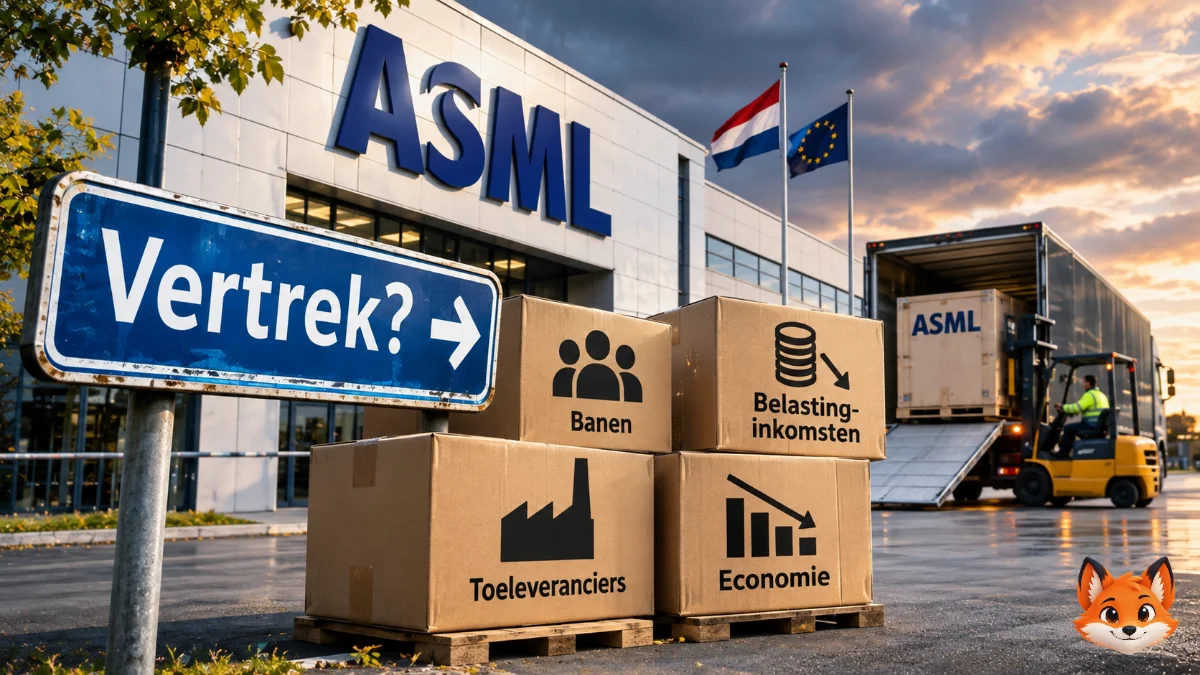 AI image
In short
- ASML reported €1.223 billion in income taxes paid in the Netherlands in 2025.
- The company employs 23,546 people in the Netherlands and works with 1,600 Dutch suppliers.
- A departure would affect tax revenue, jobs, innovation, exports and local businesses.
- The Netherlands is investing billions to retain its semiconductor industry, while political and fiscal uncertainty remains a business risk.
In 2025, ASML reported €1.223 billion in income taxes paid in the Netherlands. That is money the government uses to fund public services. Imagine a substantial part of the company's activities moving abroad. The Netherlands would lose more than a global technology leader. It would also lose an important source of public revenue. Ordinary households could eventually feel the consequences.
ASML is much more than a manufacturer of chipmaking machines. Based in Veldhoven, the company makes equipment used by manufacturers to produce the world's most advanced computer chips. These chips are used in artificial intelligence, smartphones, cars and medical equipment. The real question is not simply how much ASML is worth, but what the company contributes to the Dutch economy.
ASML generates billions and thousands of jobs
The 2025 figures show the scale of the business. ASML reported €32.7 billion in revenue, €9.6 billion in net income and €4.7 billion in research and development spending.
The company had 44,209 full time equivalent employees worldwide. Of those, 23,546 were based in the Netherlands. That represents 53% of its global workforce.
The Dutch operation also has a particularly important position. According to ASML's 2025 Tax Report, 70% of its research and development employees work in the Netherlands. The country is also home to 69% of its senior management positions, while ASML Netherlands owns 95% of the group's patents.
These are not the figures of an ordinary foreign branch. The Dutch headquarters plays a central role in the company's management, technology and development.
A departure would put Dutch tax revenue at risk
The tax contribution is perhaps the most tangible financial part of the story.
According to its 2025 tax report, ASML recorded €1.223 billion in income taxes paid in the Netherlands. The same report also lists a total Dutch tax contribution of €1.452 billion. That second figure includes taxes collected and paid to governments on behalf of other parties, including employees.
These figures describe different parts of the company's tax contribution and should not be added together.
What does that mean? If ASML moves its headquarters, profitable activities and important business functions to another country, part of its taxable economic activity could move with it. The Dutch government could then receive less corporate tax, payroll tax and other tax revenue. The actual impact depends on which operations leave.
To understand the scale, the Dutch government received €432.5 billion in 2025 and spent €447.1 billion. That left a budget deficit of €14.6 billion. ASML's contribution is significant in that financial picture.
Another 1,600 Dutch suppliers are exposed
ASML does not operate alone. A large network of specialist businesses has developed around the company. According to answers provided to the Dutch House of Representatives, ASML has approximately 1,600 suppliers in the Netherlands. Most are small and medium sized businesses.
They manufacture components, maintain equipment, develop software, provide transport and deliver specialist engineering services.
If ASML moves important operations abroad, orders could disappear from these suppliers. Some depend on ASML as their largest customer. Losing that business would be more than a temporary setback.
The effects could spread through the economy:
- Fewer orders for Dutch manufacturers.
- Fewer jobs and less payroll tax revenue.
- Lower supplier profits and potentially less corporate tax.
- Lower spending at shops, restaurants and local service businesses.
- Less investment in research, education and new technology.
The economic impact would not stop at the gates of the Veldhoven factory.
Political decisions influence where companies invest
A company like ASML does not look only at tax rates when making investment decisions. It also considers available land, energy, infrastructure, technical talent, international competition and the predictability of government policy.
These issues became particularly visible in 2024. ASML's leadership raised concerns about the Dutch business climate and the ability to attract international talent. Changes to tax rules and restrictions affecting skilled migrants were also part of the debate.
In its response to parliamentary questions, the Dutch government acknowledged that a partial relocation could affect jobs, innovation, knowledge transfer, exports, suppliers and tax revenue. The government also stressed that businesses need stable and predictable policies.
The Netherlands subsequently introduced Project Beethoven. It announced a package of €2.51 billion in public and regional investment. The funding is intended to support education, housing, transport and infrastructure.
The government is therefore investing billions to keep an important economic sector in the country. That shows the scale of what is at stake.
There is an important current development to consider. On September 8, 2026, ASML began construction of a new campus in Eindhoven. Its first phase is expected to accommodate at least 3,000 employees. A complete departure is not an announced decision. The debate is primarily about the risk that future investments and business activities could be located elsewhere.
Ordinary households could eventually pay the bill
What would a departure mean for someone who has nothing to do with ASML?
Potentially quite a lot. If the government receives less tax revenue, it has to adjust its budget. There are several possible options.
- Increase taxes to replace lost revenue.
- Reduce funding for education, healthcare or infrastructure.
- Borrow more money, increasing public debt.
- Ask other companies and taxpayers to contribute more.
None of this happens automatically after one corporate decision. The Netherlands has a large economy and many other businesses pay taxes. But losing an important taxpayer while suppliers also lose revenue makes it harder to fund the same public services.
In numbers: Imagine that a partial relocation results in 25% of Dutch activity moving abroad. Applying that percentage solely to the €1.223 billion in reported Dutch income taxes for 2025 produces a figure of approximately €306 million per year. This is a simplified scenario, not a forecast. Different tax streams would not disappear at the same speed or in the same proportion.
For households, the underlying issue is straightforward. If public revenue falls, the government must find money elsewhere or reduce spending.
Dutch investors and shareholders face another consideration. ASML is a major company listed on Euronext Amsterdam. A move of its headquarters or listing could also affect the attractiveness of the Dutch stock market and the confidence of international investors. Relocation would not automatically mean the shares disappear from Euronext.
The Netherlands and Belgium have different tax systems
In the Netherlands, the 2026 corporate income tax rate is 19% on the first €200,000 of taxable profit. The rate on profits above that threshold is 25.8%.
In Belgium, the general corporate income tax rate in 2026 is 25%. Eligible small companies can qualify for a reduced rate of 20% on the first €100,000 of taxable profit, subject to specific conditions.
If ASML moved its Dutch tax residence, taxation on certain business profits could shift to its new country of residence, depending on the corporate structure and where the activities actually take place.
For Belgian residents, a move by ASML would not automatically change their personal tax returns. Belgian investors remain subject to Belgian tax rules. Belgian suppliers could, however, experience indirect consequences if their contracts or investments depend on the Dutch semiconductor industry.
Questions worth asking
- How much tax revenue does the Netherlands actually receive from major international companies?
- How predictable is Dutch tax policy for businesses making billion euro investments?
- What happens to Dutch suppliers when major customers move abroad?
- How much additional tax would the government need to collect if major businesses relocated?
- Do the costs of retaining international companies outweigh the economic benefits?
This article is for educational purposes only and does not constitute financial or tax advice.
Sources
- ASML, Tax Report 2025
- ASML, Annual Report 2025
- Dutch House of Representatives, Answers on ASML's potential departure, June 21, 2024
- Government of the Netherlands, Project Beethoven, March 28, 2024
- Government of the Netherlands, 2025 Annual Financial Report
- Dutch Tax Administration, Corporate income tax rates 2026
- Belgian FPS Finance, Pillar 2 and international minimum taxation
- ASML, Construction begins on new Eindhoven campus, September 8, 2026