The Dutch king costs €86 million. What does it deliver?
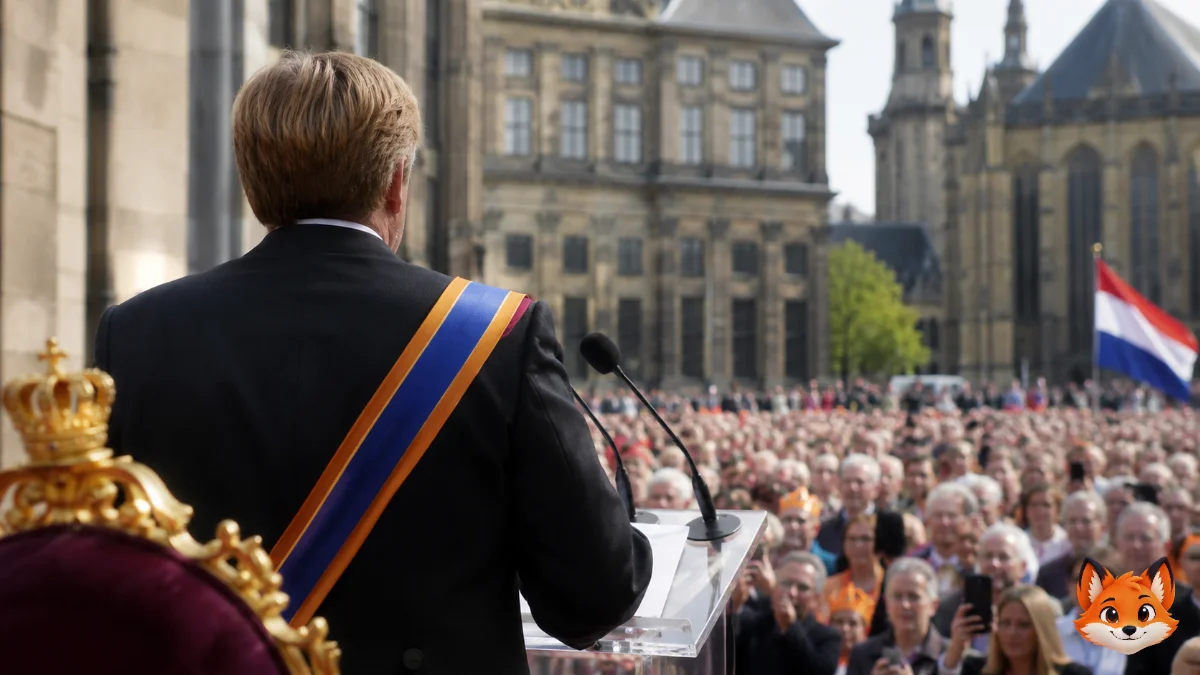 AI image
In short
- The king forms the government together with ministers, but ministers carry political responsibility.
- The 2027 royal budget is €62.1 million, with another €24 million in related public spending.
- Queen Wilhelmina left for London in May 1940 and became an important symbol of resistance.
- State visits can generate business, but the monarchy's full economic value is difficult to measure.
In 2027, the official budget for the Dutch king is €62.1 million. Add another €24 million from other government budgets and the total reaches approximately €86.1 million. Security costs are not fully disclosed in that figure. So the question is fair: what does the king actually do for the Netherlands, and why does one family inherit the position automatically?
The debate is about more than money. It concerns hereditary succession, democracy, power and the role of the royal family during the Second World War. Above all, it asks whether the Netherlands still needs a monarchy.
Willem Alexander became king through birth, not an election
The Netherlands has been a kingdom since 1815. Its first king was William I. Since then, the head of state has come from the House of Orange Nassau. Willem Alexander succeeded his mother Beatrix in 2013.
The Dutch Constitution makes the monarchy hereditary. The eldest child has priority in the line of succession. This means Amalia is first in line. Citizens cannot vote directly for the king or decide who becomes the next monarch.
That is where one of the main objections begins. In a democracy, voters choose their representatives. Those representatives must explain their actions and can be removed at elections. A king receives his position through birth.
Supporters see this as an advantage. They argue that the king stands above everyday party politics and can provide a stable public face for the country. Critics believe a public office should not automatically pass to a family member.
Both arguments deserve attention. But one fact is clear: the monarchy is not a job every Dutch citizen can apply for.
The king has influence, but ministers make the decisions
The Constitution states that the king and ministers together form the government. That sounds as if Willem Alexander has political power. In practice, decision making rests with ministers and the cabinet.
The king does have formal duties. He signs laws, delivers the Speech from the Throne and swears in ministers. He is also formally the chair of the Council of State. That role is largely ceremonial. The Council's daily work is led by its vice president.
There is more happening behind closed doors. The king meets the prime minister every week. He has the right to be informed, encourage ministers and warn them. What is said during these conversations largely remains outside public debate.
That creates an interesting democratic tension. An elected minister must answer to parliament. Under the Constitution, the king is inviolable. Ministers are politically responsible for his statements and conduct.
What does that mean? The king can share his views with the prime minister behind closed doors. But he cannot independently introduce a tax law, dismiss a minister or force through a political decision. The minister remains accountable to parliament.
Each year, the king signs approximately 500 laws and general administrative orders, as well as around 3,000 royal decrees. That sounds like enormous decision making power. Yet his signature is not personal approval of a political plan of his own. The responsible minister also signs and carries the responsibility.
Wilhelmina left in 1940, but her role did not end there
One sensitive subject in the debate about the monarchy is the Second World War. Queen Wilhelmina left for London on 13 May 1940, after Germany invaded the Netherlands. Many Dutch people remained under German occupation.
People sometimes refer to Wilhelmina as Willem Alexander's grandmother. That is not quite right: she was his great grandmother. His grandmother Juliana later went to Canada.
The question of why the head of state left the country is understandable. For those who remained, the queen's departure must have felt distant. But the historical record tells more than just the story of her departure.
The Dutch National Archives explain that Wilhelmina left for London against her wishes, together with the government. The Dutch government in exile continued its work there. On 28 July 1940, Wilhelmina spoke on Radio Oranje for the first time. She became an important symbol of resistance and addressed the Dutch people from abroad.
That does not make her departure beyond criticism. It does show that the royal family continued to play a role in resistance and in maintaining the Dutch government from London. The situation was also unlike an ordinary political crisis: the Netherlands had been attacked and the government could no longer work safely inside the country.
The bill reaches approximately €86 million in 2027
The official 2027 budget is €62.1 million. It includes payments, staff, operating costs and support. Another €24 million appears in other government budgets for costs related to the monarchy.
| Item | 2027 budget |
|---|---|
| Official royal budget | €62.1 million |
| Palaces and accommodation | €21.4 million |
| State visits | €2.5 million |
| De Groene Draeck | €0.09 million |
| Total of these items | €86.09 million |
Security costs have not been made public. The figure of approximately €86.1 million is therefore not a complete overview of every cost connected to the monarchy.
The king's personal allowance also deserves attention. In 2027, €1.197 million is budgeted as Willem Alexander's income component. Another €6.316 million is included for personnel and material expenses related to his role. That second amount is not simply extra salary he can spend freely.
In numbers: The stated €86.1 million works out at approximately €7.18 million per month. This money comes from several government budgets and does not include a publicly disclosed figure for security. It shows why a clear overview of the total cost matters.
Tax is another source of debate. Members of the royal family are subject to tax, but exemptions apply to constitutional payments and certain assets. The king and his likely successor also have exemptions from gift and inheritance tax for certain transfers within the family.
These arrangements are set out in law. But they raise a basic question: why should the head of state receive exceptions that ordinary citizens do not?
State visits create contacts, but their value is difficult to prove
Supporters often point to the economic value of the royal family. The king travels abroad, welcomes heads of state and sometimes takes Dutch businesses on trade missions. This can open doors that are harder for an individual business owner to open.
The Dutch Ministry of Foreign Affairs says the value of business contracts linked to state visits and other missions regularly exceeds €1 billion a year. That sounds impressive. But there is an important distinction: the value of contracts associated with missions is not the same as the profit directly caused by the king.
Companies also sign contracts without a royal visit. Trade missions involve more than the royal couple. Ministers, civil servants, diplomats and business owners all play a part.
The monarchy also has a diplomatic and representative role. A head of state can raise a country's profile, maintain relationships and help start conversations. Those benefits cannot always be measured in euros.
The critical question remains: how do we measure the return and compare it with the cost? Without an independent comparison between a monarchy and a republic, it is difficult to claim that the royal family pays for itself financially.
Readers interested in the political consequences of government decisions can also read The Kaag List: what has already become more expensive for the Netherlands.
The debate is about democracy, money and trust
The monarchy has supporters and opponents. Their main arguments are concrete.
Supporters point to:
- Continuity: the head of state does not change after every election.
- Diplomacy: the king can represent the Netherlands during foreign visits.
- Unity: the royal family can provide a familiar public face during national events.
- Business contacts: state visits can give Dutch companies access to new relationships.
Opponents point to:
- Hereditary succession: the position is not filled through elections.
- Costs: total spending is higher than the official royal budget alone.
- Tax exemptions: certain exceptions do not apply to ordinary citizens.
- Accountability: conversations behind closed doors are difficult for the public to assess.
In October 2026, the House of Representatives debated the 2027 royal budget. Some MPs see the monarchy as a source of stability and continuity. Others called for more oversight, transparency and changes to tax rules. There was also renewed discussion about whether the king should have a role in forming future governments.
That debate shows that the monarchy is not just a historical tradition. It is a political choice that costs money every year and affects how the Netherlands is represented.
Questions worth asking
- Should the Dutch head of state inherit the position or be elected by citizens?
- Is approximately €86 million a year a reasonable price for the monarchy's duties?
- How can the economic benefits of state visits be measured independently?
- Should tax exemptions for members of the royal family be changed?
- How much influence behind closed doors is appropriate for a position that is not elected?
This article is intended as political and financial education, not financial advice.
Sources
- Government of the Netherlands, The constitutional monarchy
- Dutch Government Legislation, Constitution of the Kingdom of the Netherlands
- National Archives, The cabinet and the Queen leave for London in 1940
- Royal House of the Netherlands, The King's budget
- Royal House of the Netherlands, Other financial matters and tax exemptions
- Ministry of Foreign Affairs, What is a state visit?
- House of Representatives, Royal budget and General Affairs, 28 October 2026