
Democrats take Washington and put Trump on the back foot
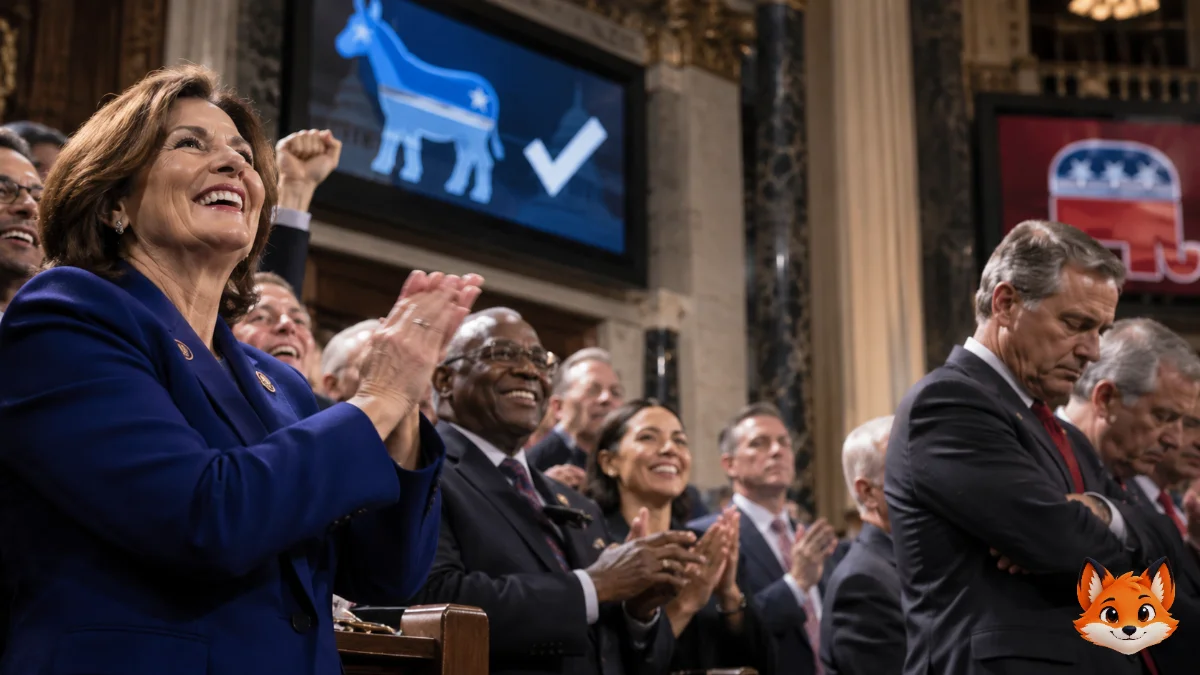 AI image
In short
- Democrats win both chambers and flip at least seven important Senate seats.
- Trump keeps his veto and presidential powers, but loses control of Congress.
- The Iran war faces greater congressional scrutiny over funding and military authority.
- The future of the CLARITY Act becomes less certain for the crypto industry.
On November 4, 2026, the balance of political power in Washington shifted. Democrats have won both the House of Representatives and the Senate. They flipped at least seven Republican Senate seats, including in Texas, Iowa and Kansas. This is not a minor change. It is a clear rejection of Trump's direction in the middle of his second term.
The consequences reach beyond US politics. Budgets, trade, the Iran war, the Federal Reserve and crypto legislation now getting a total different political market. What can Trump still do, and what does this mean for investors?
Democrats win more than a simple majority
Before the election, Republicans controlled both chambers. They held 53 of the 100 Senate seats. In the House, their majority was already narrow, with 218 Republicans against 214 Democrats.
Democrats have now taken control of both chambers. According to the Associated Press, they flipped at least seven Senate seats from Republicans. The victories in states Trump comfortably won in 2024 stand out. Democrat James Talarico won the Texas Senate race. Iowa, Kansas, Ohio, Maine, North Carolina and South Carolina also delivered Democratic gains.
In the House, Democrats reached the 218 seat threshold and secured a majority. The final seat distribution is still being counted. The political consequence is already clear: from the start of the new Congress on January 3, 2027, Trump will face Democratic majorities in both chambers.
The result points to voter frustration over the cost of living, the economy, the Iran war and the conduct of the administration. The midterms became a judgment on Trump's presidency.
Trump keeps his veto but loses control of Congress
A Democratic majority does not remove Trump from office. He remains president and retains his executive powers. He can also block legislation with a presidential veto.
Overriding a veto requires a two thirds majority in both chambers. A normal Democratic majority is not enough. Trump can therefore still block important bills.
But the balance of power changes. The House helps determine which bills and budgets receive consideration. The Senate votes on nominations for cabinet positions, ambassadors and leaders of federal institutions. Both chambers can hold hearings and launch investigations into government policy.
What does that mean? Congress makes laws and oversees government spending. Democratic majorities in the House and Senate can delay Trump's plans, launch investigations and attach conditions to budget funding. Trump can still veto legislation and use his presidential powers.
Political gridlock becomes more likely. Major new laws require cooperation. If both parties block one another, budget disputes may follow and parts of the federal government could temporarily shut down.
The Iran war faces greater political pressure
The war with Iran played a visible role in the election campaign. According to AP, voters cited the war, high prices and concerns about corruption as important reasons for their votes.
Congress has influence over military action through legislation, budgets and oversight. The War Powers Resolution of 1973 requires a president to notify Congress within 48 hours when US forces enter hostilities without a declaration of war or specific authorisation. After 60 days, military action must end unless Congress authorises it or extends the deadline by law. An additional period of up to 30 days is available for an orderly withdrawal.
This gives Democrats tools to challenge the war. They can demand information, hold hearings and introduce measures to restrict military action. They can also attach conditions to new funding.
The president remains commander in chief. A Democratic majority therefore cannot automatically end the war with one vote. A veto and political divisions remain obstacles.
For Europe, the Strait of Hormuz matters most. If the conflict escalates again or shipping is disrupted, oil and gas could become more expensive. That feeds into transport, production and inflation. The Congressional Research Service estimated US military costs at 38 billion dollars through August 1, 2026.
Bitcoin briefly drops almost 3 percent during the vote count
Crypto markets reacted quickly to the first signs of a Democratic victory. Bitcoin traded near 78,000 dollars on Tuesday evening. During the first results, it briefly dropped to around 75,700 dollars. That was a temporary decline of approximately 2.9 percent. Bitcoin later recovered towards 76,700 dollars.
Stock markets also reacted. S&P 500 futures fell 1.3 percent at their low, while Nasdaq 100 futures dropped 2.3 percent. Futures contracts indicate where markets may open. They are not final daily returns for the stock indices.
In numbers: Assume you hold 10,000 euros worth of Bitcoin. A 2.9 percent drop temporarily reduces its value to around 9,710 euros. That is an unrealised loss of 290 euros. For a 10,000 euro investment that fully tracked the S&P 500 futures move, a 1.3 percent decline would equal 130 euros. These are examples, not predictions of your own returns.
The initial reaction appears to reflect uncertainty over tighter regulation and the future of US crypto legislation. CoinDesk reported that Bitcoin later recovered part of its decline. This shows how quickly markets can react to political expectations.
The CLARITY Act faces a more difficult path
The CLARITY Act is particularly important for the crypto industry. The bill aims to clarify which US regulator is responsible for different digital assets and trading activities. This includes the division of responsibilities between the SEC and the CFTC.
The House had already passed the bill. The Senate still had to decide on it. A Democratic majority changes the political calculation. The bill could be amended, delayed or left on hold.
The GENIUS Act, the US law for payment stablecoins, was already passed in July 2025. It remains in force. A new majority cannot simply erase an existing law. That would require new legislation approved by both chambers and the president, or a successful veto override.
The Congressional Research Service notes that US crypto rules remain divided across different regulators and laws. The change in political control shows how sensitive the industry remains to developments in Washington.
For investors, this mainly means uncertainty over the rules for exchanges, tokens and DeFi. It does not automatically mean that Bitcoin will be banned or that the US crypto industry will stop operating.
The Federal Reserve and the dollar are also affected
The Senate confirms appointments to the Federal Reserve Board of Governors. A Democratic Senate can scrutinise Trump's nominees more closely or delay appointments. This gives the party influence over the composition of the central bank, but not the power to set interest rates on its own.
The Fed makes rate decisions under its legal mandate and in response to economic data. A change in political control does not automatically change that mandate.
The dollar also matters to European investors. Many US shares and crypto assets trade in dollars. If the dollar falls against the euro, your return in euros can be lower even when the dollar price of an investment stays unchanged.
The first market moves after the result are therefore not a final judgment on the coming months. Investors are now watching the composition of Congress, budget negotiations and the next steps on Iran and crypto legislation.
Questions worth asking
- Will Congress have enough votes to change budgets and military funding?
- Will the CLARITY Act remain on the agenda, or will the process restart in the new Congress?
- Will the Iran war face greater congressional oversight?
- How will the dollar, US shares and Bitcoin react when the first policy plans become concrete?
- How much of your portfolio depends on the dollar and US regulation?
This is news and educational information, not financial advice.
Sources
- Associated Press, Democrats win US House and Senate in 2026 midterms, November 4, 2026
- Associated Press, election results and latest developments, November 4, 2026
- Congressional Research Service, U.S. Conflict with Iran, September 18, 2026
- United States Code, War Powers Resolution, Section 1544
- Congressional Research Service, Cryptocurrency: Regulatory and Legislative Policy Issues, May 29, 2026
- CoinDesk, Bitcoin briefly sinks to $75,700 as bets on a Democratic sweep rattle markets, November 4, 2026