Why is Ursula bringing Gates into Europe’s AI debate?
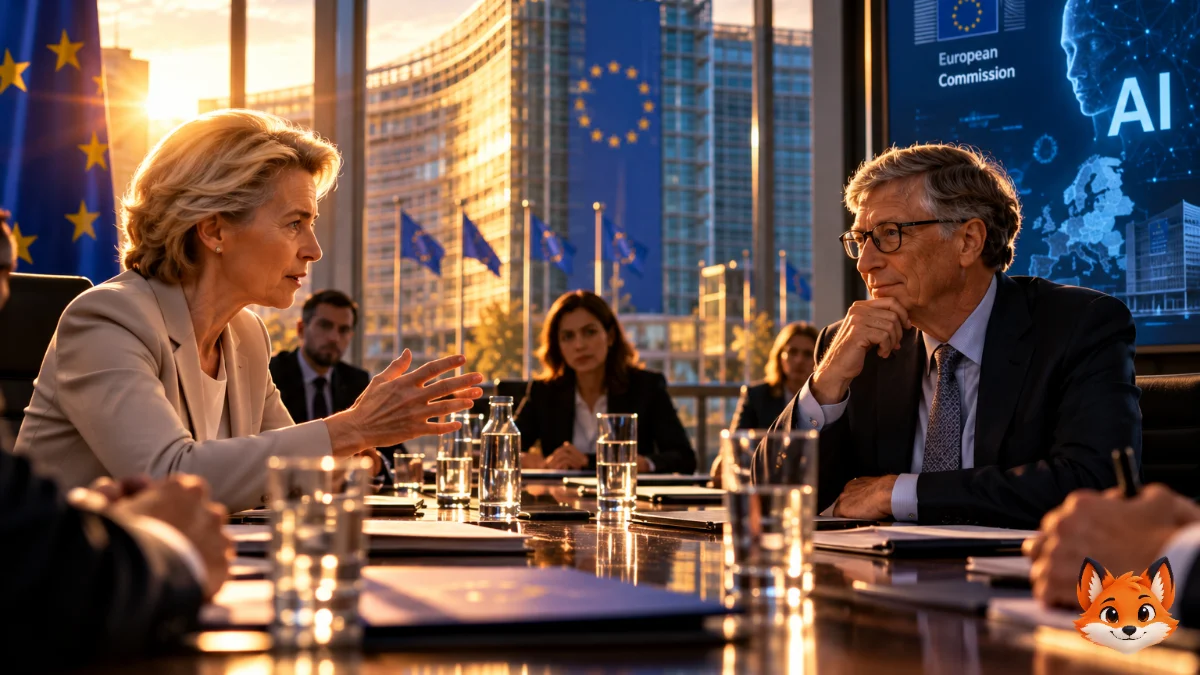 AI image
In short
- Bill Gates visited the European Commission on 21 October 2026 for discussions on energy and innovation.
- His experience at Microsoft is relevant, but he does not lead one of the major frontier AI laboratories.
- Anthropic CEO Dario Amodei and xAI founder Elon Musk have more direct roles in developing advanced AI models.
- The debate is not only about Gates, but also about the influence of European regulation on innovation and individual freedom.
On 21 October 2026, Ursula von der Leyen received Bill Gates at the European Commission in Brussels. The official announcement described the meeting as a discussion about energy and innovation. Yet the encounter raises a broader question: why do billionaires and political leaders have so much influence over technology that will affect the daily lives of millions of Europeans?
Gates has an impressive background in software and technology. But when the discussion concerns the newest AI models, their technical limits and the risks of increasingly powerful systems, other candidates work directly on that technology.
The official visit focused on energy and innovation
The European Commission listed von der Leyen alongside Henna Virkkunen, Ekaterina Zaharieva and Christophe Hansen as participants receiving Gates. Gates co founded Microsoft, chairs the Gates Foundation and founded Breakthrough Energy, an organisation that invests in clean technology.
The official photo page does not identify specific AI advice as the purpose of the visit. It would therefore be inaccurate to say Gates was invited exclusively as an AI expert. His presence fits broader discussions about innovation, energy and technology’s effect on the economy.
That distinction matters. A meeting with an influential entrepreneur does not prove that he determines European policy. But citizens are entitled to ask which advice informs policy and who gets access to decision makers.
Gates knows technology but does not build the newest AI models
Gates spent decades as a central figure at Microsoft and has extensive experience in software, entrepreneurship and technological change. He also writes and speaks about AI and its implications for work, education and healthcare.
There is, however, a difference between experience in the technology industry and leading a laboratory that develops the most advanced AI models. Gates does not run a frontier AI laboratory. His current work focuses mainly on philanthropy, technology policy, health and energy.
That does not make his views worthless. It means policymakers should explain why someone is invited: strategic insight, funding, social impact or technical knowledge of the latest models.
What does that mean? A frontier model is one of the most advanced AI systems available at a given time. Developing it requires specialised teams working on research, training, infrastructure and safety. Software experience is relevant, but it is not the same as directly leading the development of such systems.
Amodei and Musk have more direct technical roles
Dario Amodei is co founder and CEO of Anthropic. He previously served as vice president of research at OpenAI and was involved in developing large language models such as GPT 2 and GPT 3. His background directly relates to how advanced AI is built, tested and controlled.
Elon Musk founded xAI and also leads Tesla, where AI plays a role in robotics and driver assistance systems. Musk has outspoken views about AI risks and the pace of development. His business interests also mean that his advice should be examined critically.
If the European Commission mainly wants to discuss the technical capabilities and risks of the newest models, inviting leaders from several AI laboratories makes sense. That could include Amodei, Musk and other researchers, alongside independent scientists and organisations defending citizens’ rights.
The point is not to make one person the only suitable voice. It is to build a balanced group in which no single entrepreneur or politician dominates the debate.
European AI rules give Brussels more influence
In her State of the Union address on 16 September 2026, von der Leyen called for discussions with major AI laboratories about managing risks and the pace of development. She referred to risks involving advanced hacking and systems that improve themselves.
The European AI Act already includes obligations for certain AI systems and providers of models that pose systemic risk. Since 2 August 2026, the European Commission has also held enforcement powers for parts of the rules governing general purpose AI models.
Supporters argue that these rules protect citizens and provide clarity for companies. Critics fear that a growing role for central institutions could slow innovation and shift decisions away from national parliaments, entrepreneurs and citizens.
That is a serious political debate. Calling a policy socialist or communist does not, by itself, prove that it follows that ideology. The concrete questions are how much decision making power Brussels receives, how that power is checked and whether the rules remain proportionate.
Gates’ Epstein ties remain a reputational issue
The meeting is also controversial because of Gates’ past contacts with Jeffrey Epstein. US government documents and testimony have brought the relationship back into public view. Gates has acknowledged meeting Epstein and described his own judgment in doing so as a serious mistake.
In June 2026, Gates was interviewed by the US House Oversight Committee about his contacts with Epstein. In July, the Gates Foundation said an external review found no evidence that the foundation paid Epstein or participated in, or knew about, his sex trafficking and criminal activities. This does not erase the reputational questions, but it would be inaccurate to treat appearing in the files as proof of a crime.
Watch out: A name appearing in the Epstein documents does not by itself prove a crime. Gates’ contacts with Epstein are documented, and his public regret is on record. Allegations must be assessed separately against evidence, testimony and official findings.
Reputation matters for public institutions. When a policymaker meets someone facing significant public criticism, explaining the purpose of the meeting and its influence on policy is sensible.
The Covid period also affects public trust
During the Covid pandemic, Gates was a prominent supporter of vaccine development and global access to vaccines. His role and influence prompted resistance from some members of the public, particularly among people who felt that billionaires and international organisations had too much influence over health policy.
At the same time, false claims circulated about Gates, including claims that he used vaccines to track people or had called for forced vaccination. No credible evidence supports those claims. Criticism of influence and decision making must therefore be separated from unsupported conspiracy theories.
The underlying question remains legitimate: what role should a private philanthropist play in public decisions? Donations and expertise can be useful, but democratic choices should remain accountable rather than depending on the preferences of a small group of wealthy individuals.
The real question is who sets Europe’s AI direction
A visit alone does not prove a hidden agenda. But it is reasonable to ask why certain voices receive access and whether independent researchers, smaller European AI companies, workers and citizens also have a seat at the table.
Europe wants technological independence while also imposing stronger safety rules. Those goals can conflict if compliance becomes too expensive for smaller companies or if decision making becomes too centralised.
For companies and investors, the consequences are practical. New rules may raise compliance costs, delay product launches and affect the competitiveness of European businesses. The outcome depends on the exact rules, their enforcement and how companies respond. It is better to follow concrete decisions than to draw conclusions about Europe’s economic future from a single meeting.
Questions citizens can ask Brussels
- What exactly was discussed with Gates, and what advice was considered?
- Which AI researchers and companies also get access to the European Commission?
- How do the new AI rules affect costs for smaller European businesses?
- How will the European Parliament and national parliaments scrutinise AI oversight decisions?
- How will the Commission prevent large companies and wealthy donors from gaining more influence than ordinary citizens?
This article is for educational purposes and political analysis, not financial advice.
Sources
- European Commission, visit of Bill Gates to the Commission, 21 October 2026
- European Commission, State of the Union address, 16 September 2026
- European Commission, artificial intelligence rules
- Dario Amodei, official biography and research
- US House Oversight Committee, Gates and Epstein interview transcripts, 23 June 2026
- Gates Foundation, external review of Epstein contacts, 21 July 2026
- European Commission, fighting coronavirus disinformation