Tesla and Nvidia target AI chip bottlenecks with $2.8B
 AI image
In short
- Reuters reported that Tesla and Nvidia would invest a combined 2.8 billion dollars in additional AI chip component capacity in South Korea.
- Tesla would contribute 1.1 trillion won and Nvidia 2.6 trillion won.
- Samsung Electro Mechanics and Nvidia officially confirmed a partnership for advanced chip components, but not every detail in the media report.
- The expansion aims to ease a bottleneck in the growth of AI infrastructure.
Tesla and Nvidia are reportedly planning to invest a combined 2.8 billion dollars in Samsung Electro Mechanics to increase production of AI chip components. The news emerged through Reuters on October 22, 2026, based on a report by South Korean newspaper Maeil Business Newspaper. The report says new production lines would be built in Sejong, South Korea.
The story is about more than an investment between three companies. AI systems need more than powerful processors. They also need specialised components to connect chips, deliver power and keep them operating reliably. Those components are becoming a potential constraint on the expansion of data centres.
The investment is intended to address a chip component shortage
According to Reuters, Tesla would invest 1.1 trillion won and Nvidia 2.6 trillion won. Together, that amounts to about 3.7 trillion won, or approximately 2.8 billion dollars. The money would be used to expand production capacity for FC BGA substrates in Sejong.
Samsung Electro Mechanics officially announced a strategic partnership with Nvidia on October 21. The companies plan to expand dedicated manufacturing facilities in Sejong and Busan. Samsung Electro Mechanics says it plans to begin supplying substrates to Nvidia in 2026.
There is an important distinction. The partnership with Nvidia has been officially confirmed. The 2.8 billion dollar figure and Tesla’s separate contribution were reported by the press, citing industry sources. Those details were not all included in Samsung Electro Mechanics’ official announcement.
A substrate connects a chip to the rest of a system
An AI processor is not simply a piece of silicon that can be plugged into a computer. The chip needs electrical connections to the rest of the system, while heat and signals must remain manageable. That requires several layers and specialised components.
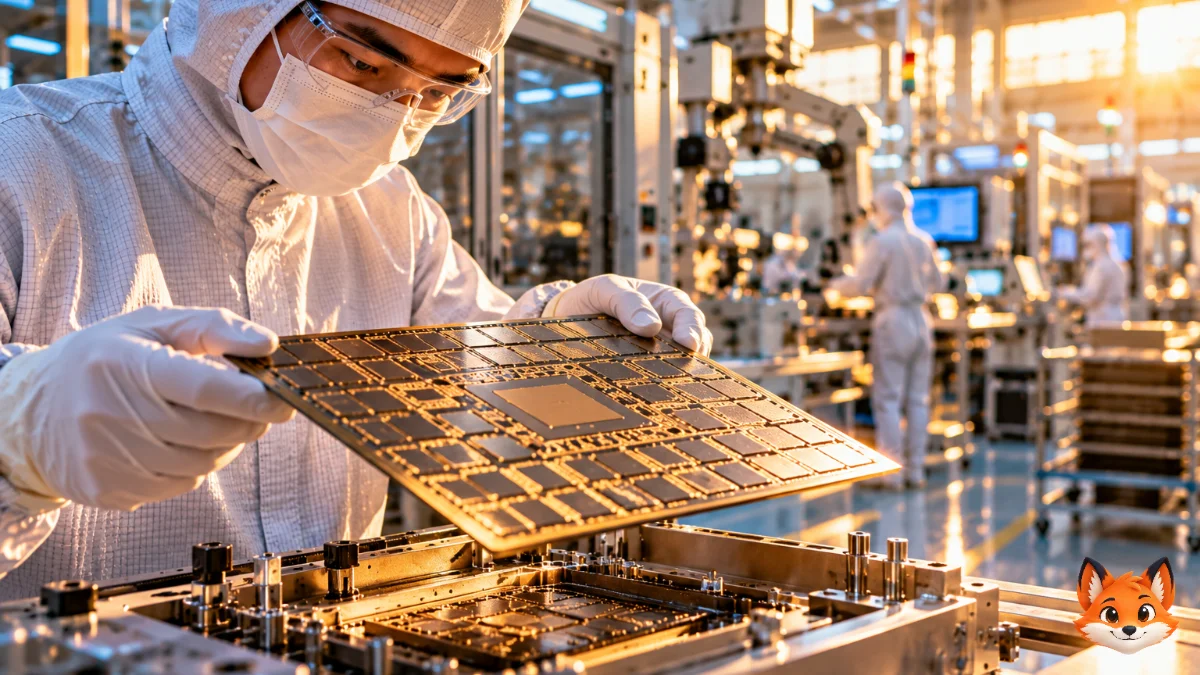
FC BGA stands for flip chip ball grid array. It is a type of package in which a chip is connected to other parts of a computer or server through a substrate. The substrate contains very fine electrical connections. Powerful AI chips need it to carry many signals while remaining reliable.
What does that mean? Think of a chip as a car’s engine. The substrate is more like the connections and fittings that allow the engine to work inside the vehicle. A powerful chip is of limited use if the components around it cannot transfer data quickly and reliably enough.
Manufacturing these substrates is technically demanding. Larger and more complex chips require precise wiring, flatness and thermal control. A manufacturer cannot simply convert an existing production line and immediately start supplying millions of components.
Nvidia is expanding its entire supply chain
On October 21, 2026, Nvidia announced that it was working with several suppliers to expand manufacturing capacity for AI infrastructure. Samsung Electro Mechanics is one of those partners. Nvidia plans to increase substrate capacity for its products by a factor of 2.5 over three years.
The company is also working with suppliers of chip packaging, testing and optical connections. That shows the challenge is not limited to making the processor. An AI data centre also needs links between chips, cooling, power delivery, memory and networking equipment.
Nvidia has a clear interest in ensuring these components are available on time. The company sells not only processors but complete platforms for AI computing. If one component is missing, delivery of an entire system can be delayed even when the main chip is ready.
Tesla has a different motive. It invests in AI for autonomous driving, robotics and its own computing infrastructure. If the reported investment and supply arrangements are accurate, helping fund substrate production would give Tesla more influence over the availability of an important component. The precise supply terms have not been fully disclosed.
The reported supply period from 2029 has not been fully confirmed
According to reporting by Maeil Business Newspaper, a supply arrangement with Tesla would run for five years, from 2029 through 2033. Reuters reported the investment amount and planned production lines as information from the newspaper, while Samsung Electro Mechanics’ official announcement says Nvidia deliveries are due to begin in 2026.
These statements do not necessarily conflict. They could refer to different contracts, production lines or volumes. Public announcements do not disclose every commercial term. It is therefore too early to describe the 2029 through 2033 period as a fully confirmed contract covering both companies.
Nvidia’s officially announced partnership includes existing South Korean capacity and expansion at factories in Sejong and Busan. Samsung Electro Mechanics expects production allocated to Nvidia to represent a significant share of its annual substrate capacity by 2028.
The share price does not tell the whole story
News of new AI contracts can encourage investors because it gives them a clearer view of future demand for components. But a contract does not prove that profits will automatically grow at the same rate. New factories cost money, must be brought up to speed and can face production delays or quality problems.
Samsung Electro Mechanics shares made a notable move on October 22, 2026. The stock reached 1,234,000 won during the session, but historical market data show it closed at 1,145,000 won, down 1.97 percent from the previous close. It is a useful reminder that a share can move sharply during the day and still finish lower.
The investment itself is also not the same as revenue or profit. The money is intended to build capacity. The financial return will depend on the number of components delivered, the agreed prices and the cost of manufacturing them.
Watch out: A major customer can improve a supplier’s prospects, but it does not automatically make the share cheap. The market also considers the price investors are already paying, the cost of new factories and dependence on a small number of large customers.
AI growth depends on more than the fastest processor
The partnership illustrates that AI infrastructure relies on an entire supply chain. Nvidia develops computing platforms, Samsung Electro Mechanics makes specialised substrates, and Tesla wants to secure components for its own technology plans. Each company therefore has a different reason to support the same production capacity.
That makes component suppliers worth watching, but it also creates concentration risk. If a manufacturer becomes heavily dependent on a few large customers, changes in their plans can quickly affect factory utilisation and revenue. Long term agreements, on the other hand, can help companies plan production more effectively.
For broader market context, it is also useful to distinguish a share from a product that only tracks its price. BitFox explains the difference in What are xStocks? Shares on the blockchain. Owning a listed share provides rights in a company; a token that tracks a share price does not necessarily provide those rights.
Questions to ask about AI supply deals
- Has the investment been confirmed by the companies involved, or only reported by the media?
- How much is going towards new factories and how much is an advance payment for future production?
- When does production begin and when will the first components be delivered?
- How much revenue will depend on Nvidia and Tesla?
- Are the extra costs of the new capacity already reflected in profit figures?
The reported 2.8 billion dollar investment highlights how important chip components have become to the expansion of AI. The official partnership between Nvidia and Samsung Electro Mechanics is confirmed, but the full terms of the reported joint investment have not all been publicly confirmed. This article is for educational purposes only and is not financial advice.
Sources
- Reuters, Samsung Electro Mechanics gets $2.8 billion chip investment from Tesla, Nvidia, report says, October 22, 2026
- Nvidia, NVIDIA and Supply Chain Partners Expand Capacity to Accelerate AI Infrastructure Buildout, October 21, 2026
- Samsung Electro Mechanics, Samsung Electro Mechanics and NVIDIA Announce Strategic Partnership to Supply ABF Substrates, October 21, 2026
- Samsung Electro Mechanics, Samsung Electro Mechanics Signs 1.5 Trillion KRW Silicon Capacitor Supply Contract, May 20, 2026
- Aju Press, Samsung Electro Mechanics Shares Rise on Strategic Partnership with NVIDIA, October 22, 2026