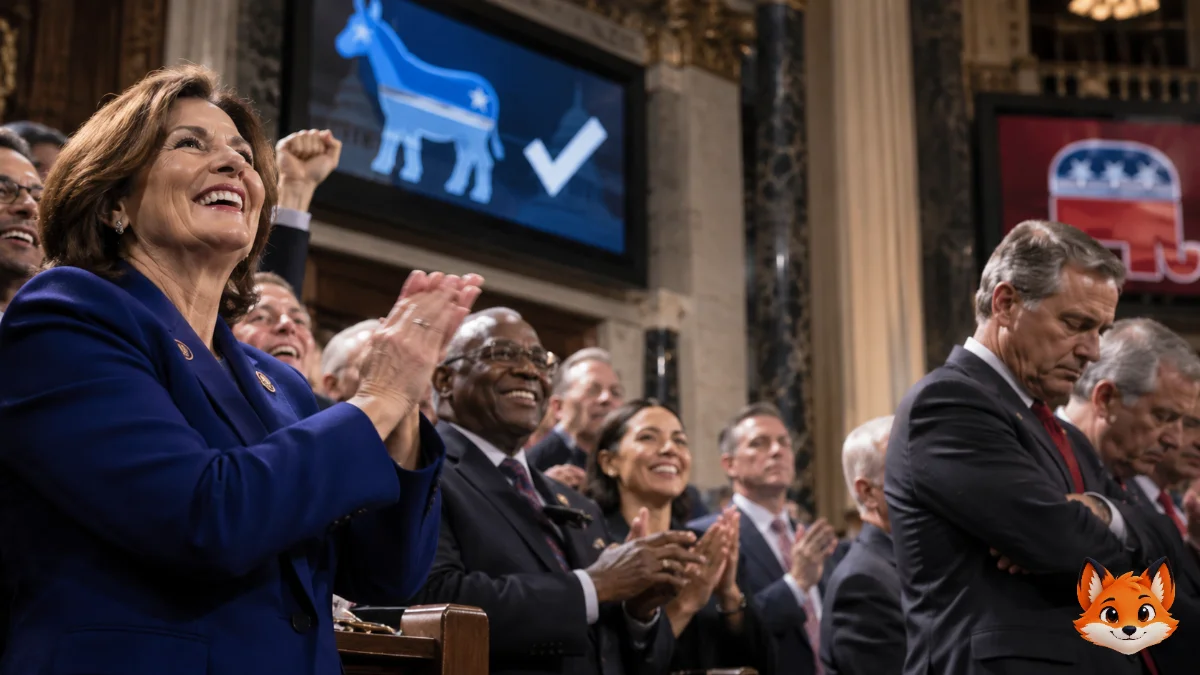
Warren gains power as crypto enters the firing line
 AI image
In short
- Elizabeth Warren is expected to become chair of the Senate Banking Committee in January 2027.
- Her agenda focuses on tougher crypto regulation, anti money laundering rules and financial oversight.
- Bitcoin lost approximately 9.6 percent between October 21 and November 5, 2026.
- Democrats also want tougher safety testing and liability rules for AI companies.
On November 5, 2026, Bitcoin closed at approximately $75,942. That was around 9.6 percent below its October 21 closing price. At the same time, Washington is preparing a political development that offers little comfort to the crypto market. Elizabeth Warren is on course to take one of the most powerful positions in American financial oversight.
The Democratic senator has spent years criticizing the way the cryptocurrency industry operates. In January 2027, she is expected to become chair of the Senate Banking Committee. That position gives her influence over legislation, hearings and investigations into financial companies. And crypto is firmly on her agenda.
Warren is approaching one of Washington's most powerful positions
Elizabeth Warren represents Massachusetts in the US Senate and currently serves as the leading Democrat on the Senate Banking Committee. Following the November 3 midterm elections, Democrats have taken control of Congress.
Reuters reported on November 6 that Warren is widely expected to take over the chairmanship when the new Congress convenes in January. Her appointment has not yet been formally confirmed.
The position gives her considerably more political influence. She gains additional staff, greater control over hearings and investigations, and more opportunities to summon witnesses.
That last point matters for the crypto industry. Companies that previously dealt mainly with regulators and lobbyists could soon find themselves directly in the spotlight of political investigations.
The Senate Banking Committee covers banks, financial institutions, monetary policy and financial markets. Cryptocurrency therefore falls directly within its area of responsibility.
Her campaign against crypto goes beyond investor protection
Warren presents her position as a fight for consumer protection. She points to money laundering, fraud, terrorist financing and the possibility that politicians personally profit from cryptocurrency projects.
There is a genuine problem here. According to the FBI's 2025 annual report, it received 181,565 complaints involving cryptocurrency. Reported losses reached $11.366 billion.
These are real risks. Investors are being scammed and criminals use digital currencies to move money.
But that is also where the debate begins.
Warren wants much of the crypto industry to operate under financial rules similar to those governing traditional banks and financial institutions. Her proposals focus on anti money laundering requirements, sanctions enforcement and oversight of digital assets.
In July 2025, she presented five principles for new crypto legislation. These included investor protection, financial stability and preventing government officials from personally profiting from crypto tokens.
The problem is that crypto works fundamentally differently from traditional banking.
An international exchange, a wallet software developer and someone independently holding Bitcoin are not the same type of financial service provider. If legislation fails to distinguish between them, the burden could fall on companies that do not operate like banks at all.
Her approach could affect an entire industry
The crypto industry consists of much more than Bitcoin. It includes Ethereum, stablecoins, exchanges, DeFi, wallet software and companies developing blockchain technology.
When US legislation imposes increasingly demanding obligations, the effects can spread throughout the entire industry.
Smaller companies do not have the legal departments of major banks. New projects could therefore face higher costs before even bringing a product to market.
International companies could also feel the consequences. The United States is an important market for global crypto businesses. If access to American customers becomes more difficult, investment and innovation could move elsewhere.
This creates a fundamental contradiction.
Washington wants American technology companies to remain internationally competitive, yet heavy regulation could restrict the opportunities available to new market entrants.
Watch out: Legislation designed to prevent fraud can also affect legitimate developers and businesses. The precise definition of who qualifies as a financial service provider will be particularly important.
Warren has also criticized Donald Trump and his family's crypto projects. She believes politicians should not personally benefit from digital currencies. That is a legitimate issue, but it should not automatically put the entire industry under suspicion.
Political power and conflicts of interest deserve equal scrutiny
There is another political dimension to this story.
Warren wants investigations into financial connections between the Trump administration and companies in the crypto industry. Reuters reported on November 6 that she is likely to focus on the approval of a banking charter for World Liberty Financial, a crypto company connected to Trump.
This raises a much bigger question: who monitors the financial interests of politicians?
Warren presents herself as someone willing to hold powerful financial institutions accountable. But her own political influence deserves scrutiny too. A committee chair who can initiate investigations and influence legislation holds considerable power.
That is not evidence of corruption or bribery. There is no substantiated evidence that Warren herself receives bribes. However, it is reasonable to examine political interests, lobbying activities and how investigative powers are used.
Investigations into potential conflicts of interest should be based on evidence, not political preferences.
Democrats also want to put AI companies under tighter control
Crypto is not the only technology sector facing tougher regulation.
On November 6, Reuters reported that Democratic lawmakers are preparing a series of new AI bills for when they take control of Congress in January.
Their proposals include:
- Independent safety testing for advanced AI models.
- Liability when AI products cause harm.
- Consumer protection against the effects of data centers.
- Limits on electricity costs caused by large data centers.
Democratic committee leaders also asked five major AI companies on October 28 to report safety incidents to Congress within 48 hours.
This is not a proposal to ban artificial intelligence altogether. It is about tighter oversight and additional legal obligations.
Still, a pattern is emerging. Both crypto and AI represent new forms of technology and economic power. Both industries are facing politicians who want greater control over how they develop.
For businesses, this means higher compliance costs and potentially less room to innovate quickly.
Bitcoin's correction makes the political timing particularly sensitive
The timing is striking. The crypto market is already going through a difficult period.
Historical price data shows that Bitcoin closed at approximately $84,012 on October 21, 2026. By November 5, it had fallen to approximately $75,942. That represents a decline of around 9.6 percent.
Reuters also reported on November 4 that Bitcoin was already more than 40 percent below its highest price of the year.
In numbers: Imagine holding €1,000 worth of Bitcoin on October 21. After a comparable price decline of 9.6 percent, your position would be worth approximately €904 on November 5. That represents a paper loss of €96 if you have not sold.
It would be misleading to blame this decline entirely on political developments. The market is also dealing with liquidity problems, uncertainty and wider economic developments.
However, the political shift in Washington introduces another source of uncertainty. Investors must consider a period in which the US government is likely to pay much closer attention to the rules governing crypto and technology companies.
Warren has considerable influence, but she does not have the final say
Becoming chair would give Warren significant opportunities, but not unlimited power.
She can organize hearings, initiate investigations and support legislation. However, passing laws requires sufficient votes in Congress. Proposals must also complete the remaining legislative process.
Furthermore, the crypto industry is not limited to American companies. Europe already has its own regulatory framework through MiCA.
The question is therefore not simply how much Warren can change, but how much political support her proposals will receive.
Questions worth asking
- Will Warren actually become committee chair in January 2027?
- Which crypto companies will be first on her investigation agenda?
- Will smaller blockchain companies face the same obligations as major financial institutions?
- Can Democrats actually pass their proposed tougher AI and crypto legislation?
- Will international technology companies move their operations to countries with less restrictive rules?
This article is intended for educational and news information purposes only, not as financial advice.
Sources
- Reuters, Wall Street critic Elizabeth Warren could be at the height of her power in new Congress, November 6, 2026
- US Senate Banking Committee, Warren's principles for crypto market structure legislation, July 9, 2025
- US Senate Banking Committee, Warren remarks ahead of Clarity Act vote, September 15, 2026
- FBI, 2025 Internet Crime Report, 2026
- US House Judiciary Democrats, AI companies asked to report safety incidents within 48 hours, October 28, 2026
- Reuters, Bitcoin could extend losses, November 4, 2026
- StatMuse, Bitcoin historical price data 2026