
Klaver targets crypto, but who pays the bill?
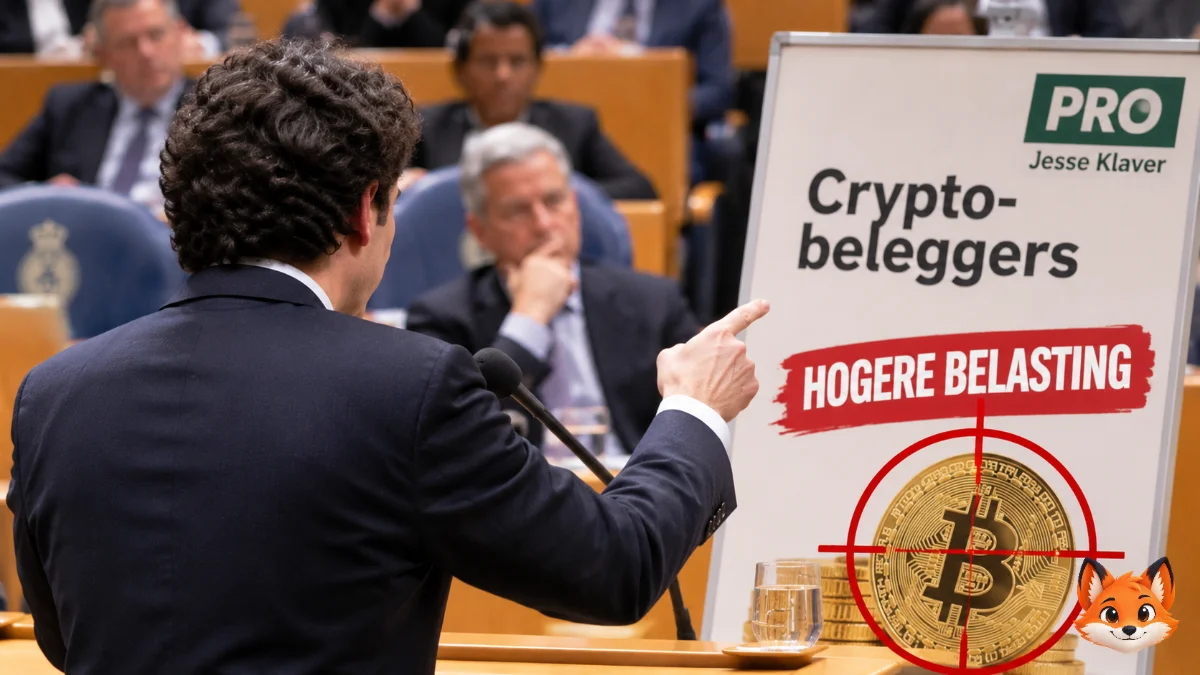 AI image
In short
- Jesse Klaver told parliament that crypto millionaires could afford to pay more tax.
- The PRO and Volt proposal introduces a 38.5 percent Box 3 rate on taxable investment income above 60,000 euros.
- Crypto, shares and other assets fall under Box 3, so the proposal does not single out crypto as a separate asset class.
- The political debate affects more than crypto investors, including savers, investors and wealthy business owners.
"I am not worried about crypto millionaires. They can afford to pay a little more tax." Jesse Klaver of PRO said this during the debate on the 2027 Dutch Tax Plan. It may sound like an offhand remark. But it reveals a political attitude worth challenging. Why does an elected representative talk about targeting a recognisable group of citizens instead of building a tax system that applies fair and consistent rules to everyone?
The remark was made in the Dutch House of Representatives on 4 November 2026. PRO and Volt have since reached a revised agreement with CDA and D66. Wealth is once again at the centre of the debate. And crypto has become a political talking point.
Klaver describes crypto millionaires as people who can pay more
During the debate, Klaver responded to criticism from crypto entrepreneurs. He said he had received angry messages, but was not concerned about crypto millionaires. In his view, they could pay a little more tax.
That is political language with a clear message. An elected representative should judge policy by its principles and consequences, not by the group that makes for an easy headline.
Why single out someone who invests in crypto? Why not simply talk about people who earn returns on wealth? Whether that wealth is held in Bitcoin, shares, property or an investment fund is the citizen's own choice.
Governments are entitled to levy taxes. But the rules should be clear. A fair system should apply the same tax principles regardless of the type of investment. Labelling one group does not improve that debate.
The proposal affects Box 3 wealth, not just crypto
The revised amendment submitted by Klaver and Volt introduces a top rate of 38.5 percent on taxable income from savings and investments above 60,000 euros. The proposed basic rate is 35.5 percent.
This is not a separate crypto tax. The Dutch Tax Administration classifies crypto assets such as Bitcoin and NFTs as Box 3 assets. Shares, bonds, savings and other assets also fall within this tax category.
The 60,000 euro threshold refers to calculated taxable investment income, not the total value of your portfolio. According to the explanation published with the agreement, the threshold is reached at around 1 million euros in investments when using an assumed return of 6 percent. Savings are assessed using a different assumed return.
What does that mean? Box 3 is the Dutch tax category for income from savings and investments. Crypto is included alongside shares and other assets. The proposed higher tax band is based on taxable investment income, not on the label attached to an investment.
It would therefore be wrong to claim that every crypto owner will pay 38.5 percent. But it would be just as misleading to suggest that only crypto millionaires are affected.
The political calculation sounds simpler than reality
The agreement between PRO, Volt, CDA and D66 is designed to raise 1 billion euros in structural measures. According to the published explanation, 221 million euros comes from the Box 3 adjustment. Other measures concern paper gifts, Box 2 and tax arrangements.
The parties intend to use 900 million euros of the proceeds to lower the lowest income tax rate in Box 1. That is the political exchange: lower taxes on work, funded through measures affecting wealth.
But one difficult question remains. Does higher tax on wealth automatically make a system fairer? That depends on how the wealth was built, what return was actually earned and how much cash someone has available to pay the bill.
A business owner may have wealth tied up in a company. An investor may own a portfolio that looks valuable on paper but loses value during a bad market year. A crypto investor may see an unrealised gain disappear before the tax year ends.
Government policy must account for these differences. A rule that looks simple on paper can have very different effects in practice.
A simple example shows where the threshold starts
Imagine you hold 1.1 million euros in investments. The proposal uses an assumed return of 6 percent for investors. In this example, that produces 66,000 euros in calculated investment income.
In numbers: Of that 66,000 euros, 6,000 euros sits above the proposed 60,000 euro threshold. The 38.5 percent rate applies to that part, resulting in 2,310 euros of tax on the top band. The first 60,000 euros is taxed at the proposed basic rate of 35.5 percent, or 21,300 euros. The total in this simplified example is 23,610 euros.
This is an illustrative calculation using the proposed rates. It is not a personal tax assessment. The final calculation depends on the legislation, allowances and individual circumstances.
There is another detail worth noting. The current Dutch Box 3 rate in 2026 is 36 percent. The proposed basic rate of 35.5 percent is slightly lower. The 38.5 percent rate applies only to the part above the threshold. A headline that only mentions the highest rate does not tell the whole story.
Klaver talks about a group, but the tax rules look at wealth
This is the heart of the criticism. Klaver uses the term crypto millionaires, while the proposal affects a much broader tax category. The rules do not ask whether someone built their wealth through crypto, shares or property. The tax category and calculated return determine the outcome.
So why put crypto in the spotlight? It gives the impression that one group of investors is a special problem. That is a poor starting point for tax policy. An elected representative also represents people who have invested their savings for years, business owners who take risks and citizens trying to build their own retirement savings.
There is nothing wrong with debating how the tax burden should be shared. But the debate should use the same rules for everyone. It should not portray one group as people who can simply be targeted.
A fair tax system should not decide that one investor is respectable while another is suspicious. It should consider ability to pay, actual returns, liquidity and the effects on investment. And the rules should be clear in advance.
Parliament still has to vote on the proposal
The revised amendment was submitted on 11 November 2026 and is on the House of Representatives voting agenda for 12 November. At the time of writing, the outcome has therefore not yet been treated as an enacted law.
The four parties present their agreement as a shift from taxes on wealth towards lower taxes on work. That is their political choice. But an agreement between parliamentary groups is no reason to dismiss the consequences for investors and business owners.
The debate should not be about whether crypto millionaires deserve to pay a little extra. The real question is whether the Netherlands wants a tax system that treats every form of wealth according to the same clear and consistent principles.
Questions worth asking
- Why does Klaver single out crypto millionaires when the measure covers a wider range of Box 3 wealth?
- How will policymakers prevent investors from being taxed on returns they do not actually have available?
- How will business owners be protected when their wealth is tied up in their companies?
- Why not first establish one consistent tax framework for crypto, shares and other investments?
- How much additional tax will the Box 3 measure actually raise after behavioural changes and possible relocation of wealth?
This article is for political and financial education and is not financial or tax advice.
Sources
- Dutch House of Representatives, Revised amendment by Klaver and Dassen, 11 November 2026
- Dutch House of Representatives, 2027 Tax Plan debate, 4 November 2026
- Volt Netherlands, Agreement between PRO, Volt, CDA and D66, 11 November 2026
- Dutch Tax Administration, Reporting and paying tax on crypto
- Dutch Tax Administration, Box 3 tax rates 2026
- Dutch Senate, Taxation of actual Box 3 returns
- BitFox, The Dutch tax bomb: who will keep business owners here?