Donbas for NATO? Europe could pay the price
 AI image
In short
- Zelensky says US negotiators asked whether Ukraine would leave Donbas in exchange for NATO membership.
- Russia wants Ukraine to remain outside NATO and sees enlargement as a threat to its security interests.
- The European Commission says progress on tackling corruption in Ukraine has been limited and warns about pressure on watchdogs.
- NATO members have committed to spending 5 percent of GDP on defence and security by 2035.
On 14 November 2026, Volodymyr Zelensky made a striking disclosure. US negotiators had asked whether Ukraine would withdraw from Donbas in exchange for NATO membership. There is no concrete proposal yet, but the question puts an uncomfortable choice on the table: who decides Ukraine's future, and who pays the price?
This is about more than territory. It concerns Europe's security, the interests of Washington and Moscow, the credibility of Ukraine's reforms and the bill facing European taxpayers.
Washington has raised a trade that does not yet exist
Zelensky said on 14 November that the US side had asked for the first time whether Ukraine would leave Donbas if the country could join NATO in return. He said Ukraine would not surrender its territory and that no detailed offer had been made.
The Ukrainian president described a broader package. It could include security guarantees, a strong Ukrainian military, military and financial support for an agreed period, and funding for reconstruction. If partners confirm the details, Zelensky says he would ask the Ukrainian public for its view.
That distinction matters. The United States has not promised NATO membership in exchange for Donbas. A question was raised during negotiations. The political pressure comes from the uncertainty itself.
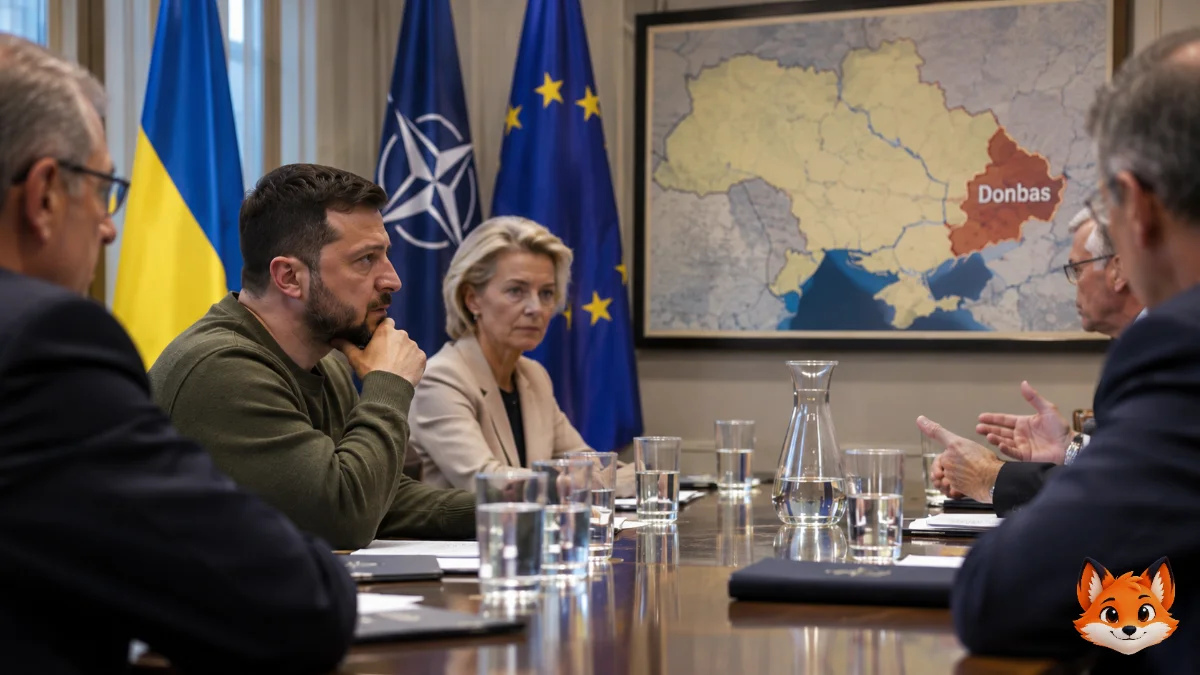
Donbas consists of the Donetsk and Luhansk regions. It has industrial assets, natural resources and a major military position. Ukraine still controls parts of the area. A withdrawal would therefore change more than a line on a map. It would alter Ukraine's defensive position.
Russia sees NATO enlargement as a strategic defeat
Moscow views the issue very differently. The Russian government wants Ukraine to stay outside NATO. For years, Russia has described the alliance's expansion towards its borders as a threat to its own security.
In a statement to the United Nations on 9 November, Russia's representative repeated that a peace settlement must address what Moscow calls the root causes of the conflict. Russia cited NATO enlargement, Western military presence and the position of Russian speaking residents.
That is Russia's position, not an independent finding. Moscow uses security arguments to support its demands, but those arguments do not change the fact that Russia invaded Ukraine in 2022. Ukraine is a sovereign state and has the right to choose its international partners.
Still, Russian interests cannot be ignored if negotiators want an agreement. For the Kremlin, Ukrainian NATO membership would bring a military alliance that Russia has opposed for decades directly to its border. For Ukraine, membership would offer protection against another Russian attack.
That is the deadlock. Kyiv sees protection where Moscow sees a threat. A deal presented as a victory by one side may give the other a reason to keep fighting.
Washington has interests beyond Donbas
Washington wants to end the war and avoid remaining indefinitely responsible for Ukraine's military and financial support. A settlement could give the US government more room to focus resources on other strategic priorities.
There is also a wider question of power. The United States wants to retain influence over Europe's security structure, while expecting European countries to take greater responsibility for their own defence. The negotiations are therefore about more than Ukraine. They also concern the relationship between Washington, Moscow and European capitals.
Ukraine has a different priority. It wants security guarantees that work in practice. Zelensky has said that a promise merely resembling NATO protection is not clear enough. He asked, among other things, what would happen if no American troops were stationed on Ukrainian soil.
Russia wants to block NATO enlargement and retain influence over Europe's security order. The US wants a settlement that ends the war without a direct military confrontation with Russia. Europe has its own security at stake.
Ukraine's corruption problems require firm conditions
Any discussion about bringing Ukraine closer to NATO must also examine the country's governance. Ukraine has introduced reforms since 2014 and has specialist anti corruption bodies. But the problems have not disappeared.
In its Ukraine Report dated 4 November 2025, the European Commission said progress in fighting corruption was limited. Independent bodies NABU and SAPO investigated cases involving senior officials. At the same time, parliament tried in July 2025 to weaken their independence by placing them under the authority of the politically appointed Prosecutor General.
After protests and international criticism, their independence was restored. That was positive, but the episode showed how vulnerable oversight of political power remains.
The Commission also pointed to delays in major corruption cases, few final convictions for illicit enrichment and insufficient seizure of criminal assets. These are not minor details when a country is seeking entry into a military alliance.
Watch out: Ukraine should not be labelled as one corrupt country. It has reformers, independent investigators and anti corruption bodies doing real work. But the European Commission has documented serious weaknesses. They must count in any decision on closer integration.
NATO membership is not a reward for political support. It creates obligations for every existing member. Controls on public spending, an independent judiciary and protection for anti corruption investigations should therefore be part of the conditions for further integration.
NATO membership would cost Europe more than a membership fee
The direct NATO bill is only a small part of the cost. The alliance had common budgets and programmes worth around €4.6 billion in 2025. NATO lists up to €5.3 billion for 2026.
The larger spending takes place in national budgets. At the 2025 NATO summit in The Hague, members agreed to spend 5 percent of gross domestic product on defence and security related expenditure each year by 2035. At least 3.5 percent is intended for core defence. Up to 1.5 percent may cover wider security, such as infrastructure and cyber security.
This is not a bill created solely by Ukraine. Existing NATO members have already made this commitment. Ukrainian membership could, however, create additional demands for military planning, air defence, ammunition stocks, infrastructure and the protection of a much longer border with Russia.
In numbers: A country with a gross domestic product of €1 trillion would spend €50 billion a year on defence and security under a 5 percent target. That is not an amount each resident personally pays. It is public money competing with other spending, including healthcare, education and infrastructure.
The distribution of shared NATO costs also matters. It follows a formula based on gross national income. For 2026 and 2027, the Netherlands has a 3.5014 percent share and Belgium 2.0716 percent. A new member would receive its own share, but the final cost depends on budgets and agreements approved by the allies.
The European Union does not automatically pay NATO's bill
There is an important distinction between the European Union and NATO. The EU is not part of the military alliance. Ukraine joining NATO would therefore not automatically require the EU budget to transfer a fixed amount to NATO.
The costs could still reach European citizens indirectly. Higher national defence budgets have to be funded somehow. Governments may raise taxes, reduce other spending or borrow more. European countries may also continue supporting Ukraine through weapons, loans and reconstruction funding.
Ukrainian NATO membership would also bring Article 5 into force for the country once it became a full member. The article says that an armed attack against one ally is considered an attack against them all. Each ally must assist, but each country decides what form that assistance takes.
That is not an automatic declaration of war by every member. It is, however, a serious obligation. A conflict with Russia could therefore affect every NATO country.
A deal without firm conditions could become expensive for Europe
The proposal described by Zelensky is not detailed enough to calculate its consequences. We do not know exactly what security guarantees Washington has in mind, how long financial support would last or what obligations other NATO countries would accept.
Europe should therefore ask more than whether Ukraine should join. It should ask under what conditions, with what oversight and with what mandate from European citizens.
A country joining the alliance must not only receive protection. It must also contribute to collective defence and meet the alliance's political and military obligations. Fighting corruption and ensuring democratic oversight belong in that discussion.
The interests are significant. Ukraine seeks protection, Russia wants to block NATO enlargement and the United States wants a settlement that serves its strategic position. Europe risks paying the bill without being the decisive negotiator.
Questions Europe should ask before agreeing
- What military obligations would European countries accept if Ukraine joined NATO?
- Who would monitor the use of military and financial support sent to Ukraine?
- What measurable progress must Ukraine make in tackling corruption?
- How will European citizens be involved in decisions affecting their security and tax money?
- What happens if Russia attacks again after an agreement?
This article explains geopolitics, defence and public finance. It is not financial or political advice.
Sources
Interfax Ukraine, Zelensky says US raised Donbas withdrawal and NATO membership, 14 November 2026
European Commission, Ukraine Report 2025, 4 November 2025
NATO, Defence investment and NATO's 5% commitment, 29 June 2026
NATO, Funding NATO, budgets and cost shares for 2026 and 2027
Permanent Mission of Russia to the United Nations, statement on Ukraine, 9 November 2026