The US China AI race is changing Europe's choices
 AI image
In short
- The United States invests far more private money in AI than China, but that does not tell the whole story.
- Chinese AI models have moved closer to the US frontier and are often offered at lower usage costs.
- Countries using AI must consider chips, data, privacy and dependence on foreign suppliers.
- AI industry growth does not automatically translate into profits for every company in the sector.
In 2025, US companies and investors put about $285.9 billion into AI. Comparable private investment in China was $12.4 billion, according to Stanford University's 2026 AI Index Report. Yet China has not simply disappeared from the AI race. Chinese models have narrowed the technical gap and are often offered at lower usage costs.
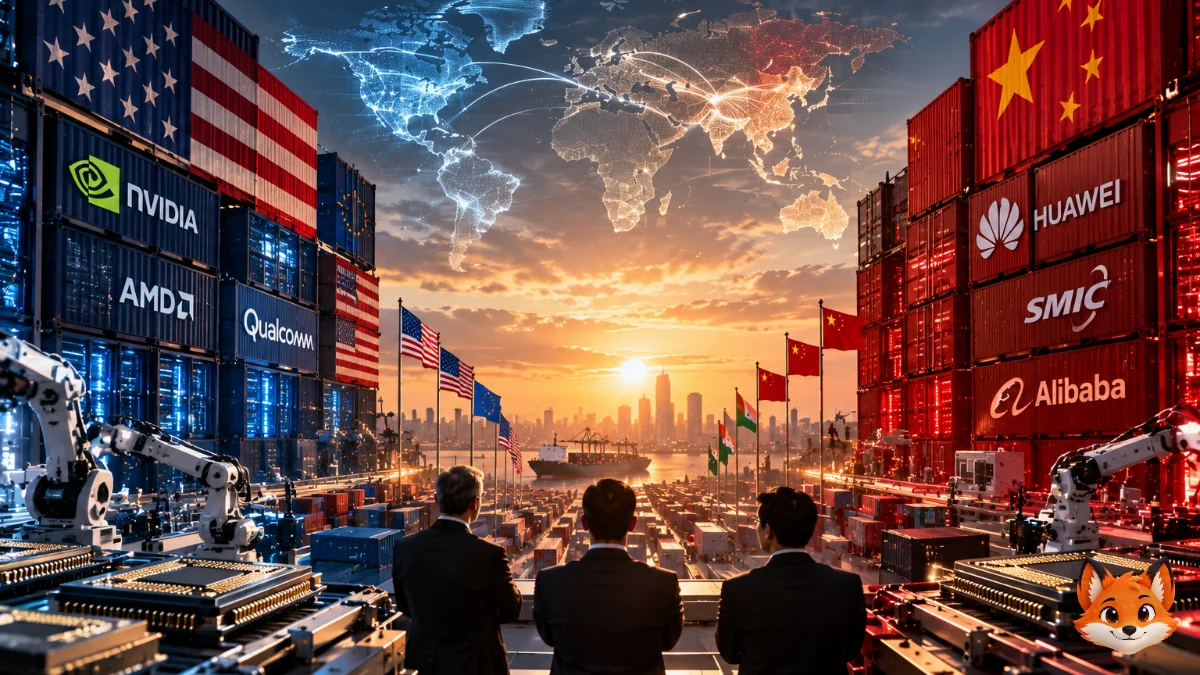
The competition is about more than building the smartest chatbot. The United States has an advantage in private capital, data centres and leading models. China is trying to expand its influence through open models, cooperation and access to AI computing capacity. Other countries must decide which technology to use, on what terms and with which dependencies.
The US has more investment money, but money does not decide the race alone
Stanford's figures show a wide gap. US private AI investment reached about $285.9 billion in 2025. China recorded $12.4 billion using the same measure. That is a difference of more than a factor of 23.
The comparison needs context. These figures cover private investment and do not capture all public support or other government funding in China. Stanford notes that Chinese government guidance funds are estimated to have invested $184 billion in AI firms between 2000 and 2023. The two countries therefore finance AI development in different ways.
The US approach relies heavily on large technology companies, venture capital and commercial cloud providers. These businesses build data centres, buy specialised chips and try to earn back their investments through subscriptions and business services.
China combines commercial companies with government policy and industrial deployment. Its government wants to make AI more widely available and expand international cooperation. The aim is not just to build a popular model, but to use AI in factories, logistics and other sectors.
Chinese models are getting closer to the US frontier
A large budget helps, but it does not automatically determine which AI model performs best. According to Stanford, US developers produced fifty notable AI models in 2025, compared with thirty from China. At the same time, the performance gap at the top has narrowed.
Stanford reported that leading US and Chinese models had exchanged positions several times since early 2025. In March 2026, Anthropic's leading model was ahead of the best Chinese model by just 2.7 percent on one major comparison. This does not mean every model is equally capable. Results vary by task, language and testing method.
What does that mean? An AI model is a system that processes text, images or other information and generates responses. An open model gives developers more freedom to use and adapt the technology themselves. This can lower costs, but users remain responsible for security, privacy and how the model is deployed.
China has pursued a practical advantage. Many Chinese developers publish models that others can download, adapt or run on their own systems. A March 2026 report from the US China Economic and Security Review Commission described how this approach supports the spread of Chinese AI models. The commission advises the US Congress and focuses on economic and national security implications for the United States.
China is using affordable AI to attract new partners
On July 17, 2026, the Chinese government announced an action plan for international AI cooperation. It includes access to computing power, open models, joint training programmes and cooperation on technical standards. China also wants to help developing countries build their own AI capabilities.
There is an economic motive. A country using Chinese AI may be able to start at a lower cost than if it built its own large models and data centres. Local companies can adapt the technology to their language, market or industry. Chinese suppliers gain more users, feedback and business relationships in return.
There are also concerns. Open availability does not automatically mean that every component is fully transparent. Data use terms, security and the ability to audit a model independently differ by supplier. A company can also become dependent on a provider if it builds its processes around one model.
The US strategy places more emphasis on advanced chips, infrastructure and partnerships with technology companies. US export rules restrict certain shipments of advanced computing chips to China. The US Department of Commerce cites national security and potential military use as reasons for these restrictions.
Europe must choose more than an AI brand
For European businesses, the choice is not simply American or Chinese. They also need to consider European privacy rules, where data is processed, security and long term costs. A low cost model may look attractive, but the total bill also includes integration, oversight and support.
The European Union wants to strengthen its own digital capacity, but it depends on a global supply chain. According to Stanford, the United States had 5,427 data centres in 2025, more than ten times as many as any other country. Production of advanced AI chips is also highly concentrated. Taiwanese chipmaker TSMC manufactures a large share of the most advanced chips used for AI.
This makes the AI economy vulnerable to chip supply disruptions and geopolitical tensions around Taiwan. Even when a European company uses an American or Chinese model, the underlying infrastructure may involve several countries.
For governments, the issue is therefore bigger than choosing the best technology. They want access to AI while avoiding complete dependence on a single foreign supplier for critical services.
The AI race creates opportunities, but not every stock benefits
AI growth attracts capital, but that does not mean every investment will earn a profit. Companies must recover their spending on chips, data centres, electricity and staff. Fast revenue growth can coexist with high costs and limited profits.
In numbers: Imagine investing €1,000 in a technology stock and its price then falls by 25 percent. Your investment is worth €750 and your loss is €250. If the price rises by 25 percent instead, your position becomes worth €1,250. This example shows what a price move means for your money, but it does not predict how an AI stock will perform.
Investors should separate three things: the growth of AI use, a company's revenue and the profit it eventually retains. A company can develop important technology without earning enough from it. And a company benefiting from AI does not have to be the maker of the best known model. Chipmakers, data centres, energy companies and software providers each play a different role.
Questions to ask before judging the AI race
- Who pays for the model's development and infrastructure?
- Has performance been tested on tasks relevant to the business or user?
- Where is data processed and who can access it?
- How easily can an organisation switch to another model?
- Is a company already making money from AI or mainly investing for growth?
This article is educational and is not financial advice.
Sources
- Stanford HAI, The 2026 AI Index Report, 2026
- Stanford HAI, Economy, The 2026 AI Index Report, 2026
- Chinese National Development and Reform Commission, Artificial Intelligence Cooperation and Development Action Plan, July 17, 2026
- US China Economic and Security Review Commission, Two Loops: How China’s Open AI Strategy Reinforces Its Industrial Dominance, March 23, 2026
- U.S. Bureau of Industry and Security, Policy Statement on Controls that May Apply to Advanced Computing Integrated Circuits, May 13, 2025