
Musk imagines life without salaries. Who pays for yours?
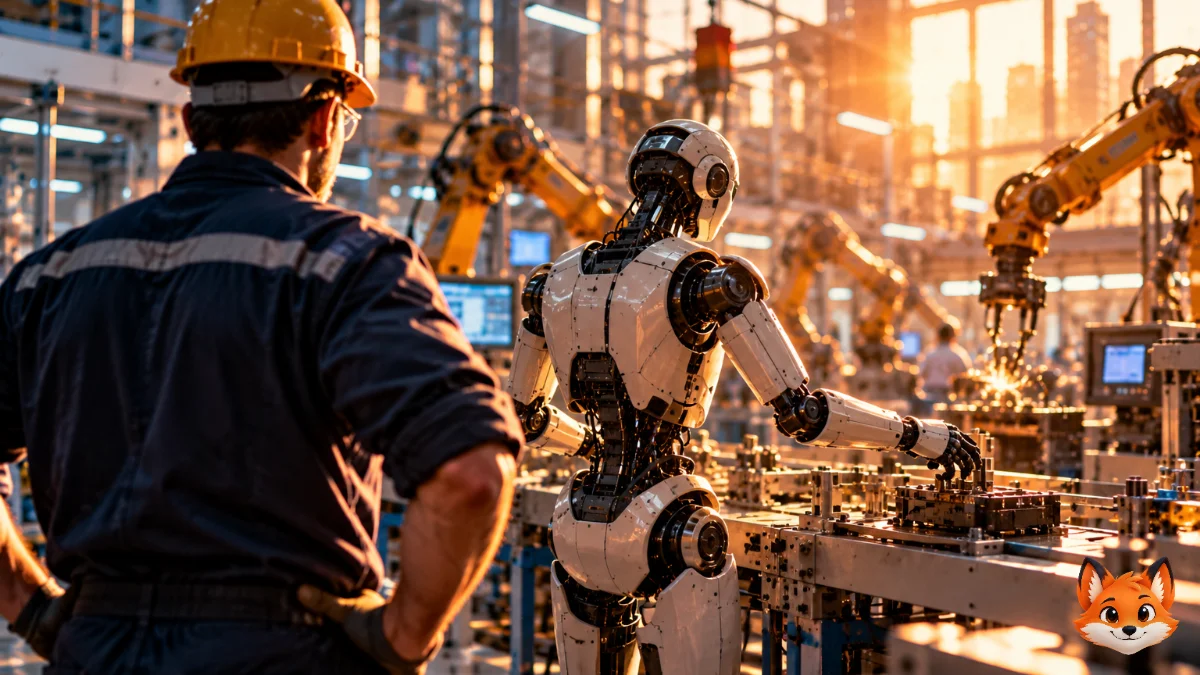 AI image
In short
- Elon Musk supports universal high income if AI and robots take over human labour.
- Finland tested basic income with 2,000 participants who received 560 euros per month for two years.
- Researchers cited by The Washington Post estimated that 12,000 dollars per year for every American adult would require nearly doubling federal tax revenue.
- AI may change existing jobs while creating new roles, so the end of work is not established.
Imagine waking up tomorrow and discovering that your salary is no longer needed to pay your bills. Elon Musk believes AI and robots could transform the economy so profoundly that everyone might eventually receive a high income, even if people no longer need to work. He calls this universal high income rather than ordinary basic income. The bigger questions are who pays for it and what happens to your wealth if a job is no longer the main source of income.
Musk expects work to lose its economic role
Musk has spoken for years about a future in which robots and artificial intelligence can perform almost every task. In April 2026, he wrote that government payments through universal high income were the best way to address unemployment caused by AI. He argues that machines could produce so many goods and services that higher incomes would not automatically lead to higher inflation.
That is a forecast, not an established economic result. Musk has not published a complete plan specifying how much everyone would receive, when payments would begin or how governments would fund them. The claim that the salary system will disappear forever within three years is also not confirmed by official labour market projections.
What does that mean? Universal basic income is a regular payment people receive regardless of whether they work. Musk goes further: he expects AI and robots to produce so much that people could eventually enjoy a high income without needing a job.
The promise sounds appealing. But between a robot doing work and a government distributing money lie difficult political and financial choices.
Finland has already tested what a fixed income can do
The idea is not just theory. Finland ran an experiment between 2017 and 2018 involving 2,000 unemployed participants. They received 560 euros each month, regardless of whether they found a job or actively looked for one.
The results were mixed. Participants reported better wellbeing and less mental strain. During the first year, the experiment had no clear effect on employment. In the second year, recipients worked an average of six more days, but researchers could not separate that result from a change to Finland's benefit system.
The study therefore does not prove that people will stop working once they receive a regular payment. It does show that financial security can affect how people experience their lives.
The next question is how much such a system would cost if it covered an entire country rather than a small group.
The bill could be larger than the gains from AI
A high income for everyone sounds simple until someone has to pay for it. Governments could raise taxes, change existing spending or use other sources of revenue. Every option affects companies, workers and savers.
In May 2026, The Washington Post described an estimate from researchers that paying every American adult 12,000 dollars a year would require nearly doubling federal tax revenue. That figure was an example in the analysis, not a specific amount Musk has committed to provide.
Musk argues that AI and robotics could generate so many additional goods and services that production would keep pace with a larger money supply. Economists point out that this depends on the amount produced, how the gains are distributed and how payments are funded.
In numbers: Suppose you receive 12,000 euros a year and your essential expenses total 18,000 euros. You would still be short by 6,000 euros a year, or 500 euros a month. A basic income would not automatically cover your entire cost of living. These figures are illustrative, not a forecast of a future government programme.
AI could remove jobs while creating new ones
The labour market is changing, but the evidence does not show that every job is disappearing. The U.S. Bureau of Labor Statistics projects that the number of data scientist jobs will grow by 33.5 percent between 2024 and 2034. Its projections also show growth in information security and computer research roles.
These are estimates for specific occupations in the United States. They do not prove that AI will not destroy jobs. They do show why predictions about the disappearance of all work are too definite.
Some tasks will disappear, others will change and new roles will emerge. The impact will vary by industry, education and country. An office job may be affected differently from work that requires physical presence, accountability or direct human contact.
The transition may also be uneven. A company can benefit immediately from lower labour costs, while a worker may need time to find another job. A future income for everyone would not automatically solve that transition.
Your wealth will not vanish automatically, but ownership matters
If robots produce more, who owns the robots, factories, software and shares? This is one of the most important financial questions behind Musk's vision. If the gains mainly go to technology owners, wealthy shareholders could benefit while workers lose income.
Governments could try to narrow that gap through taxes and public payments. But until specific policies exist, no one knows how much households would receive or what tax burden would be required.
Your savings would still matter. Even with a basic income, you would have to account for rent or mortgage payments, healthcare, inflation and unexpected expenses. A promise of future abundance does not pay today's bills.
Investors also need to consider which companies actually become more productive and which lose their business models. AI may change corporate profits, but that alone does not establish which shares are attractively priced. You can also read our explanation of stablecoins, as digital payments and new financial infrastructure form part of the broader debate about the future economy.
A world without jobs could also lack structure
Work provides more than a salary. For many people, it creates a daily routine, social contact, a sense of progress and a role in society. If paid work becomes less necessary, that structure will have to come from somewhere else.
Musk has acknowledged that a future where work is optional raises questions about meaning and purpose. The question is not only whether AI can produce enough. It is also what people do when their job no longer determines how they spend their day.
The Finnish experiment offers no definitive answer. It did show that greater income security can improve reported wellbeing without automatically removing people from the labour market.
You can prepare for uncertainty about work and money
You do not have to believe that all jobs will disappear to prepare for change. It makes more sense to organise your finances so you are not dependent on one job, one income source or one scenario.
- Track your essential expenses and how many months you could cover with available savings.
- Invest time in skills relevant to your work and learn to use AI tools critically.
- Spread financial risks rather than making your entire wealth dependent on one company, sector or technology.
- Follow official policy announcements rather than social media claims about future basic income.
- Check the tax rules that apply to you. The tax treatment of income, wealth and investments differs between the Netherlands and Belgium.
Watch out: Universal high income is currently a vision of the future, not a public payment you can count on. Do not build today's budget around money that does not yet exist and whose amount, conditions and funding remain unsettled.
Questions worth asking yourself
- How long could I cover my essential expenses if my income disappeared?
- Which parts of my job could AI take over?
- How dependent is my wealth on companies that develop or use AI?
- What official decisions have actually been made about basic income?
- What happens to my purchasing power if prices change while my income stays the same?
This article is for educational purposes and is not financial advice.
Sources
- Elon Musk, statements on universal high income, via ElonFAQs
- The Washington Post, AI leaders see mass job loss coming. They want government's help solving it, May 22, 2026
- U.S. Bureau of Labor Statistics, Artificial intelligence, information technology, and employment, 2024 to 2034, July 16, 2026
- Finnish Government, preliminary results of the basic income experiment, February 8, 2019
- Finnish Government, results of the basic income experiment, May 6, 2020
- U.S. Bureau of Labor Statistics, overview of employment projections for 2024 to 2034