Netherlands in Russia's sights after Crimea Bridge attack
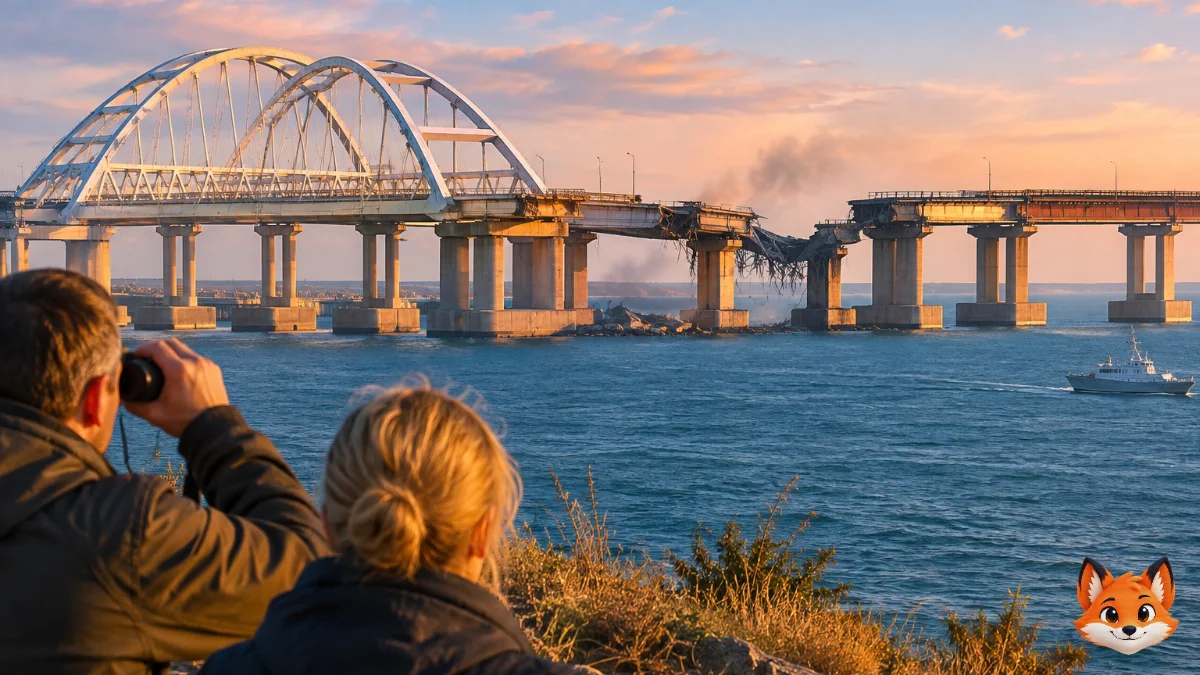 AI image
In short
- Dutch defence company Destinus confirms that its Ruta missiles were used in the attack on the Crimea Bridge.
- Russia openly questions whether the Netherlands has joined the war.
- The Dutch government has committed billions of euros in military support to Ukraine.
- Rising geopolitical tensions could affect energy markets, businesses and investors.
On Tuesday, 17 November 2026, one of the most important connections between Russia and Crimea was hit again. But this time, the attack carries a different significance: a Dutch defence company claims that its own missiles were used.
The Russian embassy in the Netherlands reacted immediately. Moscow is now asking whether the Netherlands has openly sided with Ukraine in the war. The Netherlands is therefore being drawn more directly into the international spotlight.
A Dutch company claims a role in the attack
Destinus, a defence company headquartered in the Netherlands, announced on 17 November that its weapons had been used in the attack on the Crimea Bridge.
According to DutchNews, the company told Dutch broadcaster NOS that seven Ruta cruise missiles struck the bridge. Ukrainian president Volodymyr Zelensky had previously also mentioned the Ruta missiles and Da Vinci drones.
The attack was part of a Ukrainian operation that, according to Zelensky, required several weeks of preparation. Russian air defence systems, radar installations and other military facilities were targeted first. The attack on the bridge followed.
This is a significant development. A Dutch company is not merely manufacturing weapons for the Ukrainian armed forces. It is now publicly confirming the use of its technology in a specific military operation.
That is precisely what makes Russia's reaction so sensitive.
Russia directly questions the Netherlands
On 18 November, the Russian embassy in the Netherlands published a striking statement on social media.
Moscow said it had been informed about Dutch involvement. The embassy then asked whether The Hague was openly joining the conflict.
The message is clearly intended as a warning.
Russia has long regarded Western military support and weapons deliveries to Ukraine as involvement in the war. Russian officials have also previously warned that European defence companies supporting Ukraine could become potential targets.
Destinus had already appeared on a Russian list of European companies allegedly involved in producing drones for Ukraine in April 2026.
That makes the latest development particularly sensitive. A Dutch company has now publicly acknowledged the use of its technology in an actual military operation.
However, an important distinction remains: the involvement of a Dutch company does not automatically mean that the Dutch government itself carried out the attack or directly participated in the military operation.
The Crimea Bridge is much more than an ordinary bridge
The Crimea Bridge connects mainland Russia with the Crimean peninsula. The road and railway crossing is approximately 19 kilometres long.
Russia built the bridge after annexing Crimea in 2014. Vladimir Putin opened it in 2018 by personally driving a truck across the structure.
The bridge serves three important purposes for Russia.
- Military: the crossing has been used to transport equipment and supplies towards Crimea.
- Strategic: it provides an important connection between Russia and the annexed peninsula.
- Symbolic: the bridge is a major prestige project for Putin and a visible symbol of Russian control over Crimea.
According to Reuters, the central road section was damaged during the attack. Ukraine reported that parts of the structure had collapsed. The railway section was also hit.
Russia reported that traffic had temporarily been suspended.
The attack is therefore more than a military event. It is also a direct symbolic confrontation with the Kremlin.
The Netherlands has committed billions in support
Dutch involvement in Ukraine did not begin with Destinus.
Since Russia's invasion on 24 February 2022, the Netherlands has committed substantial military and financial support.
According to the Dutch Ministry of Defence, military support delivered by the Netherlands amounted to approximately €11.7 billion as of 2 February 2026.
This includes direct deliveries from Dutch military stocks, purchases of military equipment for Ukraine and contributions to NATO funds.
On 28 October 2026, the Dutch government also announced a new support package worth €1.2 billion over the next three years. This package covers non military assistance, including energy, water and reconstruction.
The Dutch government has therefore made no secret of its support for Ukraine.
The new development is the public acknowledgement by a Dutch company that its weapons have actually been used in an attack on a strategically important Russian target.
What does this mean for the economy and investors?
Geopolitical tensions regularly influence financial markets. Energy prices, defence companies and European shares are particularly sensitive to uncertainty surrounding wars and international trade.
However, investors should be careful about directly linking every market movement to a single military event.
On 17 November 2026, the European STOXX 600 index fell 1.75% to 650.72 points. According to Reuters, the decline was mainly driven by concerns about technology stocks and Nvidia's upcoming earnings.
ASML lost 5.3% during the same trading session. Reuters also linked that decline primarily to concerns surrounding technology stocks.
Oil showed a different picture. Brent crude closed at around $93.14 per barrel on 17 November, compared with $92.44 on 16 November.
These figures show why it is important to distinguish between different causes of market movements. There is no established evidence that the decline in European shares was caused by the Crimea Bridge attack.
For investors, three developments are particularly relevant:
- Energy: further escalation between Russia and Europe could increase uncertainty about energy supplies and prices.
- Defence: European governments continue investing in military production and equipment stocks.
- European businesses: companies involved in defence production face growing geopolitical and security risks.
Dutch defence companies face a more complicated environment
The Dutch government has clear rules governing the export of military goods.
Companies generally require an export licence to ship military equipment abroad. The government assesses the destination, intended use and potential consequences for international security.
The European Union applies eight assessment criteria. Human rights, international security and the risk of further escalation are among the considerations.
An important distinction is that the government assesses whether an export licence should be granted before the goods are exported. The eventual use of a product on the battlefield is a separate matter.
The situation surrounding Destinus illustrates that the consequences of defence production extend beyond selling a product. A company can also become part of an international political confrontation through its activities.
For the Netherlands, this creates a difficult balance between supporting Ukraine, protecting national security and safeguarding Dutch businesses.
Russia's warning raises new questions
Russia's statement on 18 November does not prove that the Netherlands has officially become a party to the war. For now, it is a political warning from the Russian embassy.
But the combination of a Dutch weapons manufacturer, an attack on a strategically important Russian target and a direct response from Moscow makes this development particularly significant.
The coming weeks will be important in determining how the Dutch government responds and whether Russia announces further measures.
Questions worth asking
- What exactly was Destinus' role in supplying the missiles used?
- Did the Dutch government authorise the relevant export beforehand?
- What consequences could Russia's warning have for Dutch defence companies?
- How will European countries respond if Russia makes its threats more concrete?
This article is intended for information and education and does not constitute financial advice.
Sources
- Reuters, Russia asks if Netherlands is joining Ukraine war, 18 November 2026
- Reuters, Russia says Ukraine struck its bridge to Crimea, 17 November 2026
- Dutch Ministry of Defence, Military support for Ukraine
- Dutch Government, Export control policy for strategic goods
- European Union, Common Position on arms export controls, consolidated version 2025
- Dutch Government, New €1.2 billion support package for Ukraine, 28 October 2026
- Reuters, European shares fall 1.75%, 17 November 2026