
Market bloodbath as AI fears collide with politics
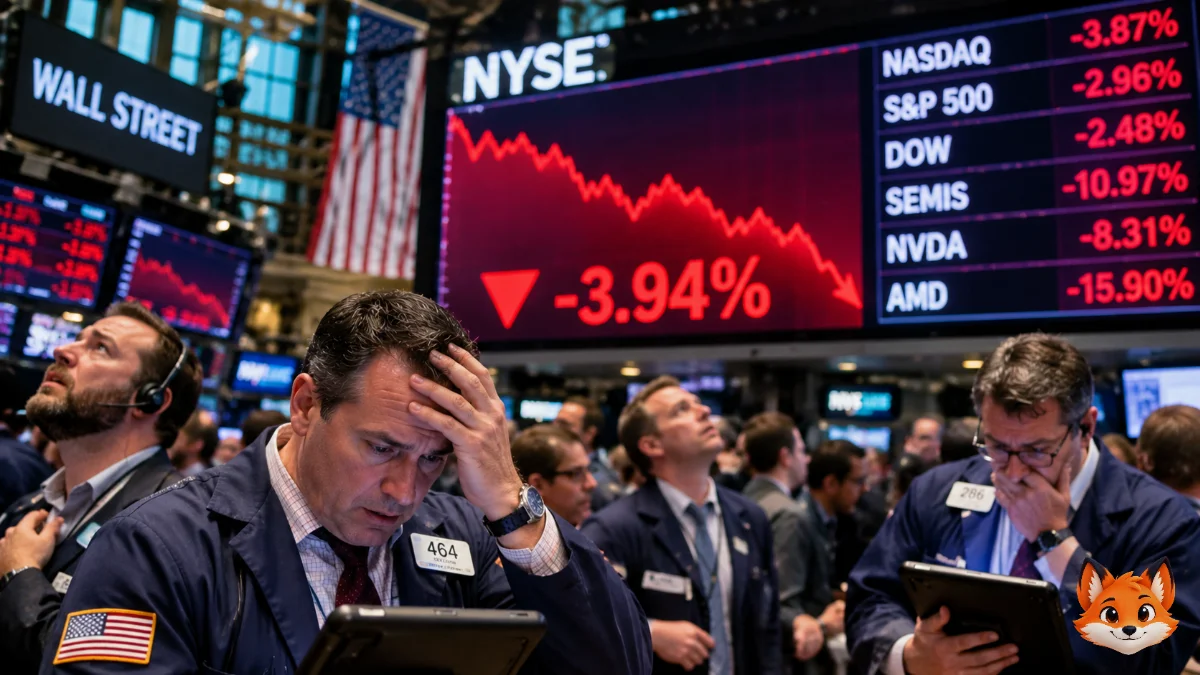 AI image
In short
- The S&P 500 and Nasdaq each lost around $2.1 trillion in market value during the November 5 selloff.
- At around 11 a.m. US time, the Nasdaq was down 4.95 percent and the S&P 500 had fallen 3.20 percent.
- Bitcoin lost around 5 percent and $428 million in leveraged long positions were liquidated within an hour.
- Democratic election victories increased political pressure on data centres, while a bill proposes a temporary construction moratorium.
More than $2 trillion in market value disappeared from the US stock market on Thursday, November 5. At around 11 a.m. US time, the S&P 500 was down 3.20 percent and the Nasdaq had fallen almost 5 percent. Bitcoin, Ethereum and major chipmakers were also hit hard. The selloff reflects a combination of doubts about the AI boom, expensive investment plans and a new political reality in Washington.
The striking reversal came just one day after investors celebrated a strong market rally following the Democrats' election victory. By Thursday, sentiment had completely changed.
The post midterm rally barely lasted
The November 3 US midterm elections gave Democrats victories in both the House of Representatives and the Senate. From January 2027, they will control Congress. That leaves President Donald Trump facing a much more difficult political period.
On Wednesday, November 4, investors initially reacted positively. The Dow Jones rose about 3 percent, the S&P 500 gained 1.6 percent and the Nasdaq climbed 1.4 percent. Investors appeared relieved that the election result was clear and that a divided political market could slow major policy changes.
But Thursday brought a sharp reversal. At around 11 a.m., the Nasdaq was down 4.95 percent. The S&P 500 had lost 3.20 percent and the Dow Jones was down 2.15 percent. MarketWatch reported that the market value of both the S&P 500 and the Nasdaq had fallen by around $2.1 trillion at that point.
Those are enormous figures. They represent an estimated decline in the value of companies in the indexes, not money literally disappearing from bank accounts.
AI and chipmakers took the hardest hit
The biggest losses came from companies building the infrastructure behind artificial intelligence. Nvidia fell 8.3 percent, according to the Associated Press. AMD dropped 15.9 percent and CoreWeave lost 14.9 percent. Reuters reported that the Philadelphia Semiconductor Index, which includes major chipmakers, fell nearly 11 percent.
Qualcomm also took a serious hit. The company issued weaker than expected guidance for smartphone chip sales. Its shares fell as much as 13.5 percent at one point.
There are several reasons behind the decline. Investors are increasingly questioning whether the enormous investments in AI will generate profits quickly enough. Technology companies are spending billions on data centres, specialist chips, cooling systems and electricity. Those expenses eventually need to be recovered.
Borrowing also remains expensive. When financing costs are high, building new data centres becomes harder to justify financially. Investors are therefore looking more critically at companies whose future growth depends heavily on AI.
The Democratic victory puts political pressure on AI
The election result has changed expectations about AI regulation. Democrats will have more influence over legislation and oversight. In several US states, candidates critical of rapid data centre expansion won important races.
Data centres require enormous amounts of electricity and water. Local residents are concerned about the impact on power grids, household bills and water supplies. If new projects are delayed, the consequences will extend beyond data centre operators. Chipmakers, cooling equipment suppliers and energy companies could also be affected.
The US Energy Information Administration estimates that electricity use by data centre servers could reach between 446 and 818 billion kilowatt hours a year by 2050. That represents a huge future demand for power.
Meanwhile, the Federal Energy Regulatory Commission is working on rules for connecting large energy users to the electricity grid. The debate over data centres has been building for some time. It did not begin with the election.
Democrats already have a bill proposing a construction pause
The political risk is concrete. On June 24, 2026, Representative Alexandria Ocasio Cortez and other Democratic lawmakers introduced bill H.R. 9442, known as the Artificial Intelligence Data Center Moratorium Act.
The proposal seeks to temporarily pause the construction and expansion of AI data centres until legislation is passed to protect the public from the risks of artificial intelligence. The bill has been referred to committees in the House of Representatives. It has not become law.
The election victory gives Democrats more influence to put the issue back on the agenda. But a construction moratorium is not automatic. The proposal must pass through Congress and could face opposition from President Trump.
What does that mean? A moratorium is a temporary pause. In this case, it concerns the construction and expansion of certain AI data centres. The proposal does not mean that all existing AI applications would be banned. It is not currently law.
Bitcoin and Ethereum were dragged into the selloff
The crypto market was not spared. On November 5, Bitcoin fell towards $76,000. Ethereum lost almost 7 percent at the time of measurement and traded around $2,256.
According to crypto news outlet Decrypt, approximately $428 million in long positions were liquidated within one hour. These are positions where traders bet on rising prices, often using borrowed money. When prices fall sharply, a trading platform may automatically close those positions.
That creates additional selling pressure. Falling prices force traders to close positions, generating more sell orders. This can temporarily reinforce the decline.
Bitcoin does not always move in line with stocks. However, when investors broadly reduce risk, crypto is often sold as well. Thursday's events showed that pattern again.
Read also The US China AI race is changing Europe's choices.
What does this market day mean for your money?
A percentage can sound abstract. A cash amount makes the impact clearer.
In numbers: Suppose you have invested €1,000 in a fund that tracks the S&P 500. If the index falls 3.20 percent, your investment is worth about €968. You have a paper loss of €32. On a €10,000 portfolio, the loss would be €320.
This example uses the index's intraday decline around 11 a.m. US time. It is not a final closing price. A fund may perform differently because of fees, its holdings and currency movements.
What you own also matters. A fund with a large technology allocation may fall more sharply than a broad global equity index. Crypto has additional risks, including leveraged positions and automatic liquidations.
The coming weeks will focus on profits and political plans
Markets now face several important questions. Can major technology companies earn enough from their AI investments? Will data centres continue expanding at the current pace? And how much influence will Democrats have over new rules for the sector?
The new Congress does not take office until January 2027. Until then, it remains unclear which proposals will actually move forward. Investors are already pricing in some of that uncertainty.
Interest rates matter too. Reuters reported that US central bankers again pointed to the risk of persistent inflation and possible future rate increases. Higher financing costs make large AI projects more expensive.
A market correction does not automatically mean a prolonged crisis is beginning. But the combination of high valuations, billions in investment and political uncertainty shows how vulnerable the AI trade has become.
Questions to ask when markets turn red
- How much of my portfolio is invested in technology and chipmakers?
- Are the companies I own already making money from AI?
- How much debt are companies using to finance their data centres?
- Do my crypto positions involve leverage or liquidation risk?
- Am I looking at the figures or reacting mainly to the panic of the day?
This article is for educational purposes and is not financial advice.
Sources
- Reuters, Nasdaq set to confirm correction as AI stocks tumble, November 5, 2026
- Associated Press, A wipeout for AI stocks sends Wall Street reeling, November 5, 2026
- MarketWatch, Nasdaq on pace for record loss in market value as tech sells off, November 5, 2026
- US Government Publishing Office, H.R. 9442 Artificial Intelligence Data Center Moratorium Act, June 24, 2026
- US Energy Information Administration, Data center server energy use grows across the commercial building stock, May 19, 2026
- Federal Energy Regulatory Commission, FERC Launches Action to Speed Large Load Integration, June 18, 2026
- Decrypt, Bitcoin Erases Election Rally as AI Stocks Plunge, November 5, 2026