The AI rally must now prove its returns
 AI image
In short
- Major technology companies are investing hundreds of billions of dollars in data centres, chips and AI infrastructure while investors look for evidence that the spending creates additional profit.
- Meta increased third quarter 2026 revenue by 26 percent, but costs rose by 68 percent and free cash flow turned negative.
- As of October 23, 2026, the S&P 500 was up 11.4 percent for the year and the Nasdaq Composite was up 11.7 percent.
- AI investment may create new revenue, but high spending also makes companies dependent on future growth and sufficient cash flow.
The US stock market is still higher in 2026 than at the start of the year, but the AI boom faces a harder question. Who pays for all the new data centres, chips and power infrastructure, and when will those investments pay for themselves? On October 23, the S&P 500 was up 11.4 percent since the start of the year and the Nasdaq Composite was up 11.7 percent. Those returns do not tell the whole story.
The largest technology companies are investing huge sums to build and deliver AI services. Investors are therefore looking beyond AI growth to the profit and cash flow it produces. Meta's latest results show why those two things can move in different directions.
The market is rising, but investors want proof
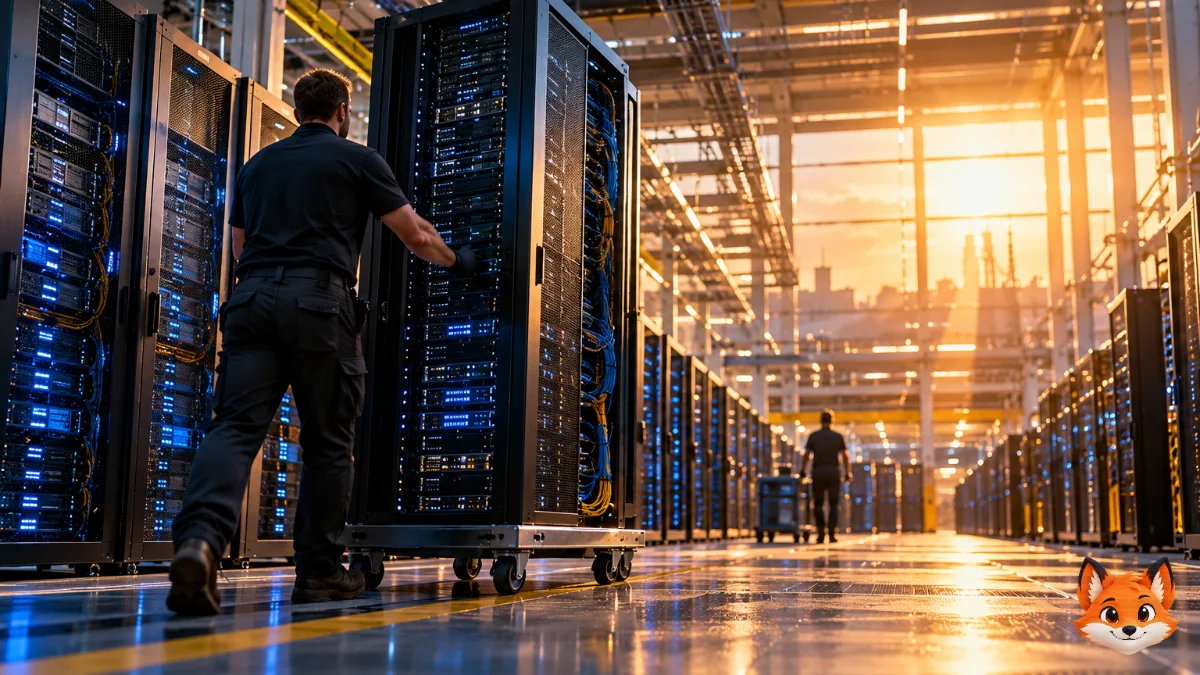
AI is a major driver of expectations for large technology companies. They are building data centres, buying specialised chips and signing contracts for power and cloud capacity. The hope is that businesses and consumers will eventually pay enough for AI services to make those investments profitable.
J.P. Morgan estimated that global investment in AI infrastructure would reach about 900 billion dollars in 2026. This is an estimate, not a final total. It nevertheless shows the scale of the financial commitment.
The stock market has already priced in some of the expected growth. As a result, a company can report good results and still see its share price fall if investors expected even better figures. High revenue growth is not the same as a high return on invested capital.
Meta shows how revenue growth and cash flow can clash
Meta published its third quarter results on October 21, 2026. Revenue reached 64.6 billion dollars, compared with 51.2 billion dollars a year earlier. That was an increase of 26 percent. Costs and expenses rose by 68 percent over the same period, partly because of a 9.89 billion dollar legal charge.
Meta reported operating income of 13.0 billion dollars and free cash flow of negative 2.12 billion dollars. The legal charge weighed on the results, so it would be wrong to attribute the entire fall in operating income to AI. Still, the quarter shows how investment and other costs can put pressure on available cash flow.
The company expects capital expenditure of 135 billion to 145 billion dollars for all of 2026. That spending includes servers, data centres and other infrastructure. Meta says AI is already generating additional advertising revenue through better recommendations and greater user engagement. The question for investors is how much of that revenue remains after all costs are paid.
What does that mean? Revenue is the money a company receives from sales and services. Free cash flow is what remains after operating expenses and investment spending. A company can therefore sell more and still have less cash left over.
Investment must deliver more than extra capacity
A data centre does not automatically make money once its servers are switched on. The company needs paying customers for AI services, cloud storage or computing capacity. At the same time, it continues to pay for electricity, cooling, maintenance and new chips.
In July 2026, Reuters calculated using LSEG estimates that five major US technology companies could spend more on capital expenditure in 2027 than they generate in free cash flow. The analysis covered Microsoft, Alphabet, Amazon, Meta and Oracle. It estimated about 534 billion dollars in additional capital spending between 2025 and 2027, compared with around 340 billion dollars in additional annual operating cash flow over that period.
That is not a fixed future outcome. Companies can change their investment plans, and AI revenue could grow faster than expected. But the gap explains why investors are watching cash flow more closely.
Share prices can fall while a business keeps growing
On October 23, 2026, the S&P 500 closed at 7,623.68 points. That left the index 11.4 percent higher than at the start of the year. The Nasdaq Composite was up 11.7 percent over the same period. These are price returns and do not include dividends.
Suppose you had invested 1,000 euros at the start of 2026 in an investment that tracked the S&P 500 exactly. With an 11.4 percent increase, that position would be worth about 1,114 euros based on the stated price return, before fees, taxes and any currency differences. This is a calculation example, not the result of a specific fund.
A positive year for the market does not mean every technology stock has risen. An index contains many companies, and individual results vary. The price investors paid for future growth also matters. A company may increase its profit while its share price falls if the market expected an even bigger improvement.
In numbers: You invest 1,000 euros in a stock. Its price falls by 20 percent, leaving your position worth 800 euros. To return to 1,000 euros, the price then needs to rise by 25 percent. Losses and recoveries therefore do not use the same percentages.
Not every AI investment earns money in the same way
Large technology companies earn money from AI in different ways. Microsoft sells cloud capacity and business software. Alphabet earns revenue from advertising and cloud services. Amazon sells cloud infrastructure through AWS. Meta uses AI partly to improve ad targeting and keep users engaged. Oracle builds capacity for business customers.
That difference matters. A company selling AI directly as a paid service has a different revenue source from a company that mainly uses AI to improve its existing advertising business. Both approaches may create value, but their returns are not measured in the same way.
Investors can therefore watch several figures in quarterly reports:
- Growth in AI and cloud revenue.
- Capital expenditure on data centres and equipment.
- Free cash flow after investment.
- Profit margins and changes in total costs.
- Company comments on demand for capacity and paid services.
The figures need to be read together. More revenue is positive, but it says little about returns when costs are growing even faster.
Upcoming results must show what AI is delivering
The next quarterly reports will give investors more information about demand for AI services and the cost of expansion. One quarter does not tell the whole story, especially because new data centres take time to build a customer base and generate revenue. At the same time, high investment can limit financial flexibility if returns fall short.
The central point is not that AI produces no revenue. Meta says AI is already contributing to advertising revenue, and Reuters previously reported growth in cloud businesses. The question is whether additional revenue will ultimately outweigh the full cost of investment and the expense of continuing to provide those services.
Questions to ask about AI stocks
- How much additional revenue can be attributed to AI services?
- Is free cash flow growing alongside revenue?
- How much is the company spending on data centres, chips and power?
- What assumptions about future growth are already reflected in the share price?
This article is for educational purposes and is not financial advice.
Sources
- Meta, Third Quarter 2026 Results, October 21, 2026
- Reuters, AI investment boom puts Big Tech's free cash flow under pressure, July 22, 2026
- J.P. Morgan, What unprecedented AI capex means for markets and investors, October 19, 2026
- Associated Press, How major US stock indexes fared Friday, October 23, 2026
- Nasdaq, Nasdaq 100 Index, official index information