One cyberattack could lock you out of your money
 AI image
In short
- The Dutch central bank advises households to prepare for 72 hours without electronic payments.
- Its recommendation is €70 in cash per adult and €30 per child.
- A 2026 DNB study found that only 58% of respondents held the recommended amount or more.
- An outage does not automatically mean your savings have disappeared, but access to your money may be temporarily blocked.
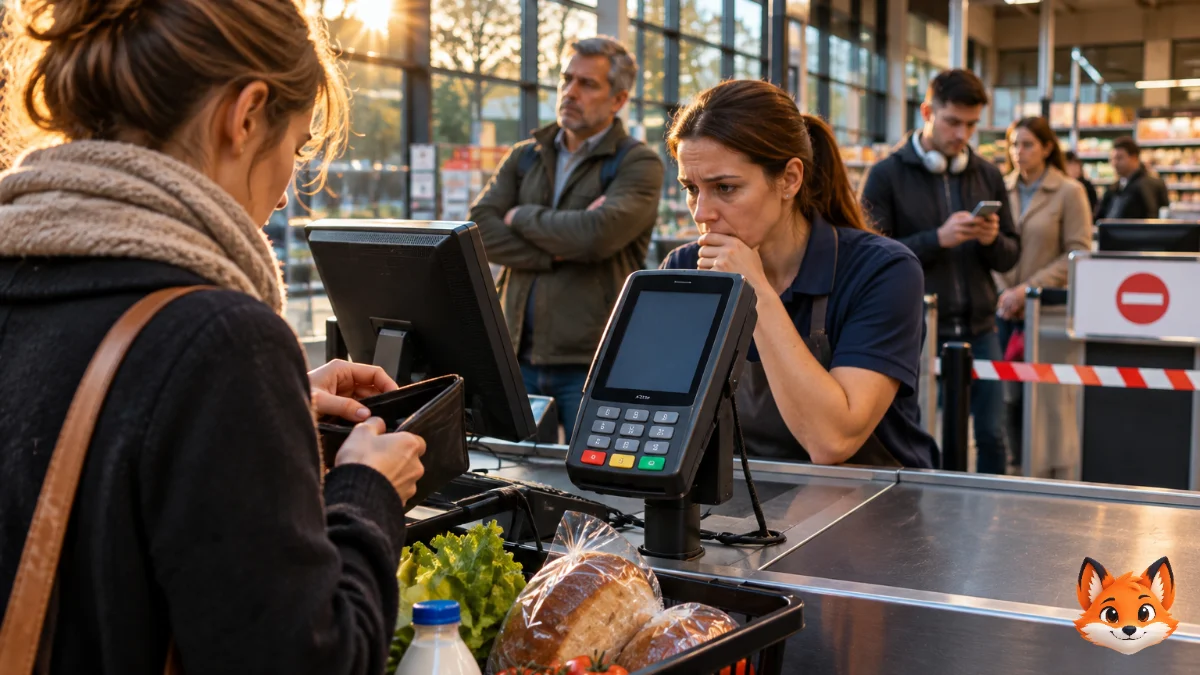
It is Saturday afternoon. You are standing at the supermarket checkout with a full trolley. You try to pay, but the card terminal does not respond. You open your banking app. That does not work either. There is already a queue at the cash machine around the corner. Your money is still in your account, but you cannot access it.
This is not just a scene from a film. De Nederlandsche Bank (DNB), the Dutch central bank, advises households to prepare for 72 hours without electronic payments. A cyberattack is one possible cause. What happens to your everyday finances when the payment system stops working?
One attack can affect more than your bank
Banks depend on digital systems. These systems process payments, manage accounts and connect banks to payment networks. Shops, cash machines and telecommunications companies are also part of that chain.
An attack on one organisation does not automatically bring down the entire financial system. But the impact becomes greater when several services experience problems at the same time. A banking app may stop working, a payment network may fail to process transactions and cash machines may stop dispensing money.
The European Union Agency for Cybersecurity, ENISA, identifies financial institutions as attractive targets. Its 2025 threat report found that data breaches accounted for 64% of recorded cybercrime claims against the financial sector. Ransomware accounted for 36%. With ransomware, criminals try to block access to systems or files and demand money in return.
These figures describe recorded claims, not the percentage of banks that actually experienced an outage. They do show why the financial sector attracts attention from cybercriminals.
Your balance can remain intact while payments fail
This is the difference many people overlook. A cyberattack on payment systems is not the same as a bank going bankrupt.
During an outage, your balance may remain exactly where it was. What fails is your access to that balance. You may be unable to transfer money, pay by card or withdraw cash.
Imagine you have €3,500 in your current account and €8,000 in savings. That is €11,500 in total. A technical outage does not automatically mean you have lost that money. But if your card, banking app and cash machines are unavailable, that balance is of little practical use at that moment.
What does that mean? Liquidity means being able to access and use your money immediately. Having €11,500 in an account is not the same as having €11,500 available to spend today. That difference becomes obvious when digital systems fail.
DNB advises households to prepare for 72 hours
On 20 May 2025, the Dutch National Forum on the Payment System, chaired by DNB, published specific advice. Households are encouraged to keep cash available for the first 72 hours of an emergency.
The amounts are based on calculations by Nibud, the Dutch National Institute for Family Finance Information:
- €70 per adult.
- €30 per child.
The money is intended for essential expenses such as water, food, medicine and transport. This is Dutch guidance, not a legal requirement.
In numbers: A family with two adults and two children would need €200 in cash under this recommendation. That amount is intended to cover essential expenses during the first three days. Without cash at home, the family depends on alternative payment methods or help from others.
Retailers are also advised to keep sufficient change available. A supermarket can face problems of its own when its payment connection stops working.
More than four in ten Dutch respondents fall short
In September 2026, DNB published a study based on 5,672 Dutch respondents. The findings are striking.
71% knew about the recommendation to keep cash at home. However, only 58% actually held the recommended amount or more.
That means 42% of respondents had less than the advised amount. The study also found that 70% had multiple digital payment instruments for purchases in shops.
That sounds reassuring. But having two bank cards is not much help if both banks depend on the same payment network. Having alternatives is most useful when the outage is limited to one bank or one provider.
Your bank deposits are protected, but an outage is different
Many people know about deposit guarantee schemes. In the Netherlands, the scheme generally protects up to €100,000 per account holder per bank if a bank fails. The same basic protection applies across the European Union.
However, this protection covers the loss of bank deposits following a bank failure. It does not ensure that you can withdraw cash or make card payments during a cyberattack.
Watch out: Imagine you have €80,000 in a bank account and the banking app stops working for three days. That alone does not qualify you for compensation under the deposit guarantee scheme. Your money has not automatically disappeared. You simply cannot access it temporarily. Those are two very different problems.
Belgian savers also benefit from the European basic protection of €100,000 per person per bank, through the national deposit guarantee scheme. Claims are handled through the relevant Belgian authorities.
Europe is improving protection, but dependencies remain
Since January 2025, the European Union has applied stricter digital resilience rules to financial institutions. These rules are known as DORA. Banks must manage digital risks, report incidents and assess their dependence on external IT providers.
In March 2026, the European Commission concluded that the EU financial sector has a solid framework for protection and cooperation. Previous cyber incidents and other disruptions have also shown that European institutions can respond.
Still, no system can make every outage impossible. Banks also rely on external technology companies for cloud storage, software and payment services. A problem at one supplier can therefore affect several financial institutions.
DNB is also investigating ways to allow debit card payments to work offline during major disruptions. This is a fallback option under development, not a solution that is already available everywhere.
What can you do before an outage happens?
You do not need a safe full of banknotes at home. The aim is to have a practical reserve and alternatives.
- Consider the Dutch recommendation of €70 per adult and €30 per child.
- Keep a physical debit card as well as mobile payment options.
- Consider a second payment account with another bank.
- Keep important telephone numbers and banking details somewhere other than your phone.
- Check how your bank communicates during a major outage.
For residents of Belgium and other EU countries, the Dutch cash recommendation is not automatically their national guidance. Check the information published by your own central bank or government.
Questions worth asking
- How many days could you cover essential expenses if card payments stopped working?
- Could you access your money if your banking app became unavailable?
- Do your payment methods depend on the same bank or provider?
- Do you know how your bank communicates during a cyber incident?
- Can you distinguish temporary loss of access from the actual loss of savings?
This article is for educational purposes only and does not constitute financial advice.
Sources
- De Nederlandsche Bank, Are households ready to weather a digital storm in retail payments?, Working Paper 869, 16 September 2026
- De Nederlandsche Bank, Prepare for a three day disruption of electronic payments, 20 May 2025
- ENISA, Threat Landscape 2025, October 2025
- European Commission, Commission report confirms resilience of the EU financial sector, 13 March 2026
- Government of the Netherlands, Is my money protected by the deposit guarantee scheme?, accessed 12 November 2026