
Ueno Bank collapsed, but is your savings money gone?
 AI image
In short
- Paraguay's central bank intervened after Ueno Bank's solvency fell below half the legal minimum.
- Around 3 million customers temporarily lost access to their bank accounts.
- Deposit protection covers up to 75 monthly minimum wages, or 228,300,000 guarani per person per bank.
- The crisis has spread into politics and bond markets, while the central bank says the problem is specific to one bank.
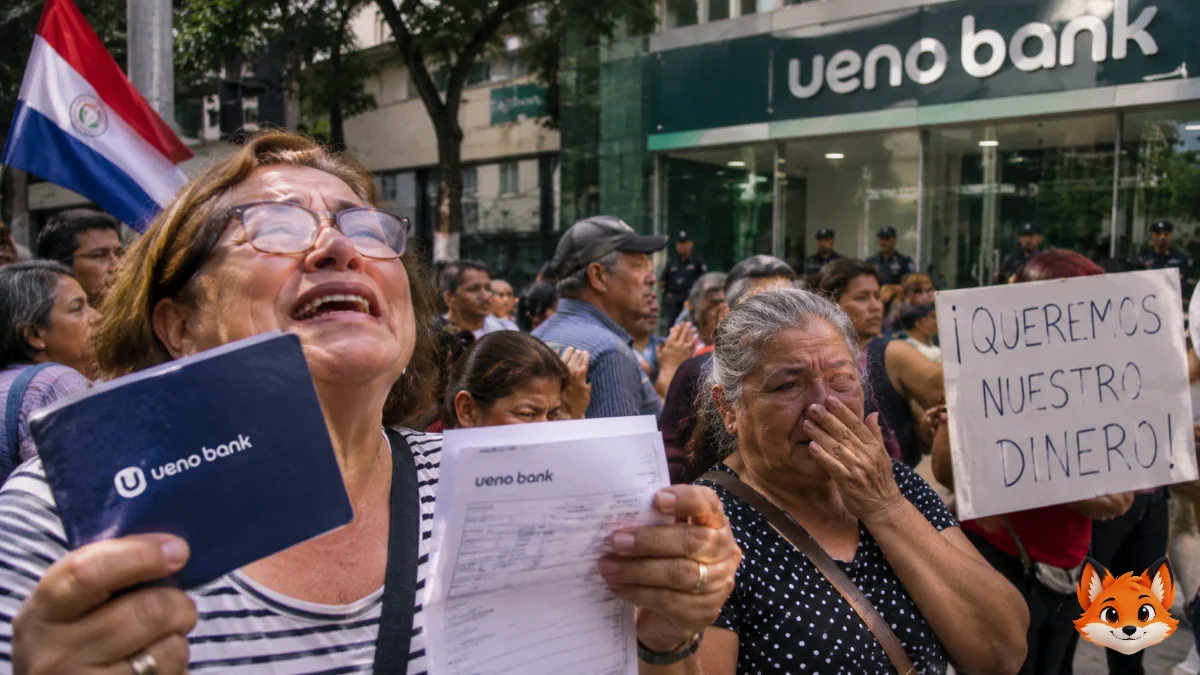
On 2 November 2026, Paraguay's central bank intervened in Ueno Bank. Around 3 million customers were then unable to access their accounts. Savers, pensioners and business owners took to the streets. The big question is whether their money has disappeared or whether they will get it back.
The answer is not simple. Deposit protection exists, but not everyone receives the full amount immediately. And the bank's problems have now become a political crisis too.
The central bank intervened because Ueno lacked capital
Ueno Bank grew rapidly into one of Paraguay's best known digital banks. It had around 3 million customers in a country of approximately 6.5 million people. That makes the impact of the intervention enormous.
On 2 November, the Banco Central del Paraguay (BCP) unanimously decided to begin formal resolution proceedings for Ueno Bank. The reason was serious: after adjustments to its financial statements, the bank's solvency ratio had fallen below half the legal minimum.
Solvency measures how much of a bank's own capital is available to absorb losses. Banks need that capital when borrowers fail to repay loans or assets lose value. When the buffer becomes too small, depositors' money is at risk.
The central bank has taken control and is appointing administrators to assess the bank's assets and liabilities. The aim is an orderly resolution and the greatest possible protection for depositors.
What does that mean? A bank entering resolution does not simply reopen. The regulator first examines what the bank owns, what it owes and how much money is available. It then determines how customers and creditors will be paid.
Three million customers have temporarily lost access to their accounts
The closure affects more than people with savings accounts. Customers also used Ueno for salaries, pensions, everyday spending and business payments. If your banking app does not work and your card is declined, the problem is immediate.
According to Reuters, around 3 million customers could not access their accounts. Ueno also administered about $850 million in public funds, including money connected to Paraguay's pension and health system.
The central bank says this is an isolated case, not a general crisis affecting all Paraguayan banks. In its May 2026 Financial Stability Report, the BCP said the banking system as a whole had adequate capital. Total regulatory capital stood at 17.8 percent, compared with a minimum requirement of 12 percent.
That report predates the intervention at Ueno. It does not prove that other banks cannot face problems. It does show why one bank failure and a nationwide banking crisis are two different things.
Your savings are protected, but there is a limit
Paraguay has a deposit guarantee scheme. It protects savings when a bank can no longer meet its obligations. According to the central bank, the maximum coverage is 75 monthly minimum wages per person per bank.
On 3 November 2026, that amounted to 228,300,000 guarani. The limit applies per person and per bank, not per account. If you have a current account and two savings accounts at the same bank, the balances are added together.
On 4 November, the central bank announced that savers could receive an advance payment under the guarantee. The advance is up to 40 monthly minimum wages, or 121,760,000 guarani. The BCP said payments would start within 24 hours and be completed within five working days.
The advance is not the same as the full guarantee. Customers with larger balances must wait for the rest of the resolution process. Repayment of amounts above the guarantee limit depends on the assets available when the bank is wound down.
In numbers: Suppose you had 100 million guarani in Ueno Bank. That amount is below the official guarantee limit of 228.3 million guarani. If you had 300 million guarani, 228.3 million would fall within the normal coverage. Recovery of the remainder depends on the resolution process.
The bank case has become a political crisis
Ueno's problems are not just financial. President Santiago Peña held shares in Grupo Vázquez, the group that controls Ueno, until March 2025. The former head of the central bank, Carlos Carvallo, had also previously led Ueno. Those links have raised questions about supervision and possible conflicts of interest.
Carvallo resigned at Peña's request. Paraguay's Public Prosecutor's Office confirmed that it was investigating possible financial crimes. On 4 November, prosecutors charged 27 people in connection with the case. These are allegations, not convictions. Investigators are examining, among other things, loans to companies allegedly linked to the banking group.
On 5 November, Congress also began debating Peña's removal. The opposition accuses him of conflicts of interest and misuse of pension funds, among other things. A two thirds majority is required to advance impeachment proceedings. The political outcome remains unresolved.
Investors are feeling the impact too
The problems are not limited to Ueno's customers. Investors are watching the bank's bonds and Paraguay's government debt. A bond is a loan to a company or government. Its market price changes when investors reassess the risk.
Ueno's international bonds due in 2031 traded at around 99 cents per dollar when issued in March 2026. In the week of the intervention, the price fell to around 86 cents. That is a decline of approximately 13.1 percent from 99 cents.
Paraguayan government bonds due in 2055 also lost around 1 cent per dollar of face value on 3 November. That is a smaller move, but it shows that investors are reassessing the country's risk as well.
Watch out: A fall in a bond price is not the same as a loss on a bank account. Bond prices move when the risk of non payment changes, while eligible savings are covered by a legal deposit guarantee. That guarantee does not cover bonds or shares.
Investor example: Suppose you had bought €10,000 worth of Ueno bonds at a price of 99 cents per dollar. At a price of 86 cents, the same nominal amount would be worth approximately €8,687, assuming the exchange rate stayed the same. The difference is around €1,313. This is an estimate based on the quoted bond prices, excluding fees and currency movements.
What happens next to the money and the bank?
The central bank is examining Ueno's assets and liabilities. It must then establish how much money is available to repay customers and other creditors. Deposit protection provides an initial safety net, but resolving larger balances takes time.
Customers should follow official BCP announcements and keep evidence of their balances and transactions. Do not rely on social media posts claiming that other banks are about to be taken over. On 4 November, the BCP explicitly rejected rumours about further interventions at other banks.
Paraguay has more at stake than one bank. The country needs foreign investors. If investors begin to doubt the quality of banking supervision, they may demand higher interest rates on government debt. That makes borrowing more expensive for the state.
The central bank stresses that this is a problem involving one specific bank. The coming weeks should show how much money can be recovered and whether the turmoil remains limited to Ueno.
Questions to ask
- How much of my balance is covered by the deposit guarantee?
- Is the advance payment of 40 monthly minimum wages already available in my account?
- How will balances above the guarantee limit be handled?
- Is there official evidence that other banks are in trouble?
- What happens to bonds and other investments if a bank is liquidated?
This article is for educational purposes only and is not financial advice.
Sources
- Banco Central del Paraguay, starts resolution proceedings for Ueno Bank, 3 November 2026
- Banco Central del Paraguay, advance deposit guarantee payment for Ueno savers, 4 November 2026
- Banco Central del Paraguay, Financial Stability Report May 2026
- Ministerio Público, charges in the Ueno Bank investigation, 4 November 2026
- Reuters, Paraguay bank crisis spurs lawmakers' calls to impeach president, 4 November 2026
- Reuters, Paraguay Congress begins session to debate President Peña's impeachment, 5 November 2026
- bne IntelliNews, Ueno collapse exposes the weak spot in Paraguay's investment pitch, 5 November 2026
- European Central Bank, euro foreign exchange reference rates, 4 November 2026