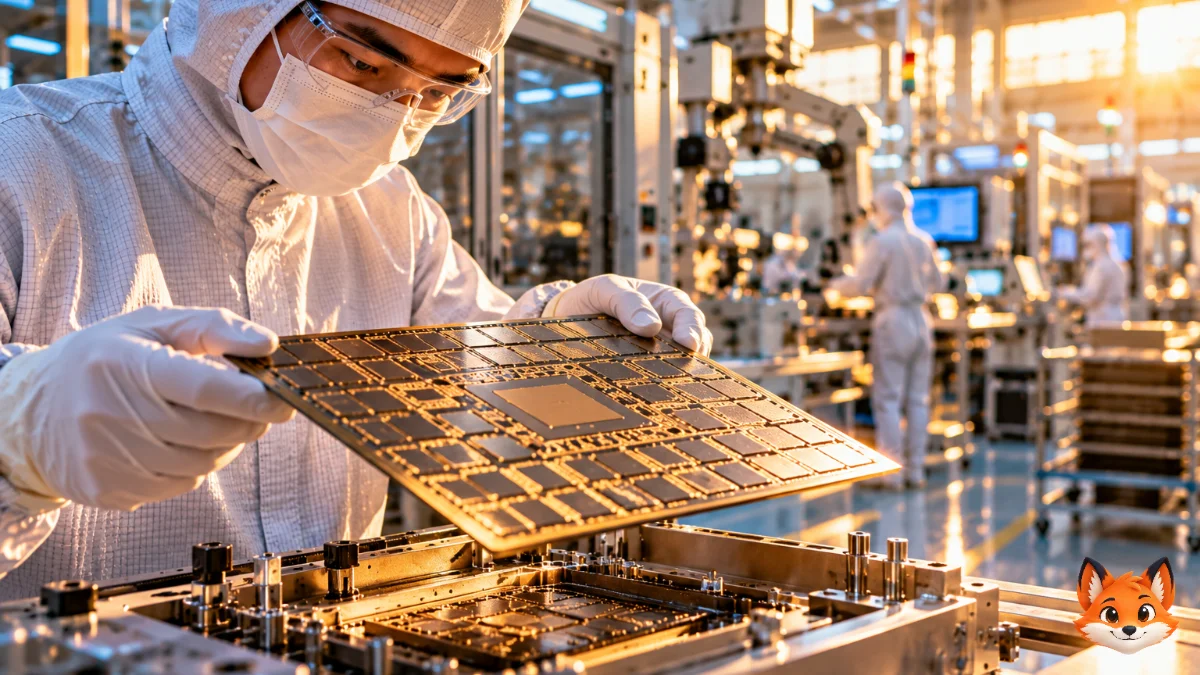
Without These Chips, the World Could Grind to a Halt
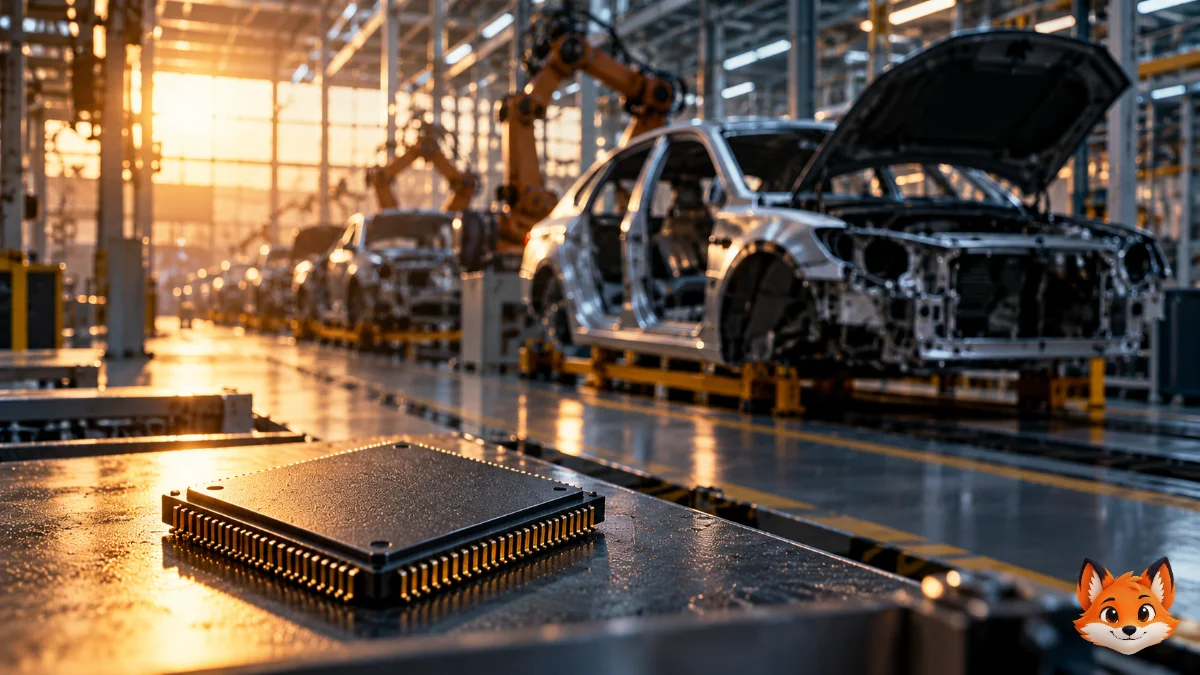 AI image
In short
- Global semiconductor sales reached $791.7 billion in 2025, but production remains concentrated in a limited number of countries and companies.
- Taiwan plays a central role in advanced chip manufacturing, so a conflict or prolonged production disruption could have international consequences.
- Europe is trying to expand its manufacturing capacity, but building a factory does not immediately remove dependence on equipment, materials and expertise.
- [object Object]
In 2025, the global semiconductor industry sold $791.7 billion worth of chips. That is almost $800 billion in tiny components most people never see, yet rely on every day. They sit inside cars, phones, payment terminals, medical equipment and military systems. A large share of the most advanced production depends on a limited number of companies and countries.
The vulnerability is not just the number of factories. Chip production requires specialised machines, exceptionally pure materials, huge investments and expertise built over decades. If one key link fails, a company cannot simply call another factory and switch suppliers. That makes semiconductors a source of economic and geopolitical power.
A chip shortage can stop more than your smartphone
A semiconductor is a small piece of material containing electronic circuits. Some chips perform calculations, others store data or manage electrical power. Not every chip is advanced, but nearly every modern industry needs them.
Cars use chips for engine management, airbags, braking systems, navigation and entertainment. Payment terminals rely on them to process transactions. Hospitals need chips in scanners, monitoring equipment and laboratory systems. Data centres depend on powerful processors to run websites, digital payments and business software.
The dependency extends beyond finished products. Factories use chips in robots, measurement equipment and inventory systems. If one component is missing, an entire production line can slow down even when every other part is ready.
What does that mean? A chip shortage does not have to make all electronics disappear. One specific component being unavailable may be enough. A carmaker could be unable to finish thousands of vehicles even if the engines, tyres and bodywork are ready.
The economic impact spreads through the supply chain. Lower production can mean longer delivery times, higher costs and reduced revenue. Consumers may eventually notice the effects in product prices or availability.
The chip industry is growing, but production remains concentrated
The Semiconductor Industry Association reported global semiconductor sales of $791.7 billion in 2025. That was 25.6 percent higher than the $630.5 billion recorded in 2024. In February 2026, the organisation projected global sales of roughly $1 trillion for 2026. That is a forecast, not a confirmed outcome.
The growth shows how important chips have become for computers, data centres, cars and communications technology. But a large market does not mean production is evenly distributed around the world.
The Organisation for Economic Co-operation and Development describes semiconductors as one of the most geographically concentrated industries. Its analysis estimates that around 75 percent of value added in the semiconductor supply chain it studied was generated by five economies. Four of those economies are in Asia. Value added is the difference between the value a business produces and the goods and services it buys.
This concentration creates vulnerability. An earthquake, power outage, blockade, trade dispute or export restriction can affect much more than the economy where the disruption begins. The consequences can travel through suppliers and customers to companies on the other side of the world.
Taiwan occupies a position that is difficult to replace
Taiwan is one of the most important locations for advanced semiconductor manufacturing. Taiwanese company TSMC makes chips designed by other businesses. This model is known as a foundry: the manufacturer produces the chip while the customer supplies the design.
In its 2025 annual report, TSMC said advanced technologies, defined as 7 nanometres and below, accounted for 74 percent of its wafer revenue. A wafer is a thin slice of semiconductor material on which many chips are produced at once. TSMC also reported manufacturing 12,682 different products for 534 customers in 2025.
Those figures show the scale and specialisation of the business. A modern chip factory is not an ordinary production site that can be replaced within a few months. Equipment needs precise calibration, processes must be validated and production yields must be high enough to make the operation economically viable.
Taiwan is also located in a region where tensions between China and Taiwan create a security concern. A military crisis, blockade or prolonged disruption to transport and power supplies could affect chip manufacturing. This is not a prediction, but a risk that governments and companies take into account.
Not all the world's chips come from Taiwan. Other manufacturers produce semiconductors in South Korea, the United States, Japan and Europe. Even so, replacing the most advanced manufacturing capacity is difficult. Additional factories elsewhere help only when they support the required technology, have sufficient capacity and can deliver reliably.
The Netherlands plays a key role behind the scenes
The dependency is not only about factories. The machines used to make chips are also difficult to replace. This is where the Netherlands enters the picture.
ASML, based in Veldhoven, makes lithography systems. These machines project patterns onto material that is later turned into electronic circuits. Extreme ultraviolet lithography, or EUV, is important for producing the most advanced chips. It uses light with an extremely short wavelength to create tiny patterns.
In its 2025 annual report, ASML reported revenue of €32.7 billion and research and development spending of €4.7 billion. The company delivered 48 EUV systems that year. Such machines are part of a manufacturing process that depends on many specialised suppliers working together.
Watch out: Building a chip factory in Europe does not mean Europe can independently produce every chip it needs. A factory also needs machines, materials, software, spare parts and specialised workers. A shortage in just one of those areas can limit production.
The Dutch role gives Europe influence in the global semiconductor chain, but it also makes the Netherlands part of the strategic dependency. Export controls on advanced equipment are therefore more than trade policy. They also affect relations between Europe, the United States and China.
Europe is trying to become less vulnerable
The European Union wants to expand its semiconductor sector. The European Chips Act is designed to encourage investment, research and manufacturing capacity, strengthening Europe's position in the global market.
New factories cost billions and require years of preparation. They also need access to energy, water, skilled workers and a network of suppliers. Building knowledge and experience takes time. Opening a factory is only one part of the challenge.
Spreading production can reduce risk. If one region is disrupted, capacity elsewhere may cover part of the demand. But this only works if alternative factories can produce the right chips. A plant making chips for cars is not automatically suitable for advanced processors used in data centres.
There is also a trade off between efficiency and resilience. Concentrating specialised production in a few large locations is often cheaper. Building factories in multiple regions makes the supply chain more resilient, but requires additional investment and may raise production costs.
A chip crisis can affect prices and stock markets
When chips become scarce, manufacturers face longer lead times and higher costs. Businesses may produce less, delay orders or pass higher costs on to customers. The effects vary by product. A missing chip in a low cost component can sometimes hold up the delivery of a much more expensive device.
Stock markets react not only to shortages that have already happened. Investors also estimate how much profit companies may earn in the future. Share prices can fall before the full impact becomes visible, or rise when investors expect a recovery.
The PHLX Semiconductor Index, a US index of semiconductor companies, shows how large these swings can be. Historical index data shows that the index fell about 35 percent in 2022. It rose about 67 percent in 2023. The index tracks a group of listed companies and does not represent every individual stock.
In numbers: Suppose you held €1,000 in an investment that exactly tracked the index at the start of 2022. After a 35 percent decline, about €650 would remain. A 67 percent increase the following year would take that amount to roughly €1,086. This simplified example excludes fees, taxes, dividends and differences between the index and an actual investment.
The lesson is not that semiconductor companies are automatically good or bad investments. The sector is sensitive to economic growth, inventory cycles, export restrictions, technological changes and expectations about new applications. Strong industry sales do not automatically mean every company is profitable or that its shares are attractively priced.
A chip crisis can also affect households indirectly. If electronics become more expensive or a car is delivered later, household spending changes. Lower production can also affect employment and company results.
The vulnerability will not disappear simply by building more factories
The United States, Europe and Asian economies are investing in domestic manufacturing capacity. That can reduce dependence on a single region. Yet the supply chain remains international. A factory may be in one country while design software, raw materials, machines and packaging capacity come from elsewhere.
Advanced chip manufacturing also requires reliable electricity and water supplies. Dust particles can disrupt production, processes need constant monitoring and a new manufacturing technique requires extensive testing. Even with sufficient funding, a new location cannot immediately reproduce the experience of an established factory.
Companies try to reduce risk by finding multiple suppliers, holding inventories of critical components and spreading production across regions. That costs money. The amount of extra inventory needed depends on the component and its lead time. Some specialised chips have no direct substitute.
The main vulnerability is therefore not simply a shortage of factories. It is the world's dependence on a tightly connected network in which certain components, machines and expertise are difficult to replace.
Ask these questions before drawing conclusions
When reading news about semiconductors and geopolitics, these questions help separate facts from speculation:
- Is this an actual production stoppage or a possible future scenario?
- Which types of chips are affected, and which industries use them?
- Are alternative manufacturers able to supply the same technology and volume?
- Which businesses bear the costs, and which can pass higher prices on to customers?
- Are share prices reacting to company results or mainly to expectations and uncertainty?
The semiconductor industry shows that economic power is not only about oil, gas or raw materials. Specialised technology can also become a strategic bottleneck. The world does not need to stop literally for the effects to be felt: a shortage of one essential component can change production, prices and company results.
This article is for educational purposes and is not financial advice.
Sources
- Semiconductor Industry Association, Global Annual Semiconductor Sales Increase 25.6% to $791.7 Billion in 2025, February 6, 2026
- OECD, Economic Security in a Changing World, Semiconductor Value Chains
- TSMC, Annual Report 2025
- ASML, Annual Report 2025
- Federal Reserve Bank of St. Louis, PHLX Semiconductor Sector Total Return Index
- European Commission, European Chips Act