South Korea stocks crash 6 percent as AI fears spread
 AI image
In short
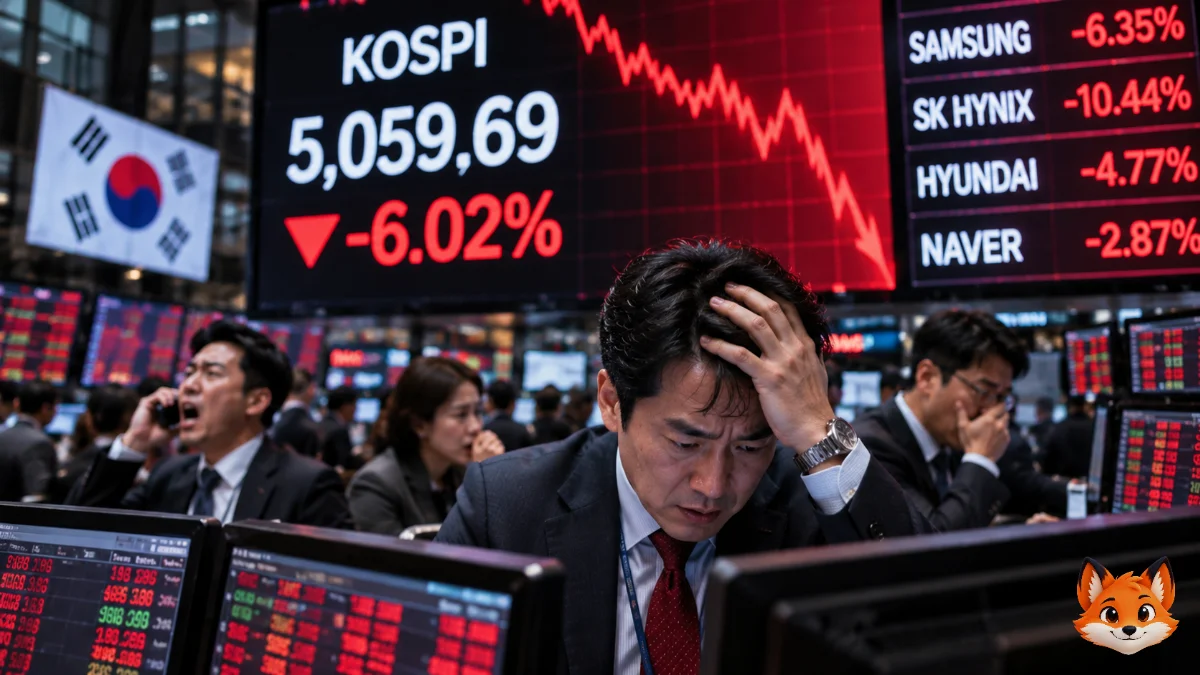
- South Korea's KOSPI closed 6.02 percent lower on November 6, 2026, after falling 8.8 percent intraday.
- Samsung Electronics lost 6.35 percent and SK Hynix fell 10.44 percent.
- Foreign investors sold 2.77 trillion won worth of South Korean shares.
- The government is temporarily easing collateral rules for investors who borrow money to buy shares.
South Korea's stock market lost 6.02 percent on Friday, November 6, 2026. Earlier in the morning, the KOSPI had fallen as much as 8.8 percent. Trading was halted for twenty minutes. Chipmakers took some of the biggest losses as investors worried about the future of AI data centres following the US midterm elections.
The selloff did not come out of nowhere. South Korea depends heavily on its semiconductor industry. That industry is now at the centre of a debate about the enormous investments required to build artificial intelligence infrastructure.
The KOSPI lost more than 11 percent in two days
The KOSPI is South Korea's main stock market index. It is comparable to the AEX in the Netherlands, although it includes many large technology and industrial companies.
On Friday, the index closed at 5,059.69 points, down 6.02 percent for the day. The KOSPI had already fallen 5.3 percent on Thursday. Across two trading sessions, the decline therefore exceeded 11 percent.
The morning had been even worse. The index fell to 4,911.28 points. That was the first time it had dropped below 5,000 during trading hours since February.
The decline was so rapid that the Korea Exchange activated a circuit breaker. This is an emergency mechanism that temporarily stops trading when a market index falls too sharply.
The exchange halted trading for twenty minutes
At 9:03 a.m. local time, trading in KOSPI shares was suspended for twenty minutes. At that moment, the index was 8.52 percent below its previous close.
The Korea Exchange uses this measure to give investors time to reassess the situation. Under the official exchange rules, the first circuit breaker is activated when the KOSPI falls at least 8 percent and remains at that level for one minute.
Trading resumed after the pause. The index recovered some of its losses, but still ended the day more than 6 percent lower.
What does that mean? A circuit breaker is an automatic emergency brake on the stock market. If the index falls at least 8 percent for one minute, trading stops for twenty minutes. The aim is to slow panic selling temporarily.
Samsung and SK Hynix suffered some of the biggest losses
South Korea's stock market is heavily influenced by its major chipmakers. Samsung Electronics and SK Hynix are among the most important companies in the index. Both shares came under heavy pressure on Friday.
Samsung closed 6.35 percent lower at 188,700 won. SK Hynix lost 10.44 percent and finished at 1,132,000 won. Both companies had suffered even larger losses earlier in the session.
This matters to investors outside South Korea too. Samsung and SK Hynix supply memory chips used in servers, computers and AI data centres. If investors question growth in that sector, companies supplying the infrastructure are affected as well.
The decline was not limited to chipmakers. Carmaker Hyundai Motor fell 4.77 percent. There were exceptions, however. Technology company Naver closed 2.87 percent higher.
The US election result is affecting South Korean chipmakers
A major part of the immediate trigger came from the United States. Democrats won control of both the House of Representatives and the Senate in the midterm elections. That increases political pressure on the construction of new AI data centres.
Democratic politicians have proposed measures that would temporarily restrict the expansion of AI data centres. This creates uncertainty about how quickly US technology companies will expand their infrastructure.
That is a serious issue for South Korea. Its chipmakers benefit from demand for memory chips used in AI servers. If major technology companies delay investment, demand for those chips could be affected.
This does not mean data centre construction has already been stopped. These are political proposals and uncertainty about future rules. Yet investors reacted as if growth across the entire AI supply chain was under pressure.
Read also A handful of companies are gaining power over AI.
Foreign investors pulled billions out of South Korea
Another factor was selling by foreign investors. They sold 2.77 trillion won worth of South Korean shares on Friday. That is approximately $2.06 billion.
Retail investors and institutional investors bought shares instead. Together, they purchased around 2.3 trillion won. Their buying was not enough to absorb the selling pressure.
The South Korean won also weakened. At 3:30 p.m. on Friday, it traded at 1,356.6 won per US dollar. That was 14.5 won weaker than the previous trading session.
For foreign investors, the share price is only part of the equation. The exchange rate matters too. Someone investing in South Korean shares from euros is exposed to both the stock market and movements in the won against the euro.
The government is trying to prevent forced selling
South Korea's finance minister called an emergency meeting on Friday with regulators and the central bank. The government wants to prevent falling share prices from triggering more forced selling by investors.
The authorities will therefore temporarily suspend a collateral requirement for securities firms that provide loans to investors. The requirement to maintain a collateral ratio of 140 percent on these loans will be waived for three months, starting November 9, 2026.
These loans are often used to buy shares with borrowed money. If a portfolio loses value, a broker may demand additional collateral or close positions. That can increase selling pressure.
At the same time, the Korean government stressed that the country's economic foundations remain strong. The Ministry of Finance and Economy expects economic growth in the mid 3 percent range in 2026, exports of $1 trillion and corporate operating profits above 900 trillion won.
What does the crash mean for investors?
The KOSPI decline shows how quickly an index can move when one sector has a large influence. Anyone investing in South Korean shares through a fund may see that movement reflected directly in their portfolio.
In numbers: Suppose you invest €1,000 in a fund that tracks the KOSPI. After a decline of 6.02 percent, your investment would be worth about €939.80. Your paper loss would be €60.20. This example does not include fees or currency movements.
Despite the decline, the KOSPI was still up 20 percent compared with the beginning of 2026. At the same time, the index was around 44 percent below its record level in June. Both figures show how strongly the index had risen before the recent correction.
For investors, several questions are worth considering:
- How much of my portfolio depends on chipmakers?
- Am I investing directly in South Korea or through a global fund?
- How does the exchange rate affect my return in euros?
- Do the companies in my fund depend on new investment in AI data centres?
This article is for educational purposes and is not financial advice.
Sources
- Ministry of Finance and Economy, Market Situation Review Meeting, November 6, 2026
- Korea Exchange, Circuit Breakers in stock market
- Bank of Korea, Monetary Policy Decision and Opening Remarks, October 22, 2026
- Reuters, South Korea stocks plunge as US midterm results spark AI selloff, November 6, 2026
- Yonhap News Agency, Seoul stocks crash for second day on AI rout after US midterms, November 6, 2026