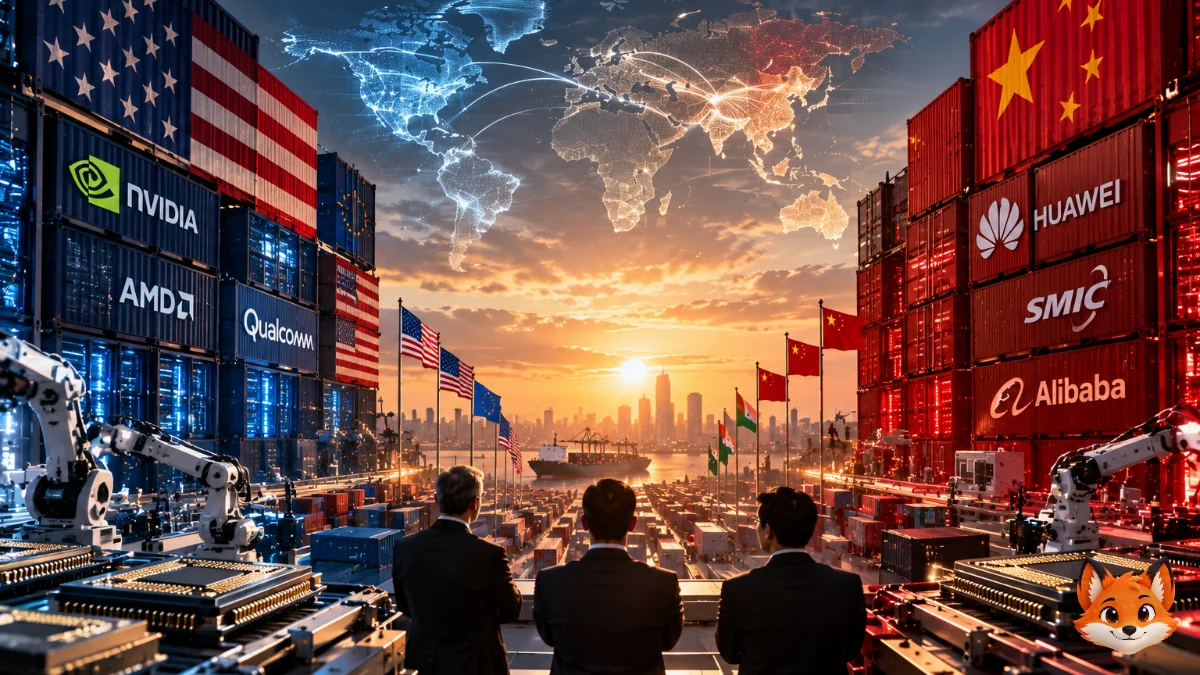
A handful of companies are gaining power over AI
 AI image
In short
- OpenAI, Anthropic and Nvidia spent a combined $5.8 million on lobbying in the third quarter of 2026.
- According to Stanford, industry produced more than 90 percent of notable frontier AI models in 2025.
- Politicians make the laws, but technology companies largely control which AI models people can access.
- Owning the smartest AI creates economic and political influence, but does not automatically give anyone control of the world.
OpenAI, Anthropic and Nvidia spent a combined $5.8 million on lobbying during the third quarter of 2026. For all three companies, that was their highest quarterly spending on record. They are building technology that changes how people work and how businesses operate, while also talking to the officials responsible for regulating it.
That raises an uncomfortable question. If a handful of companies eventually own the world's most capable AI, how much power will elected governments still have?
AI companies are spending more to influence policy
On October 22, 2026, The Verge reported the latest American lobbying figures. Nvidia spent $2.2 million, Anthropic spent $2.1 million and OpenAI spent $1.5 million between July and September.
Lobbying is the process of trying to persuade politicians and government officials to support particular policies. It is legal and widely practiced in Washington.
The interesting part is what happens when companies that face new regulations also have direct access to the people developing those regulations.
According to federal disclosures, OpenAI discussed copyright, oversight of advanced AI and cybersecurity. Anthropic raised issues including export controls and electricity costs for data centers. Nvidia discussed competition policy, exports and emerging technologies.
Each company has something at stake.
Strict requirements can increase operating costs. Favorable rules can help a company expand or protect its position against competitors.
Spending money on lobbying does not prove corruption or show that a company wrote a particular law. It does show that influencing government decisions has become valuable enough for these businesses to spend millions pursuing it.
The most advanced AI increasingly comes from industry
Stanford University's 2026 AI Index Report found that industry produced more than 90 percent of notable frontier AI models in 2025.
That tells us something about who controls technological progress.
Universities still contribute research and talent. But training the most advanced models requires expensive computing infrastructure, specialist teams and enormous amounts of capital.
Stanford reported approximately $285.9 billion in American private AI investment during 2025. Europe recorded about $20.9 billion, while China recorded $12.4 billion in private investment.
Those figures do not capture every source of funding. Government support plays a substantial role in China's technology sector, for example.
Still, the investment gap helps explain why American companies hold such a prominent position in advanced AI development.
What does that mean? A frontier AI model is a highly capable system that can perform tasks such as programming, analyzing documents and solving complex problems. As organizations build their services around these systems, they may become dependent on the companies that operate them.
Owning the technology gives companies power over access
Imagine a government using an AI model to examine thousands of documents. Or hospitals, banks and schools relying on the same provider for important software.
The provider gains influence without ever standing for election.
It decides which models customers can use, how much access costs and what restrictions apply. It can also change or discontinue a model.
That is commercial power, not the same thing as governing a country.
A technology company cannot pass a tax law or replace a court. But when an institution depends on one supplier, switching away becomes difficult and expensive.
There is another issue.
The organization operating an AI model sets many of its safety rules and decides how it responds to particular requests. Those choices can influence the information people receive and the tasks the software performs.
If millions of people rely on the same models, decisions made inside a private company can have effects far beyond its customers.
Who gets to challenge those decisions?
Europe is trying to regulate technology built elsewhere
The European Union has chosen to introduce its own framework through the AI Act.
Providers of general purpose AI models must maintain technical documentation and publish information about the content used to train their systems. Additional obligations apply to the most powerful models, particularly around safety risks and incident reporting.
From August 2, 2026, the European Commission can fully enforce the obligations for these providers, including through fines.
Brussels is therefore trying to regulate technology that is largely developed outside Europe.
But the situation is complicated.
European companies also depend on American technology to develop products, serve customers and compete internationally. Making access more difficult or expensive could affect those businesses too.
Regulation can protect people against misuse. It can also create compliance costs that established companies can afford more easily than smaller competitors.
The relevant question is not simply whether Europe should regulate AI.
It is whether those rules make the market safer without leaving even more power in the hands of the largest companies.
AI spending creates opportunities and risks for investors
Advanced AI is not just about software.
Companies need chips, electricity, data centers and networking equipment. They also need customers willing to pay enough to cover those expenses.
Stanford estimated global corporate AI investment at $581.69 billion in 2025. That total includes different forms of investment and acquisitions, not just spending on new models.
For investors, the distinction between technological progress and shareholder returns matters.
A company can build impressive technology while spending too much money to generate attractive profits. A chipmaker or electricity supplier may benefit from AI expansion without developing an AI model of its own.
In numbers: Suppose you invested €5,000 in a technology focused fund in 2026. If its value dropped by 20 percent, your holding would be worth €4,000. That is a paper loss of €1,000. Returning to €5,000 would then require a 25 percent gain. This is a mathematical example, not a reported market return.
Government decisions can also affect the economics of AI.
Export restrictions on advanced chips affect different businesses from copyright rules or privacy regulations. Higher electricity costs can change the profitability of data centers.
A spectacular AI demonstration therefore tells investors very little about the return they will eventually receive.
The smartest AI does not automatically create a world ruler
Could the person controlling the most advanced AI eventually become the most powerful person in the world?
The question deserves serious consideration.
AI can support scientific research, cybersecurity, military analysis and the development of new technologies. Companies and countries that lead in those areas may gain important advantages.
But powerful software is only one part of the equation.
AI companies depend on electricity, chips, data centers, employees, customers and access to international markets. Governments can restrict exports, regulate products and change procurement rules.
Leadership in AI performance is not permanent either.
Stanford's 2026 report described how American and Chinese models had exchanged leading positions across different technical evaluations.
Watch out: Having the best AI model does not give its owner unrestricted access to information or control over other systems. That depends on contracts, technical connections, permissions and laws. The greater concern is what happens when too many essential services rely on a single provider.
The bigger danger may not be one technology executive suddenly ruling the world.
It may be a gradual shift in which more decisions depend on systems that ordinary citizens cannot properly inspect or challenge.
Citizens need to know who makes the final decisions
The latest American lobbying figures show AI companies becoming more active in politics. Europe's AI rules show governments trying to limit some of that power.
Both developments are happening at the same time.
For citizens and investors, several questions deserve attention:
- Which companies provide the AI used by governments and major institutions?
- Which lobbying meetings take place before new regulations are adopted?
- Can customers switch providers when prices or terms change?
- Who is accountable when an AI system influences an important decision?
- Which businesses earn sustainable profits from AI, and which mainly spend money building it?
Building the smartest AI creates influence. Whether that influence turns into lasting power depends on how effectively governments, businesses and citizens can hold its owners accountable.
This is educational information, not financial advice.
Sources
- The Verge, OpenAI, Anthropic, and Nvidia had record lobbying quarters, October 22, 2026
- Stanford University, AI Index Report 2026
- Stanford University, AI Index 2026 Economy
- European Commission, General purpose AI obligations under the AI Act, 2025
- European Union, Regulation 2024/1689 on Artificial Intelligence