
Nvidia posts record revenue but loses its CEO
 AI image
In short
- Nvidia reported 115.8 billion dollars in revenue for the third quarter of fiscal 2027.
- Founder Jensen Huang resigned on November 12, with CFO Colette Kress appointed interim CEO.
- Reuters reports that smaller AI infrastructure companies could face more expensive financing following the leadership change.
- Nvidia shares closed at 155.46 dollars on November 17, while uncertainty over its leadership remains.
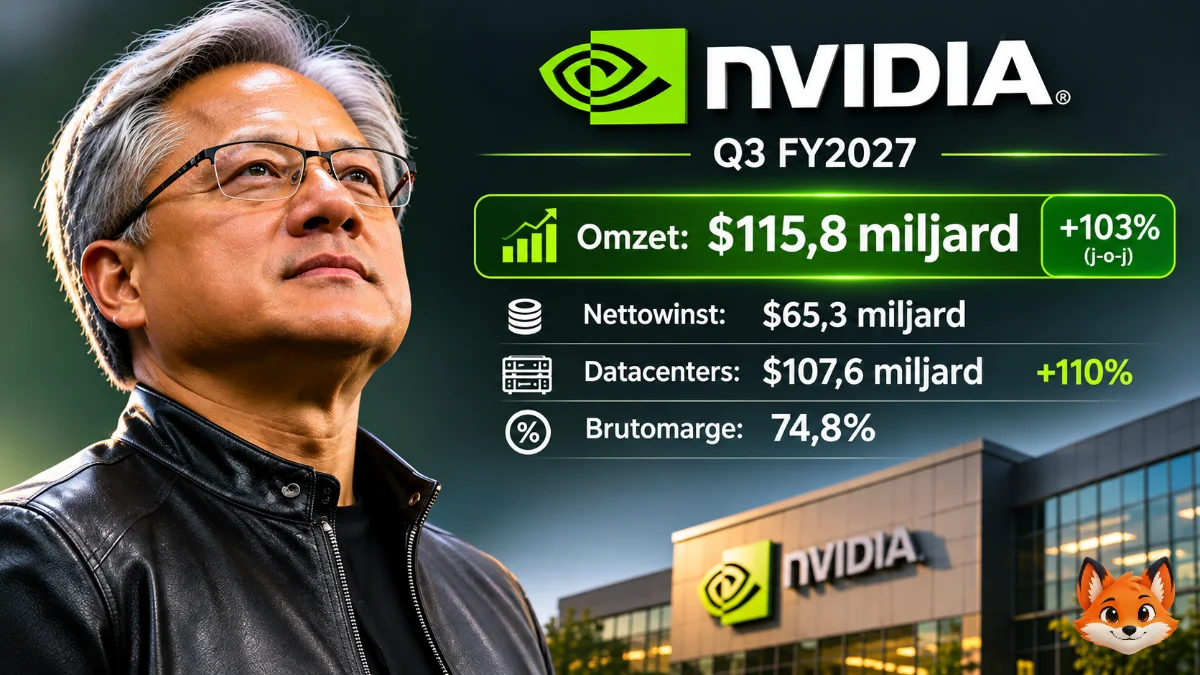
Nvidia generated 115.8 billion dollars in revenue during the third quarter of fiscal 2027. That is 103 percent more than a year earlier. But behind those record figures, something happened that may concern investors even more: founder and CEO Jensen Huang suddenly stepped down.
On November 12, Nvidia announced that Huang had resigned with immediate effect. Chief Financial Officer Colette Kress temporarily took over. One week later, the company presented its strongest quarterly results to date. The numbers are impressive. But who will shape the future of the world's most important AI chip company?
Nvidia is making more money than ever from the AI boom
The figures for the third quarter, which ended on October 25, 2026, show just how much demand for AI chips has grown.
Nvidia reported revenue of 115.8 billion dollars. In the same quarter a year earlier, revenue was 57 billion dollars. Net income under US accounting standards reached 65.3 billion dollars.
The data center business continues to expand as well. It generated 107.6 billion dollars, an increase of 110 percent year over year. This division supplies chips and systems used by companies to train and run large AI models.
Gross margin came in at 74.8 percent. This means Nvidia retains a large share of revenue after direct production costs, before paying other expenses.
What does that mean? A gross margin of 74.8 percent means that around 74.80 dollars of every 100 dollars in revenue remains after direct production costs. Salaries, research, sales expenses and taxes still have to be paid.
Nvidia is no longer just a chip manufacturer. It is a major part of the infrastructure behind global AI investment. That position makes the next development particularly interesting.
Jensen Huang leaves at a remarkable moment
Jensen Huang led Nvidia for 33 years. Under his leadership, the company transformed from a graphics chip manufacturer into a central player in the AI industry.
On November 8, the board announced an independent investigation following reports that Huang had been targeted in a foreign intelligence operation. The board said it had no indication that national security or company secrets had been compromised.
Four days later, Huang resigned. Nvidia did not say that his departure was directly connected to the investigation. Claiming a direct connection would therefore be speculation.
Colette Kress was appointed interim CEO. She has served as Nvidia's CFO since September 2013 and will lead the company while the board searches for a permanent successor.
The timing is remarkable. Nvidia currently has enormous influence over the development of artificial intelligence. The question is not simply who will become the next CEO, but whether that person will be willing to take the same business risks.
The stock market reacts to more than quarterly results
A good quarter does not automatically mean a rising share price. Investors also consider expectations, valuation and uncertainty.
On November 17, Nvidia shares closed at 155.46 dollars. That was 0.44 percent below the previous trading session. Historical market data also showed the share price was approximately 16.69 percent lower than a year earlier.
In numbers: Suppose you had invested 1,000 euros in Nvidia shares a year earlier and experienced that 16.69 percent price decline. Your investment would now be worth approximately 833.10 euros. That is a loss of 166.90 euros, excluding currency movements, fees and taxes.
The share price shows that even a company reporting record revenue does not necessarily have a rising stock price. A share price also reflects what investors expect from the future.
European investors face another factor: the dollar. Nvidia shares are quoted in US dollars. Changes in the exchange rate between the dollar and the euro therefore affect the final return in euros.
Smaller AI companies are feeling the pressure too
The leadership change could affect more companies than Nvidia alone.
According to Reuters, investors are concerned about the financial support Nvidia provides to certain partners. This includes financing, guarantees and agreements under which Nvidia purchases unused computing capacity from its partners.
One important example is CoreWeave. The company builds data centers using Nvidia chips and rents computing capacity to AI businesses.
Reuters reported on November 17 that CoreWeave bonds issued in June at a yield of 9.625 percent were now yielding nearly 15 percent. This points to falling bond prices and a higher return demanded by investors.
CoreWeave shares had also fallen approximately 45 percent since the Nasdaq's record on October 6.
Watch out: A higher bond yield does not mean a higher profit for the investor. Yields often rise because bond prices fall. This can indicate that investors see a greater risk of the issuer failing to meet its obligations.
Reuters also highlighted Nebius. Convertible bonds issued by this AI infrastructure company fell to around 70 cents on the dollar. Their yields climbed above 12 percent.
Nvidia also has an agreement with CoreWeave under which it purchases 6.3 billion dollars of unused capacity. According to Reuters, the agreement runs until April 2032.
That makes Huang's successor relevant to the wider AI market. A new CEO may take a different approach to financial risk and support for smaller partners.
Nvidia has set another ambitious revenue target
Nvidia is already looking ahead.
For the fourth quarter of fiscal 2027, the company expects revenue of approximately 130 billion dollars, plus or minus 3 percent.
That is another enormous figure. At the same time, Nvidia is not assuming any data center computing revenue from China in this forecast.
The company has also put a new product in the spotlight: the Vera Rubin NVL72 system. Nvidia says the first systems have already shipped.
New chips, expanding data centers and substantial investments keep demand for Nvidia products at the center of the AI industry. But financial results do not tell the entire story.
One important question is how much money customers actually make from the AI applications they build using this infrastructure. If those investments fail to deliver sufficient returns, their willingness to keep purchasing more chips could change.
Investors need to separate three different developments
Anyone following Nvidia should distinguish between three separate issues.
- Revenue and profits show how the company is performing today.
- The share price also reflects expectations about future growth and risk.
- A CEO transition may affect strategy and financial agreements with partners.
The final point deserves particular attention. Huang was the public face of Nvidia for decades. His departure means the market must reassess its confidence in the company's next chapter.
Readers who followed our earlier coverage of Jensen Huang's departure from Nvidia can now see how quickly the leadership issue has coincided with fresh record results.
Questions worth asking
- How will Nvidia's revenue develop over the coming quarters?
- Who will become Jensen Huang's permanent successor?
- Will Nvidia continue providing financial support to smaller AI infrastructure companies?
- How much return are customers actually generating from their AI investments?
- How much does the dollar affect returns for European shareholders?
This article is provided for educational purposes only and does not constitute financial advice.
Sources
- NVIDIA, Financial Results Third Quarter Fiscal 2027, November 17, 2026
- NVIDIA, Announcement of CEO Transition, November 12, 2026
- SEC, NVIDIA Form 8-K, November 17, 2026
- Reuters, Nvidia turmoil marks the end of easy money for the AI trade, November 17, 2026
- Financial Times, NVIDIA historical share performance, November 17, 2026
- ECB, Euro foreign exchange reference rates, November 17, 2026