Greta admits the climate fight was about capitalism
 AI image
In short
- Greta confirmed in November 2026 that overthrowing capitalism was a goal from the beginning.
- We Don't Have Time helped publicise her protest and connected her with journalists in 2018.
- The Greta Thunberg Foundation was established by her parents in 2019 and reports receiving 1,235,000 euros in prize money.
- The climate movement has developed into a political movement pursuing wider economic and social change.
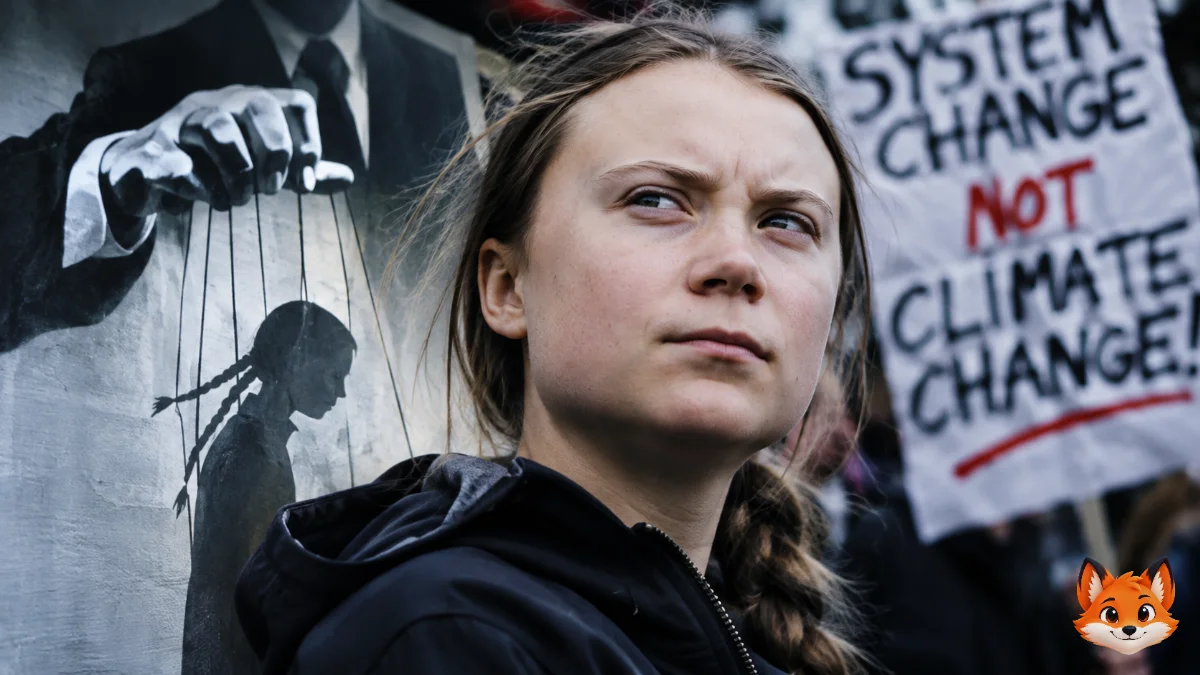
From a girl holding a cardboard sign outside the Swedish parliament to a global political symbol. Greta Thunberg spent years representing a movement presented as a fight to save the climate. On 17 November 2026, a video emerged in which she confirmed that overthrowing capitalism had been a goal from day one. That changes the discussion.
Greta is now speaking openly about a different goal
In the short video, Greta says:
"Now they want to overthrow capitalism. Yeah, we wanted that from day one."
She is responding to comments about the radicalisation of activists and accusations that they support terrorist groups.
The clip is short. The full original recording and context matter when interpreting its precise meaning. But the words themselves are striking.
This is no longer just about cleaner energy, lower emissions or protecting nature. It is also about changing the economic system.
That is a political agenda.
Greta had already criticised capitalism before this statement. In her 2019 United Nations speech, she questioned economic growth and accused politicians of putting money ahead of future generations.
Her November 2026 statement brings that ideological direction back into focus.
A fifteen year old became a global figure remarkably quickly
On 20 August 2018, fifteen year old Greta began her school strike outside the Swedish parliament.
According to Fridays for Future, she started alone. Other students joined her and the movement spread internationally.
But a global movement does not grow through a photograph of a girl holding a sign alone.
It needs communications, contacts, organisations and people who can spread a message.
One interesting name from the early days is We Don't Have Time. Its founder, Ingmar Rentzhog, was among the first people to report on Greta's protest.
In February 2019, the organisation itself confirmed that it had promoted her protest through social media and connected her with journalists and other contacts in its network.
Greta also served as a youth advisor to the organisation's foundation between November 2018 and January 2019.
There is an interesting detail here.
We Don't Have Time was not simply an activist group. It operated through a combination of a commercial company and a foundation. The company generated revenue, including from advertising, while the foundation received at least 10 percent of profits for climate initiatives.
This does not prove that the organisation controlled Greta. It does show that commercial and activist interests met early in the movement's development.
A financial network also exists behind Greta
The Greta Thunberg Foundation was established in 2019 by her parents, Malena Ernman and Svante Thunberg, because Greta was still a minor.
The foundation manages money from awards, royalties and donations and distributes it to organisations and projects.
According to its own financial information, the foundation had received a total of 1,235,000 euros in prize money by October 2025. It reports that the entire amount had been distributed to charities and projects.
There are concrete examples.
- Greenpeace received funding for climate initiatives.
- 350.org received support for climate justice.
- The Stop Ecocide Foundation received support for its work towards making ecocide an international crime.
- The foundation also funded organisations working on human rights and social justice.
According to the foundation, Greta is not a board member and does not receive a salary.
This is not evidence of a hidden financier pulling the strings. It does show that her name, public profile and awards have become part of an organised network pursuing political and social change.
Who benefits? The organisations involved receive money, visibility and access to a global audience.
The climate message has become a fight against the system
This is where the main contradiction lies.
A cleaner environment is a goal that people with different political beliefs can support. But when climate policy becomes linked to overthrowing capitalism, the nature of the movement changes.
It now involves property, economic growth, businesses, energy supply and the role of government.
These are political choices, not simply technical climate questions.
The consequences can be substantial.
Consider a factory that depends on affordable electricity and gas. If policies increase energy and production costs, its competitive position comes under pressure. If the company moves production abroad, global emissions do not simply disappear. Production happens somewhere else.
This raises an uncomfortable question: how much economic damage should society accept in the name of climate policy, and who ultimately pays?
Ordinary households do not automatically benefit from the transition
Supporters of a rapid energy transition point to the need to reduce fossil fuel consumption. However, energy must also remain affordable and reliable.
A household on a modest income gains little from a political ideal if the energy bill becomes increasingly difficult to pay.
Workers in industries dependent on fossil energy also need a realistic transition.
The consequences of climate policy are not distributed equally.
Large companies often have more options to adjust investment, locations and production costs. Ordinary employees have far less freedom.
That is a serious criticism of activism demanding major economic changes without always explaining who pays for the transition.
Is Greta a puppet or an independent activist?
The question of who Greta really represents is understandable.
She has gained access to international politicians, media organisations, conferences and influential groups. Her public profile has also helped channel financial resources towards climate organisations.
But there is a difference between a network supporting someone and a network controlling that person.
There is no convincing publicly available evidence that Greta is a paid puppet of a specific billionaire, political party or organisation.
That does not make criticism of her political agenda any less relevant.
Her own statements provide enough material for a serious debate. There is no need to invent a secret handler when the activist herself openly discusses systemic change.
The wolf in sheep's clothing is a strong metaphor. But the question of whether a movement presented itself primarily as a climate campaign while pursuing a much wider economic agenda deserves serious attention.
What has the movement actually achieved?
Fridays for Future has involved millions of young people in the climate debate. That is a measurable achievement.
But the wider social balance is more complicated.
Interrupting lessons, blocking roads and disrupting events have also generated opposition. The increasingly radical political message makes it harder to bring people with different political views to the same table.
A movement claiming to represent everyone must also allow debate about its methods and the cost of its goals.
The central criticism is therefore not that Greta is involved in politics. That is her right.
The criticism is that a movement which began for many people as a call to protect the planet has also become an ideological campaign against the economic system on which much of our prosperity is built.
That deserves a much more honest debate than simply counting the likes on a protest photograph.
Questions worth asking
- Why was the movement's economic agenda not presented as clearly as its climate goals from the beginning?
- Which organisations receive money, influence and visibility through the activism?
- Who pays when climate policies increase energy and production costs?
- Is there room for people who take climate change seriously but disagree with Greta's political agenda?
- Who checks the results of organisations using her name and public profile?
This article is a critical political and economic analysis, not financial advice.