
EU tells TikTok to change its recommendation algorithm
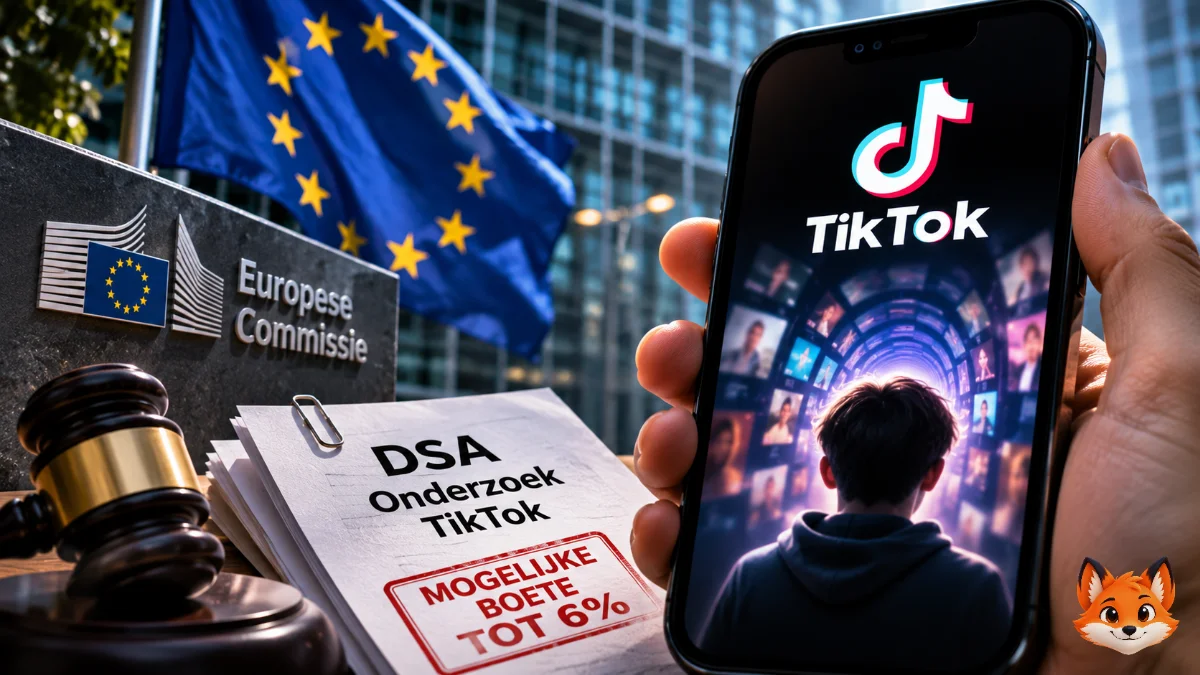 AI image
In short
- The European Commission preliminarily finds that TikTok's recommendation system breaches the Digital Services Act.
- Users may repeatedly see videos about sadness, isolation and body image.
- TikTok says it reaches 189 million people per month in the European Union.
- A confirmed breach could lead to a fine of up to 6 percent of global annual turnover.
On November 6, 2026, Brussels put TikTok under renewed pressure. The European Commission preliminarily found that the app's recommendation system breaches the EU Digital Services Act. The issue is not limited to individual videos. It concerns what TikTok continues to recommend afterwards. Users can end up in an endless stream of similar and sometimes harmful videos.
The Commission calls this the rabbit hole effect. Someone who watches several videos about sadness, loneliness or body image may then receive more and more similar content. The Commission says minors and vulnerable adults are particularly at risk.
Brussels is focusing on the For You feed
The For You feed is the screen where TikTok recommends personalised videos. Its algorithm looks at what you watch, what you interact with and which content holds your attention. It then tries to predict which video you may want to see next.
That system makes TikTok attractive. You do not have to search for new videos yourself. The app keeps filling the feed automatically. But that is exactly where Brussels sees a problem.
Someone who watches a few videos about losing weight may then receive more videos about weight, appearance and dieting. A person watching content about sadness or loneliness may enter a similar stream. Recommendations can keep reinforcing the same subject.
The Commission says TikTok did not properly assess these risks and failed to take sufficient steps to reduce potential harm. The case is about how the system works, not one particular video that happens to be online.
The algorithm can create a tunnel of similar videos
A recommendation system learns from behaviour. If you watch a video to the end, replay it or interact with it, the system may interpret that as interest. It can then show you more videos on similar subjects.
That is not always a problem. Someone who enjoys cooking videos may appreciate seeing more recipes. Sensitive topics are different. Repeated exposure to content about body image or mental health may push viewers further in one direction.
The Commission specifically mentions sadness, isolation and body image. The risk is greater for people who are already vulnerable. For minors, there is an additional concern: they are still developing their self image and online habits.
What does that mean? A rabbit hole is a digital trap. You watch one subject and the algorithm keeps recommending similar content. It can become harder to leave that stream or discover different topics.
The Not Interested button does not solve the problem
TikTok already gives users ways to influence their feed. For example, users can say that they are not interested in a video. The app also offers screen time settings and parental controls.
The European Commission says these measures are not sufficient. The option to reject content does not appear to have enough influence on recommendations. The Commission wants TikTok to give more weight to preferences that users explicitly select.
The platform should also rely less heavily on viewing time when making new recommendations. In addition, settings that let users influence their feed should be easier to find and more effective.
That could noticeably change the app. If viewing time becomes a weaker signal, the order of recommended videos may change. TikTok would need another way to decide what is relevant to each user.
TikTok reaches 189 million people per month in the EU
The debate affects a huge audience. In its transparency report published on August 31, 2026, TikTok said it reached 189 million people per month across the European Union. That figure covers the first half of 2026.
During the same period, TikTok said it removed around 104 million pieces of content that violated its own rules. This includes videos, comments, advertisements and other content. The figure does not, by itself, prove that the recommendation system is safe.
These figures come from TikTok itself. The company has an interest in presenting its safety policies positively. Still, they show the scale of the responsibility when a recommendation system reaches so many people every day.
ByteDance faces a potential fine of up to 6 percent of revenue
TikTok is owned by ByteDance. The Digital Services Act allows the European Commission to impose a fine of up to 6 percent of worldwide annual turnover if a breach is ultimately confirmed.
That is the legal maximum, not a fixed amount TikTok automatically has to pay. The Commission must complete the procedure first and consider factors including the seriousness and duration of the infringement.
In numbers: Suppose a company has worldwide annual revenue of €1 billion. Six percent would amount to a maximum of €60 million. This is a calculation only, not an estimate of ByteDance's revenue or a possible fine for TikTok.
There is an important distinction for investors. ByteDance is not publicly listed. There is no ordinary stock market price for TikTok or ByteDance that retail investors can follow directly in response to this case. Any potential fine would initially affect the company itself.
TikTok gets a chance to respond first
The findings published on November 6 are preliminary. TikTok can access the investigation documents and submit a written response. The European Board for Digital Services will also be consulted.
The Commission will then assess whether its objections stand. If it ultimately confirms a breach, it can require TikTok to change the system and impose a fine. TikTok can challenge a final decision before the EU courts.
This is not the first investigation into TikTok's design. On February 6, 2026, the Commission issued preliminary findings about addictive features such as infinite scroll, autoplay and notifications. The new case focuses more specifically on how recommendations lead users towards increasingly similar content.
Read also The US China AI battle also affects Europe. It shows how European rules are gaining influence over major technology companies.
The outcome could affect other platforms
This case goes beyond TikTok. The European Commission is also examining recommendation systems on other major social platforms. The way platforms rank and present content is becoming an increasingly important subject for regulators.
For users, the practical questions are straightforward:
- Can you reset your recommendations?
- Can you tell the platform which topics you want to see less often?
- Can you easily switch off notifications and autoplay?
- Do you understand why a particular video keeps appearing?
The outcome of the procedure is not yet final. What is clear is that Brussels is looking beyond the content a platform removes. It is also examining how a platform actively pushes content towards its users.
This article is for educational purposes and is not financial advice.
Sources
- European Commission, Commission preliminarily finds TikTok’s For You feed in breach of Digital Services Act for harmful rabbit holes, November 6, 2026
- European Commission, Commission preliminarily finds TikTok's addictive design in breach of the Digital Services Act, February 6, 2026
- European Union, Digital Services Act, Regulation 2022/2065
- European Parliament, Addictive design on online platforms, May 4, 2026
- TikTok, Digital Services Act: Our seventh transparency report on content moderation in Europe, August 31, 2026