
AI speeds up cancer research, but cannot cure it yet
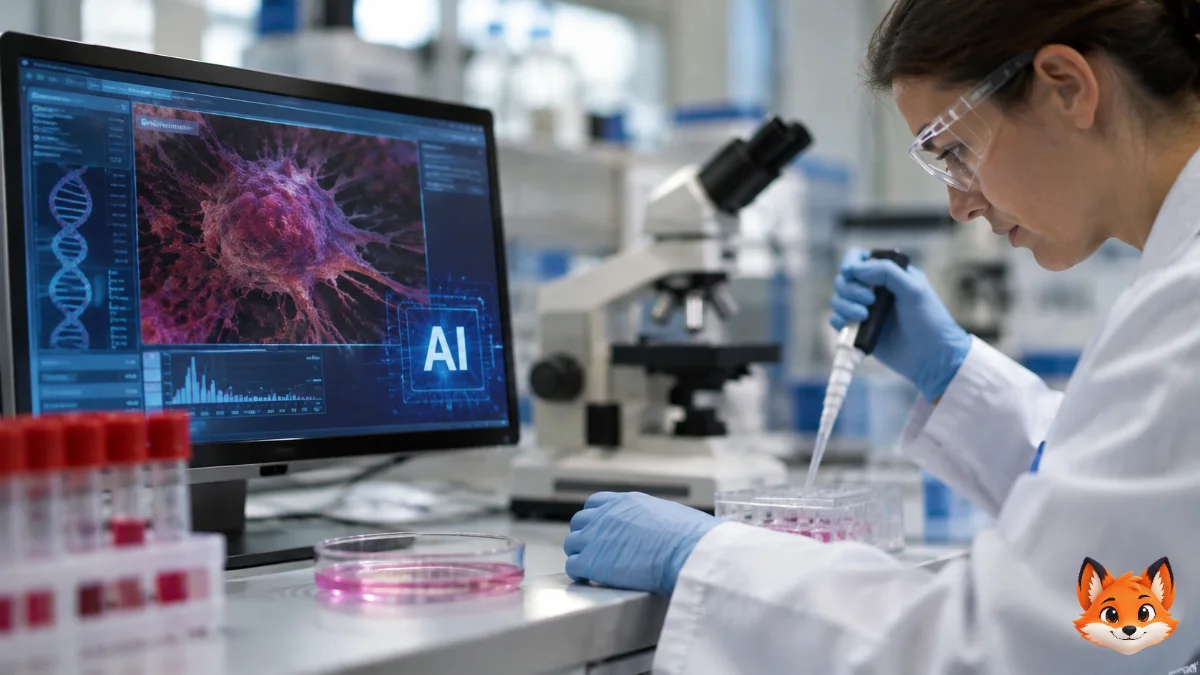 AI image
In short
- Anthropic CEO Dario Amodei believes AI could help overcome major diseases such as cancer within ten years.
- Claude has already delivered measurable results in designing and improving potential medicines.
- Most AI assisted drug research is still at an early stage.
- Laboratory results do not prove that a treatment works in humans.
On November 11, 2026, Dario Amodei made a remarkable statement. According to the CEO of Anthropic, the company behind Claude AI, cancer, Alzheimer's, heart disease and mental illness could become things of the past within ten years. His words sound like science fiction. But behind the statement is a development that is beginning to take shape: artificial intelligence is actively helping researchers develop medicines.
The question is how much of this has actually been proven. And whether ten years is a realistic timeframe.
Amodei expects a medical breakthrough within ten years
Amodei made his statement during a presentation for investors. He argued that AI could allow humanity to solve medical problems that scientists have struggled with for generations.
He described cancer, Alzheimer's, heart disease and mental illness as conditions that could become relics of the past in less than a decade.
That is a bold statement. Cancer is not a single disease. It is an umbrella term covering hundreds of different conditions in which cells grow uncontrollably.
According to the US National Cancer Institute, an estimated 2,041,910 new cancer cases would be diagnosed in the United States in 2025. The institute estimated that 618,120 people would die from cancer in the same year.
That puts the potential impact into perspective. A genuine breakthrough could change millions of lives.
However, Amodei is also presenting a vision of the future. As an AI company, Anthropic has an interest in demonstrating the potential social value of its technology. That does not automatically make his statement wrong, but it does deserve scrutiny.
Claude is already producing results in real laboratories
The interesting part is that Anthropic is not simply talking about possibilities. On October 27, 2026, the company published a detailed account of its work in medical research.
Anthropic is now working with six organisations involved in developing medicines. These include Bristol Myers Squibb, Generate Biomedicines and BigHat Biosciences.
The results are striking.
At Generate Biomedicines, Claude helped researchers design new genetic instructions for a CAR T cell treatment. This is a form of therapy in which the immune system is modified to attack cancer cells.
One design was approximately 70 percent shorter than the existing version. In laboratory tests, the modified immune cells produced around ten times as many receptors. These proteins help the cells recognise their targets.
BigHat Biosciences also reported results. Researchers created and tested approximately 1,010 variants of two potential medicines in around ten weeks.
The best versions bound to their targets more than ten times as strongly as the original versions.
These are concrete research results. But there is an important qualification.
What does that mean?
A medicine that performs well in a laboratory is not automatically a treatment that patients can use. Researchers must first demonstrate that it is safe and actually works in the human body. This requires several stages of testing.
The first results are impressive, but they are not cures
Anthropic published further results.
In a partnership with Divergence Labs, Claude generated approximately 35,000 antibody designs in about one month. Researchers selected candidates for further testing.
At Enveda, Claude helped review technical and medical documentation. According to Anthropic, a test covering 1,061 pages identified all eleven issues previously found by human reviewers. It also detected seven additional issues.
The time required for human review fell by 89 percent, according to the company.
This demonstrates where AI is already adding value. It can help researchers process information faster, design molecules and identify promising research directions.
But pay attention to the distinction. These results were published by Anthropic itself. Independent clinical confirmation of these specific applications is a different matter.
Anthropic also acknowledges that most of its medical research remains at the preclinical stage. This means that the medicines are generally not yet being tested in humans.
Research shows how far AI medicines have actually progressed
Anthropic is not the only company exploring the potential of AI in pharmaceuticals.
A scientific study published in 2026 examined 129 medicines discovered or developed with the help of AI that had entered human clinical trials.
These medicines came from 69 different companies.
Of this group, 72 medicines had completed Phase 1 and 24 had completed Phase 2. Only five had reached or entered Phase 3.
That final number matters. Phase 3 generally involves large patient groups and aims to establish whether a treatment actually works and is sufficiently safe.
The figures show that AI is already playing a real role in medicine development. At the same time, most of this new generation of medicines remains relatively early in the process.
Science still has a considerable distance to cover before these medicines become available in hospitals.
Developing a medicine remains a complicated process
Why does developing a medicine take so long?
A computer can analyse thousands of molecules. But the human body is not a computer model.
A substance that kills cancer cells in a laboratory may also damage healthy cells. A medicine can also behave differently inside the body than researchers initially expect.
This is why a new medicine goes through several stages:
- Preclinical research: researchers test a substance in laboratories and other suitable research models.
- Phase 1: the first human studies mainly examine safety and tolerability.
- Phase 2: researchers investigate whether the medicine works and what dosage is appropriate.
- Phase 3: larger patient groups are studied to further establish effectiveness and safety.
- Approval: regulators assess the complete evidence before a medicine becomes available.
AI can accelerate several parts of this process. This includes selecting molecules, analysing research data and preparing clinical trials.
But AI cannot simply predict the biological reactions of a human body as if they were a fixed mathematical calculation.
The US Food and Drug Administration and the European Medicines Agency jointly published guidelines for the responsible use of AI in drug development in January 2026.
They emphasise that medicines must still meet requirements for quality, effectiveness and safety. AI does not change those requirements.
AlphaFold shows what artificial intelligence can actually achieve
There is a reason why scientists and technology companies have so much confidence in AI.
A good example is AlphaFold from Google DeepMind.
This system predicts the three dimensional structures of proteins. Proteins play an important role in almost every biological process in the human body.
In 2022, DeepMind and the European Bioinformatics Institute made more than 200 million predicted protein structures available to researchers.
That was a major scientific advance. Researchers gained access to information that previously could have required years of work.
AlphaFold demonstrates that AI can genuinely transform scientific research.
But predicting a protein structure is very different from curing a disease. Cancer involves genetic changes, the immune system and the environment surrounding tumour cells.
There is no single solution that automatically works for every type of cancer.
The ten year promise remains an expectation for now
We need to separate two developments.
On one hand, AI is becoming increasingly capable of supporting scientific research. Anthropic's results show that Claude is no longer just generating text. It is taking a practical role in designing and improving potential medicines.
On the other hand, there is no evidence that this development will eliminate all major forms of cancer within ten years.
The history of cancer research also shows how difficult this challenge is. The United States launched its War on Cancer in the 1970s. Since then, medicine has made enormous progress, but cancer remains a major cause of death.
That does not mean Amodei will be proven wrong. It means his statement remains an expectation rather than an established scientific result.
Perhaps the most interesting development is not the prediction itself. It is the fact that AI is now actively contributing to research that previously required considerably more human time and resources.
At BitFox, we also follow the influence of AI on major technology companies and the balance of power within the industry. We previously examined the power struggle surrounding AI and the influence of major technology companies.
Questions to ask before believing the promise
- Do the results come from laboratory experiments or human clinical trials?
- Has an independent research institution confirmed the findings?
- Has a medicine actually demonstrated that it is safe and effective?
- Does the statement concern one specific type of cancer or all forms?
- Who funds the research and what commercial interest does that organisation have in the results?
The coming years will be interesting. AI has established a place in medical research, but there is still a long scientific journey between a promising laboratory result and a medicine that saves lives.
This article is for educational purposes only and does not constitute medical or financial advice.
Sources
- NDTV, Cancer Will Be History In 10 Years: Anthropic CEO's Big Promise, November 11, 2026
- Anthropic, Early Progress on Accelerating Drug Development with Claude, October 27, 2026
- National Cancer Institute, Cancer Statistics
- FDA and EMA, Guiding Principles of Good AI Practice in Drug Development, January 2026
- FDA, Considerations for the Use of Artificial Intelligence in Drug Development, January 2025
- PubMed, Artificial Intelligence Enabled Drug Discovery: A Growing but Largely Early Stage Clinical Pipeline, 2026
- Google DeepMind, AlphaFold