Your tap water is clean, but what is still in it?
 AI image
In short
- More than 99.9 percent of Dutch drinking water measurements meet legal standards.
- The RIVM recommends a stricter health based guideline for PFAS than the current legal limit.
- Most medication residues are removed, but not always completely.
- A properly certified water filter can further reduce exposure to certain unwanted substances.
In the Netherlands, you turn on the tap and fill a glass without thinking twice. According to the government, more than 99.9 percent of drinking water measurements meet legal requirements. Yet the Dutch public health institute RIVM makes another point: the quality of drinking water sources is under pressure.
PFAS, medication residues, pesticides and industrial chemicals enter the environment. Water companies remove much of this contamination, but not every substance disappears completely. Is tap water still the best option, or does an additional home filter make sense?
Legal limits do not tell the whole story
Dutch tap water has an excellent international reputation. For good reason. Water companies continuously test supplies and use advanced treatment methods.
In 2024, 99.84 percent of Dutch drinking water measurements complied with legal quality requirements. The government reports more than half a million checks every year.
That sounds excellent. But there is a difference between meeting a legal limit and aiming to reduce unwanted substances as much as possible.
Take PFAS. These are chemicals that break down very slowly and can remain in the environment for a long time.
According to the RIVM, the legal limit for a group of 20 PFAS substances is 100 nanograms per litre of drinking water. The institute now recommends a stricter health based guideline of 4.4 nanograms per litre, expressed as PFOA equivalents.
That is a substantial difference.
What does that mean? A legal limit is the maximum amount permitted under the law. A health based guideline is a stricter scientific benchmark intended to keep health risks as low as possible. These are different assessment systems, so the figures should not be compared as if they were identical measurements.
PFAS is not the only substance entering water sources
The Netherlands obtains approximately 60 percent of its drinking water from groundwater and 40 percent from surface water.
Rivers present a particular challenge. Water from the Rhine and Meuse carries substances originating in several countries. The Dutch Human Environment and Transport Inspectorate commissioned Utrecht University to investigate PFAS levels in these rivers.
The findings were striking. The measured PFAS concentration in the river water was 4 to 7 times higher than the RIVM's recommended guideline for drinking water.
The water can still legally be used to produce drinking water. However, current treatment does not remove enough PFAS to bring concentrations below the stricter health based guideline.
That deserves attention.
Medication residues also enter water sources. These include painkillers, diabetes medication and other medicines that reach surface water through wastewater.
The RIVM says that the concentrations eventually found in Dutch drinking water are currently so low that health effects are not expected. That is reassuring, but it does not mean every residue is completely removed.
Chlorine treatment differs between the Netherlands and Spain
People living in the Netherlands are generally not familiar with a noticeable chlorine taste in their tap water. There is a reason for that.
Under normal conditions, the Netherlands does not use chlorine to disinfect drinking water. Other methods, including ozone, UV treatment and filtration, play a role.
Spain takes a different approach. Drinking water disinfection is compulsory, and a residual amount of disinfectant must remain in the distribution system.
The Spanish Ministry of Health reported that sodium hypochlorite was used in 46 percent of registered treatment processes in 2024. This is a commonly used form of chlorine treatment.
That does not mean Spanish tap water is unsafe. It uses a different treatment approach.
The Netherlands, Germany and Spain all report good results
How does the Netherlands compare with other European countries?
| Country | Official figures | What stands out? |
|---|---|---|
| Netherlands | 99.84 percent in 2024 | Very high compliance with standards |
| Germany | More than 99 percent in 2020 to 2022 | Good to very good water quality |
| Spain | 99.3 percent in 2024 | High compliance in water analyses |
These figures come from national governments and regulators. Measurement methods and reporting periods differ, so they do not create a definitive ranking.
One thing is clear: tap water is generally well monitored in all three countries. Differences mainly concern water sources, local infrastructure and treatment methods.
In Spain, taste can also vary by region because of the water source, mineral content and disinfection method.
Filtering your own water adds another treatment step
Here is the interesting part. Why use a home filter if the water already meets legal standards?
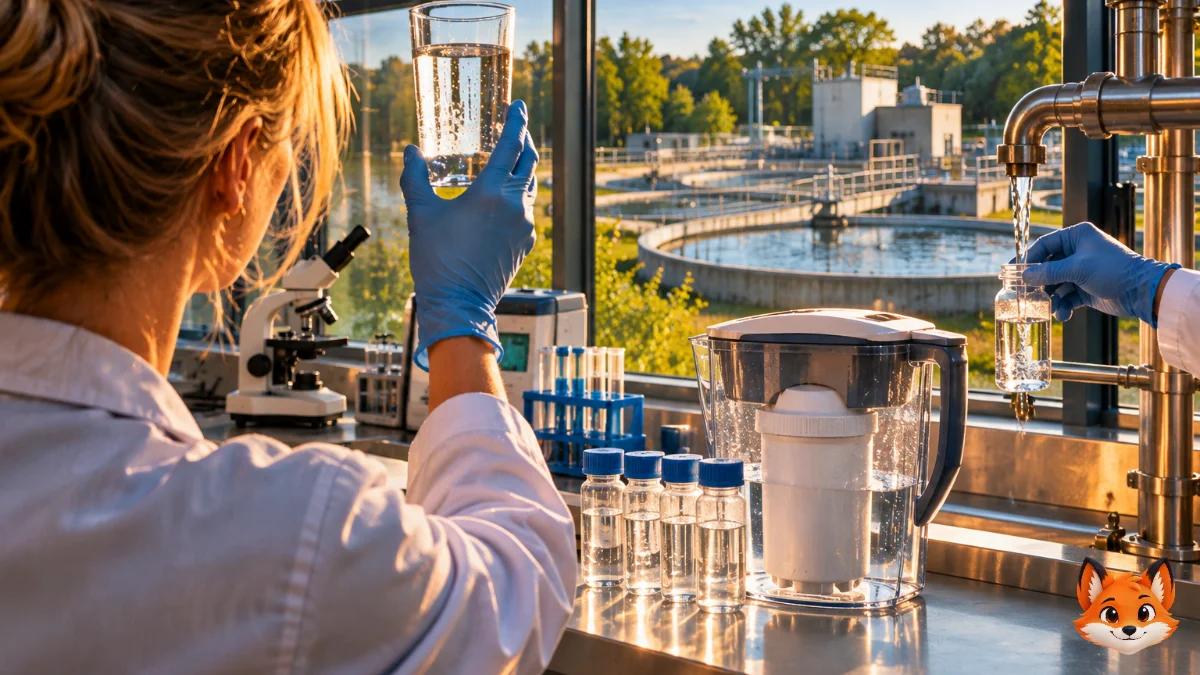
Because a properly selected filter can further reduce certain substances. It adds another treatment step between the water supply and your drinking glass.
There are several technologies:
- Activated carbon: can reduce certain organic compounds, chlorine and substances affecting taste.
- Reverse osmosis: uses a membrane to reduce certain PFAS, salts and other dissolved substances.
- Ion exchange: uses specialised resins to remove certain dissolved substances from water.
The US Environmental Protection Agency has published research showing that certain activated carbon, ion exchange and reverse osmosis systems can reduce PFAS levels.
But not every filter does the same job.
Watch out: An inexpensive filter jug does not automatically remove PFAS, medication residues and every other unwanted substance. Look for independent certification and check which specific substances the system has been tested to reduce.
For PFAS, the EPA identifies NSF/ANSI 53 and NSF/ANSI 58 certifications as relevant standards. Always check whether the certification covers the specific PFAS you want to reduce.
A filter only works properly when you maintain it
A filter that has not been replaced for months may lose its effectiveness. You could end up paying for a system that no longer performs as intended.
Reverse osmosis also has disadvantages. Alongside filtered water, the system produces wastewater. According to the EPA, some systems studied can produce approximately one litre of wastewater for every litre treated.
Reverse osmosis also removes minerals. That is not necessarily an immediate health problem, but it is worth considering when choosing a system.
Boiling water does not remove PFAS or medication residues either. Boiling kills certain pathogens, but it does not remove these chemical substances.
What makes sense?
- Check the quality report from your local water supplier.
- Find out which substances receive additional attention in your area.
- Choose a filter with independent certification for the substances you want to reduce.
- Follow the replacement schedule carefully.
- If you have concerns, have water from your own tap tested, particularly if your property has old pipes.
Your drinking glass deserves more attention
Dutch drinking water is good. Official measurements support that conclusion. But problems at the source have not disappeared.
PFAS remain in the environment. Medication residues reach surface water, and treatment systems have to deal with an increasing range of substances.
A household filter does not replace a reliable public drinking water supply. It does provide an additional layer of treatment that can reduce certain unwanted substances further.
The assumption that everything coming out of the tap is automatically completely clean deserves a closer look.
Questions worth asking
- Which PFAS substances are measured in my drinking water area?
- Does my water supplier use groundwater or surface water?
- Does my filter demonstrably reduce PFAS and medication residues?
- When should I replace my filter?
- How is water quality monitored inside my own property?
This article is educational information and is not medical advice.
Sources
- RIVM, PFAS in drinking water, current information
- RIVM, Drinking water quality, updated January 20, 2026
- RIVM, Effects of medicines on drinking water and water sources
- Human Environment and Transport Inspectorate, PFAS in the Rhine, Meuse and drinking water, February 29, 2024
- Dutch Government, Protecting drinking water quality
- Spanish Ministry of Health, Drinking water quality report 2024
- German Environment Agency, Drinking water quality in Germany, April 8, 2025
- US EPA, Identifying Drinking Water Filters Certified to Reduce PFAS, November 18, 2025