Tesla's flying Roadster is spectacular, but who pays?
In short
- Tesla revealed a new Roadster on October 15, 2026, featuring rocket style thrusters developed with SpaceX.
- Production is planned for 2028, although the next generation was first announced in 2017.
- Reuters reports reservation deposits of $50,000 for the Performance version and $250,000 for the Thrust version.
- The demonstration may strengthen Tesla's image, but it does not prove that the technology is suitable for everyday road use.
An electric car that twists through the air, jumps over vehicles and drives upside down on a track. On October 15, 2026, Tesla demonstrated just how far it wants to push the new Roadster. The event looked more like a science fiction film than a conventional car launch. But the real question is not how spectacular the car looks. It is whether this technology can ever become practical and affordable.
Tesla has turned the Roadster into a flying showpiece
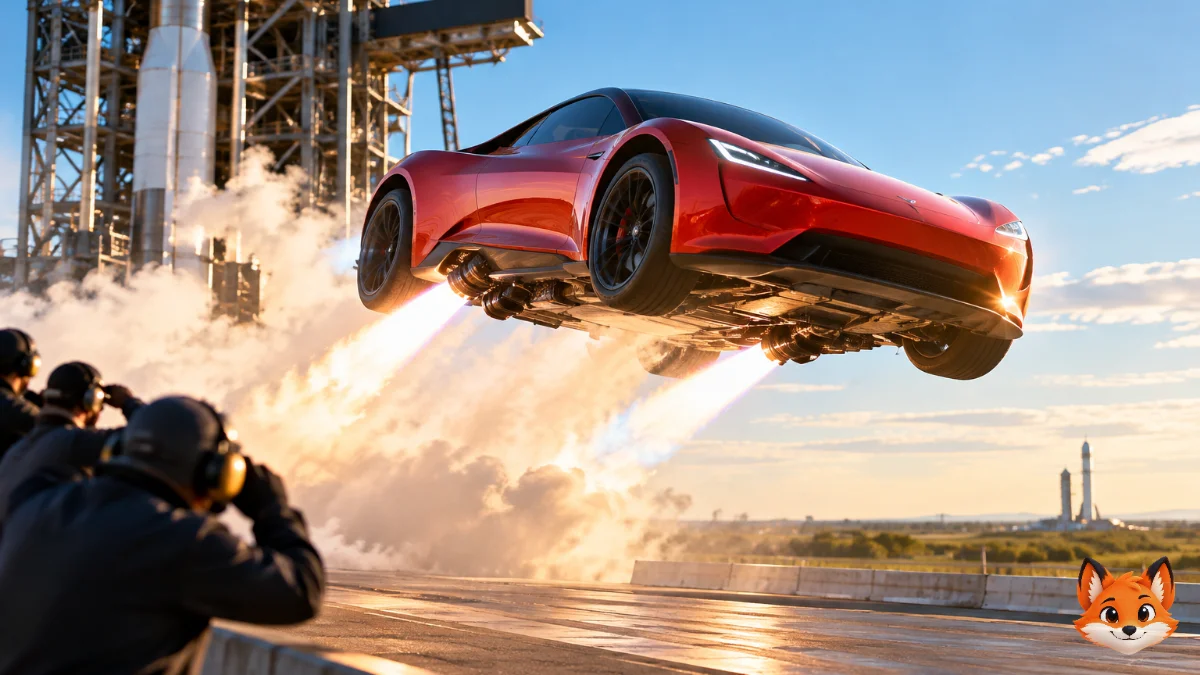
At an event in Texas, Tesla showed a new Roadster developed in collaboration with SpaceX. The car used a system of thrusters to rotate in midair during a demonstration and then land. A suction system allowed it to drive upside down on a track.
The presentation was designed to impress. It featured countdown music, smoke and a launch sequence more reminiscent of a rocket test than a traditional car reveal. Yet behind the spectacle lies a serious engineering question: can aerospace technology become useful in an electric car?
According to Reuters, Tesla is targeting production in 2028. That is almost nine years after the company first announced the next generation Roadster in 2017. At the time, Tesla promised exceptional performance and aimed to begin deliveries in 2020. That schedule was missed.
The demonstration is therefore a new milestone, but it does not prove that customers will soon be able to drive the car. Tesla still needs to develop the technology further and show that the vehicle can operate reliably and safely.
Rocket technology looks spectacular, but it may not be practical
The new Roadster combines electric propulsion with technology developed in collaboration with SpaceX. According to Reuters, the car can accelerate from zero to approximately 97 kilometres per hour in less than one second. Its stated top speed exceeds 370 kilometres per hour.
Range matters too. Tesla describes a range of more than 480 kilometres on a single charge. That sounds impressive, but it is less than half the distance of more than 960 kilometres that Elon Musk discussed when the earlier prototype was presented in 2017.
The rocket style thrusters are the most striking feature. However, a demonstration is different from a car used every day. A road vehicle must not only be fast. It must also meet requirements for safety, reliability, maintenance and regulatory approval.
The European Union, for example, requires vehicle type approval before a model can be sold on the European market. Authorities examine safety systems and technical requirements. It is not yet clear whether the aerial manoeuvres shown during the demonstration could ever be permitted on public roads.
For that reason, the demonstration should be viewed as an engineering experiment, not proof that flying cars will soon appear in everyday traffic.
Nine years of waiting make the promise harder to believe
Tesla announced the Roadster in 2017 with an initial base price of $200,000. The company originally targeted deliveries in 2020. By October 2026, Reuters reported that production was planned for 2028.
The gap between promises and delivery matters. Innovation is not just about an idea that looks impressive. It is also about whether a company can actually build, test, certify and deliver the product.
Tesla is now a much larger company than it was during the first Roadster presentation. Its 2025 annual report recorded approximately $94.83 billion in revenue. Net income attributable to common shareholders was approximately $3.79 billion. Those are substantial figures, but they do not automatically make the Roadster a financial success.
Elon Musk has previously suggested that the Roadster would not have a major financial impact on Tesla. The car has a symbolic role. It is meant to demonstrate what the company can achieve and give the brand an unusual flagship vehicle.
That is an understandable strategy. An attention grabbing model can attract interest in technology that might eventually appear in other products. But Tesla still needs to show which parts of the demonstration can be used in practical products.
Reservations of $50,000 raise expectations
According to Reuters, Tesla is asking for a $50,000 reservation deposit for the Performance version. The Thrust version, equipped with thrusters, requires a $250,000 deposit. The exclusive Rocket version is available by invitation and is described as a single seat vehicle.
These are substantial amounts. At a hypothetical exchange rate of $1 to €0.90, a $50,000 deposit would equal €45,000. A $250,000 deposit would equal €225,000. This is an illustration only, not a current exchange rate or a confirmed euro price.
A reservation deposit is also not the same as the full purchase price. Tesla has not announced the final retail price of the new Roadster. It is also unclear exactly which technical features will be included in the final production version.
Anyone considering a reservation should therefore examine the terms, refund conditions and the difference between reserving a vehicle and placing a final order. An impressive demonstration does not remove those uncertainties.
The stock market reacts to the story, not just the car
After the presentation, Tesla shares rose approximately 5% in premarket trading on October 16, 2026, according to Reuters. This shows how a product event can influence sentiment around a company.
Suppose someone owns €1,000 worth of Tesla shares and the share price temporarily rises by 5%. The position would then be worth approximately €1,050. The paper gain would be €50, provided the share price maintained that increase. A later decline could erase that gain.
This example shows why a price reaction after an event is not the same as a realised return. The movement may be short lived and says little on its own about future business performance.
According to Reuters, Tesla is scheduled to report its third quarter results on October 21, 2026. Those results will provide more information about the company's actual operations. Revenue, margins and cash flow tell investors more about financial health than attention surrounding a single unusual car.
The Roadster could therefore generate publicity and brand value. But the demonstration alone does not prove that the car will produce significant revenue or that Tesla shares will become more valuable over the long term.
The real innovation may not be flight
The Roadster's most visible feature is not necessarily its most important innovation. The collaboration between Tesla and SpaceX could generate knowledge about lightweight materials, propulsion, control systems and the management of complex technology.
That is interesting because electric cars face several engineering limits. More power requires effective thermal management. Greater range requires efficient energy use. And an extremely fast vehicle must remain controllable under demanding conditions.
Technology developed for an experimental vehicle can sometimes find applications in other products. That is a possibility, not an established outcome. Tesla has not yet demonstrated which parts of this particular system can be manufactured at scale.
Practical requirements also remain important in Europe. A vehicle must meet the applicable safety rules before it can be approved for ordinary public road use. A spectacular demonstration cannot replace that approval process.
Questions to ask before judging the spectacle financially
- Has the technology been tested under normal driving conditions?
- When will production begin, and what features will the final car have?
- How much of the announced performance has been independently verified?
- How much revenue could the Roadster realistically contribute to the business?
- Is the market reacting to measurable business results or mainly to expectations?
The new Roadster shows how a carmaker can use a product reveal to attract attention and demonstrate technical ambition. But a spectacular demonstration is only one step. Development, regulation, manufacturing and sales still stand between the prototype and a successful product. This article is for educational purposes only and does not constitute financial advice.
Sources
- Reuters, Tesla reveals new Roadster with SpaceX thrusters, October 15, 2026
- Tesla, official Roadster information
- Tesla, 2025 annual report filed with the US Securities and Exchange Commission
- European Commission, explanation of vehicle type approval
- EUR Lex, European regulation on general vehicle safety