Germany’s biggest banking group opens crypto to millions
 AI image
In short
- The Sparkassen-Finanzgruppe has around 42 million customers.
- The Sparkasse app has 20 million users.
- Customers can trade five cryptocurrencies through DekaBank.
- The rollout is gradual and each Sparkasse decides when to participate.
- The service does not include personal investment advice, and crypto is not covered by statutory deposit protection.
Germany’s biggest banking group opens crypto to millions
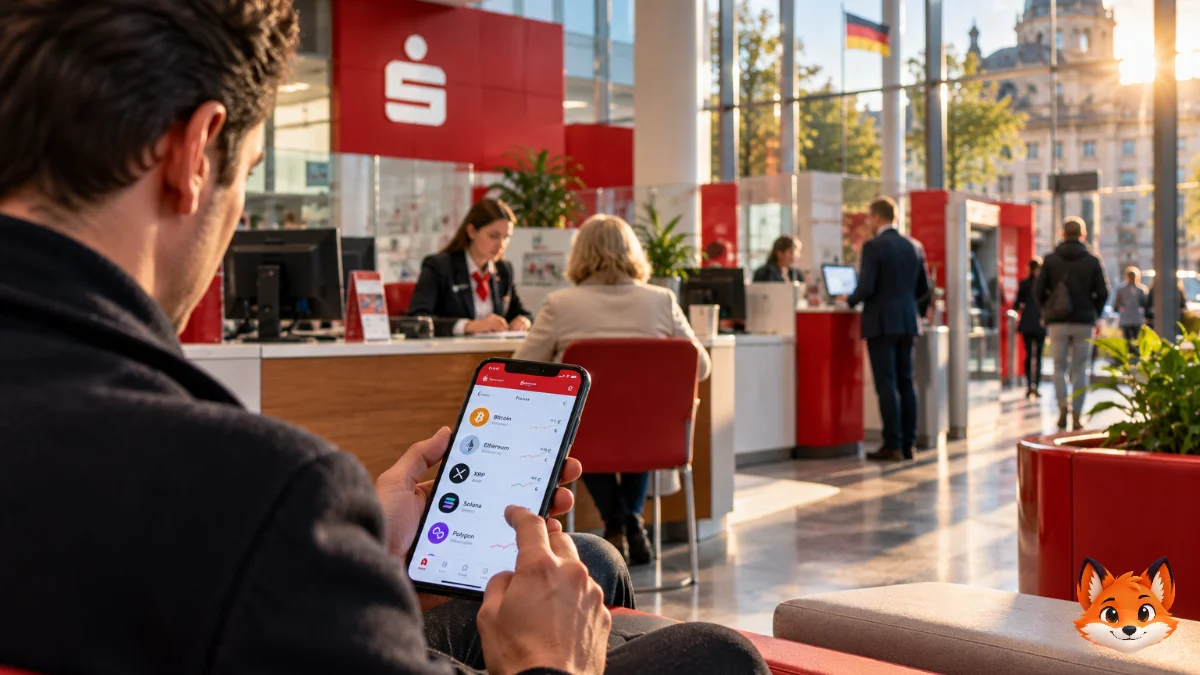
Germany’s largest banking group is taking a notable step into the crypto market. From 19 October 2026, customers of the first participating Sparkassen can buy and sell cryptocurrencies through the familiar Sparkasse app. The service is provided by DekaBank and launches with five established crypto assets. The significance lies not only in Bitcoin, but in the reach of the banking network bringing crypto into an existing financial environment.
A huge customer base behind the new service
The Sparkassen-Finanzgruppe is not one bank with a single headquarters and one customer list. It is a large network of regional savings banks and financial service providers. According to the group’s own reporting, it serves around 42 million customers. The Sparkasse app has 20 million users.
That reach makes the launch significant. A crypto service from a smaller trading app mainly reaches people already looking for a platform. An offer inside a familiar banking app may also be visible to customers who have never used a crypto exchange.
This does not mean that tens of millions of people will automatically start buying crypto. It means access is being added to an existing financial environment that many Germans already use in their daily lives.
What does this mean? The Sparkassen’s strength is not just that they offer cryptocurrencies. It is also the relationship they already have with their customers. The banking app may lower the barrier to a first purchase. That says nothing about whether crypto is suitable for an individual customer.
Sources: https://finanzbericht.dsgv.de/interview-schmalzl https://www.f-i.de/de/fi-magazin/next/spektrum/ausgabe-2-2026-spektrum/app-sparkasse-20-millionen-marke-geknackt
Why bring crypto into the banking app now?
The Sparkassen were cautious about cryptocurrencies for a long time. That position is understandable. Prices can fluctuate sharply, customers can suffer substantial losses, and the technology introduces its own risks. At the same time, banks risk losing customers to other providers if they do not offer digital investment products at all.
The launch shows how traditional financial institutions are responding to a market no longer served only by specialist crypto platforms. An offer through the banking app brings crypto closer to customers who already have a banking relationship, without requiring them to open a separate trading account immediately.
That does not mean the Sparkassen are presenting crypto as a replacement for savings, investment funds or other traditional financial products. Cryptocurrencies remain speculative assets whose value can change sharply.
The banking environment may feel familiar, but that does not change the risks of the underlying product.
Source: https://www.deka.de/krypto/angebot
Which cryptocurrencies can customers buy?
The service launches with five cryptocurrencies:
- Bitcoin
- Ethereum
- XRP
- Solana
- Polygon
Customers open a separate crypto account through the Sparkasse app. They can then buy or sell the supported assets themselves. DekaBank provides the product and holds the cryptocurrencies centrally on behalf of customers.
According to DekaBank’s product information, personal investment advice about these cryptocurrencies is not part of the service. Customers make their own buying and selling decisions. The list is limited to the assets supported by the provider. Customers do not automatically gain access to every cryptocurrency or every feature available through specialist exchanges.
The provider’s current terms, fees and restrictions should be checked before using the service.
Source: https://www.deka.de/krypto/angebot
Not every Sparkasse is launching at the same time
This is not a nationwide launch in which every customer sees the new feature on the same day. The service is being rolled out in stages. Each regional Sparkasse decides whether and when to add the offer.
For customers, availability therefore depends on their own Sparkasse. If the feature does not appear in the app, it does not necessarily mean they are doing something wrong. Their bank may not have introduced the service yet.
The gradual rollout also shows that the group is leaving room for local decisions. The network’s size makes the launch significant, but it also means implementation will not be identical everywhere.
Customers should check with their own Sparkasse to see whether the service is available and which terms apply.
Source: https://www.deka.de/krypto/angebot
The bank holds the crypto, but that has consequences
Customers do not have to arrange the technical custody themselves. DekaBank holds the cryptocurrencies centrally on their behalf. This may be simpler than setting up a wallet and managing private keys independently.
However, customers do not necessarily have the same freedom they would have with a self custody wallet. DekaBank’s product information describes restrictions on transferring cryptocurrencies to external addresses. Customers should therefore check which transfers are permitted before opening an account.
Another important point is that cryptocurrencies held through this service are not covered by the statutory deposit guarantee that applies to eligible bank deposits. Seeing a crypto balance in a familiar banking app does not guarantee its value.
Warning: a banking app does not make crypto risk free Suppose someone buys €1,000 worth of crypto. If its market value then falls by 20 percent, the position is worth €800. After a 50 percent decline, it is worth €500. These are mathematical examples, not predictions. Fees and any taxes are excluded.
Source: https://www.deka.de/krypto/angebot
What does European regulation mean?
The European regulation on crypto asset markets, known as MiCA, establishes a framework for certain crypto assets and crypto services. Among other things, it aims to make rules for providers and services clearer and more harmonised across the European Union.
That does not mean every cryptocurrency has the same protection as a bank deposit, or that every risk disappears. European supervisors warn consumers that risks and levels of protection can differ depending on the crypto asset and service.
For a large financial group such as the Sparkassen, a clearer regulatory framework is relevant when introducing a crypto service. But regulation does not eliminate price volatility, technical problems or the possibility of losing money.
Sources: https://www.bundesbank.de/en/tasks/financial-supervision/individual-aspects/micar-markets-in-crypto-assets-regulation-913886 https://www.esma.europa.eu/press-news/esma-news/eu-supervisory-authorities-warn-consumers-risks-and-limited-protection-certain
Questions to ask before getting started
Anyone considering the service should first review the practical conditions:
- Is the crypto service available through my own Sparkasse yet?
- What fees apply to buying and selling?
- Can I transfer crypto to an external wallet, and under what conditions?
- What happens if the app or trading infrastructure is temporarily unavailable?
- Could I lose the full amount without affecting my essential expenses?
- Do I understand how the value of my cryptocurrencies can change?
Bringing crypto into a major banking app makes access easier. It does not prove that buying crypto is a sensible choice. The decision remains with the customer, while the risks of the crypto market remain.
Disclaimer: This article is for general information only and is not personal financial, legal or tax advice. Cryptocurrencies can fall sharply in value, and a total loss is possible. Always check the provider’s current terms and risk information.
Sources
- DekaBank, product information for Krypto, powered by Deka: https://www.deka.de/krypto/angebot
- Sparkassen-Finanzgruppe, information about the group: https://finanzbericht.dsgv.de/interview-schmalzl
- Finanz Informatik, information about 20 million Sparkasse app users: https://www.f-i.de/de/fi-magazin/next/spektrum/ausgabe-2-2026-spektrum/app-sparkasse-20-millionen-marke-geknackt
- Deutsche Bundesbank, explanation of MiCA: https://www.bundesbank.de/en/tasks/financial-supervision/individual-aspects/micar-markets-in-crypto-assets-regulation-913886
- ESMA, warning about crypto risks and limited protection: https://www.esma.europa.eu/press-news/esma-news/eu-supervisory-authorities-warn-consumers-risks-and-limited-protection-certain